

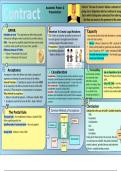
Contract
Academic Poster & Trietel in ‘The Law of Contract’ defines a contract to b
Presentation giving rise to obligations which are enforced or recog
factor which distinguishes contractual from other leg
that they are based on the agreement of the contra
1
OFFER 6
Intention To Create Legal Relations Capacity
Invitations to treat – The step before an offer where parties ICLR - Refers to intention of parties involved and if law assumes (prima facie) that all parties to a contra
will express willingness which could lead to an offer/contract. they had agreed to be legally bound therefore enter into that contract.
Offer – One party has explicitly stated that they want to enter creating a legally enforceable contract. • Minors – Minors’ Contract Act 1987 – protects the
a contract under specific terms: price, time, quantity. Presumptions – spouses, family & friends do not • Minors will be liable for goods/services deemed a
Difference between ITT/Offer : have binding obligations Sale of Goods Act 1979 – Ryder v Wombwell 1868
• Gibson v Manchester City Council – Balfour v Balfour 1919. • Mentally disordered persons – The Mental Capac
• Storer v Manchester City Council. • Intoxicated Individuals
2
Acceptance 5 Consideration Formalities
Sale or disposition of an in
Acceptance is when the offeree must make a unequivocal In present day, contracts
Consideration– “Some right, interest, profit or benefit accruing to are commonly made: The Law of Property (Misce
expression of intention & assent to terms of the offeror. one party, or some forbearance, detriment, loss or responsibility 1989.
informally, conduct,
General Principles – 1) Intention to assent to the offer MUST given, suffered or undertaken by another.” – Currie v Misa 1875. Grey v IRC 1960 – held that
orally or in writing. There
be in response to the offer and match the terms of the offer Past Consideration – Essentially, past consideration is no
not in writing, formalities w
consideration – Roscorla v Thomas 1842. is no legal requirement
precisely. 2) There must be a communication of acceptance. for a contract to be contract was unenforceable
Exceptions – Pao On v Lau Yiu Long 1980 – Held that in certain
Rules relevant to acceptance: situations, past consideration may be valid, if there is adequate formally presented in a
• Silence is not valid acceptance – Felthouse v Bindley 1862. interference of an implied request or promise stemming from document.
• Acceptance must mirror terms of offer – Hyde v Wrench promisor.
1840
3 Conclusion
4 Common Methods of Acceptance Linking this to the case of Carlill v Carbolic Smoke Bal
The Postal Rule Offer
The postal rule – first established in Adams v Lindsell 1818. Signature Acceptance
Rules regarding postal rule: Writing Consideration
Specified mode of communication – then not applied. Conduct ICLR
Capacity
Receipt Rule– Hentom v Fraser 1892. Formalities Intentio
legal r
Taking all of these factors into account, the elements
Electronically
Deeds are necessary to establish: the parties intentions,
Orally protect interests, provide fairness and determine
if there is a legally binding contract.
Academic Poster & Trietel in ‘The Law of Contract’ defines a contract to b
Presentation giving rise to obligations which are enforced or recog
factor which distinguishes contractual from other leg
that they are based on the agreement of the contra
1
OFFER 6
Intention To Create Legal Relations Capacity
Invitations to treat – The step before an offer where parties ICLR - Refers to intention of parties involved and if law assumes (prima facie) that all parties to a contra
will express willingness which could lead to an offer/contract. they had agreed to be legally bound therefore enter into that contract.
Offer – One party has explicitly stated that they want to enter creating a legally enforceable contract. • Minors – Minors’ Contract Act 1987 – protects the
a contract under specific terms: price, time, quantity. Presumptions – spouses, family & friends do not • Minors will be liable for goods/services deemed a
Difference between ITT/Offer : have binding obligations Sale of Goods Act 1979 – Ryder v Wombwell 1868
• Gibson v Manchester City Council – Balfour v Balfour 1919. • Mentally disordered persons – The Mental Capac
• Storer v Manchester City Council. • Intoxicated Individuals
2
Acceptance 5 Consideration Formalities
Sale or disposition of an in
Acceptance is when the offeree must make a unequivocal In present day, contracts
Consideration– “Some right, interest, profit or benefit accruing to are commonly made: The Law of Property (Misce
expression of intention & assent to terms of the offeror. one party, or some forbearance, detriment, loss or responsibility 1989.
informally, conduct,
General Principles – 1) Intention to assent to the offer MUST given, suffered or undertaken by another.” – Currie v Misa 1875. Grey v IRC 1960 – held that
orally or in writing. There
be in response to the offer and match the terms of the offer Past Consideration – Essentially, past consideration is no
not in writing, formalities w
consideration – Roscorla v Thomas 1842. is no legal requirement
precisely. 2) There must be a communication of acceptance. for a contract to be contract was unenforceable
Exceptions – Pao On v Lau Yiu Long 1980 – Held that in certain
Rules relevant to acceptance: situations, past consideration may be valid, if there is adequate formally presented in a
• Silence is not valid acceptance – Felthouse v Bindley 1862. interference of an implied request or promise stemming from document.
• Acceptance must mirror terms of offer – Hyde v Wrench promisor.
1840
3 Conclusion
4 Common Methods of Acceptance Linking this to the case of Carlill v Carbolic Smoke Bal
The Postal Rule Offer
The postal rule – first established in Adams v Lindsell 1818. Signature Acceptance
Rules regarding postal rule: Writing Consideration
Specified mode of communication – then not applied. Conduct ICLR
Capacity
Receipt Rule– Hentom v Fraser 1892. Formalities Intentio
legal r
Taking all of these factors into account, the elements
Electronically
Deeds are necessary to establish: the parties intentions,
Orally protect interests, provide fairness and determine
if there is a legally binding contract.


