
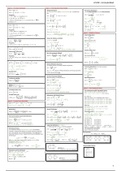
1CV40 - Formulenblad
Chapter 2 – The Failure Distribution Chapter 4 – Time-Dependent Failure Models
𝑅𝑅(𝑡𝑡) = ℙ{𝑇𝑇 ≥ 𝑡𝑡} Weibull Distribution: The Gamma Distribution:
∞
𝛽𝛽 = shape parameter, and 𝜃𝜃 = scale parameter (𝜃𝜃 = characteristic 𝛾𝛾 is the shape parameter, 𝛼𝛼 is the scale parameter
𝑅𝑅(𝑡𝑡) = � 𝑓𝑓(𝑡𝑡 ′ )𝑑𝑑𝑑𝑑′ = 1 − 𝐹𝐹(𝑡𝑡) 𝑡𝑡
𝑡𝑡 life). 𝑡𝑡 𝛾𝛾−1 ∗ 𝑒𝑒 −𝛼𝛼
Properties: β 𝑡𝑡 𝛽𝛽−1 𝑓𝑓(𝑡𝑡) = , 𝛾𝛾, 𝛼𝛼 > 0, 𝑡𝑡 ≥ 0
λ(t) = ∗ � � , 𝜃𝜃 > 0, 𝛽𝛽 > 0, 𝑡𝑡 ≥ 0 𝛼𝛼 𝛾𝛾 ∗ Γ(𝑦𝑦)
I) t ≥ 0, II) R(0) = 1, III) lim [𝑅𝑅(𝑡𝑡)] = 0, θ 𝜃𝜃 𝑡𝑡
𝑡𝑡→∞
𝑅𝑅(𝑡𝑡) = 𝑒𝑒 −(𝑡𝑡/𝜃𝜃)
𝛽𝛽 𝐼𝐼 � , 𝛾𝛾�
IV) 0 ≤ 𝑅𝑅(𝑡𝑡) ≤ 1, ∀𝑡𝑡, 𝑡𝑡 ∈ [0, ∞) 𝑅𝑅(𝑡𝑡) = 1 − 𝛼𝛼
𝛿𝛿𝛿𝛿(𝑡𝑡) β 𝑡𝑡 𝛽𝛽−1 Γ(𝛾𝛾)
V) R(t) is a monotonously decreasing function of t, i.e. ≤ 𝑓𝑓(𝑡𝑡) = ∗ � � ∗ 𝑒𝑒 −(𝑡𝑡/𝜃𝜃)
𝛽𝛽
𝛿𝛿𝛿𝛿
θ 𝜃𝜃 𝛼𝛼(𝛾𝛾 − 1), 𝛾𝛾 > 1
0, ∀∆𝑡𝑡, ∆𝑡𝑡 > 0 𝑡𝑡𝑚𝑚𝑚𝑚𝑚𝑚𝑚𝑚 = �
1 0, 𝑜𝑜𝑜𝑜ℎ𝑒𝑒𝑒𝑒𝑒𝑒𝑒𝑒𝑒𝑒𝑒𝑒
𝑀𝑀𝑀𝑀𝑀𝑀𝑀𝑀 = 𝜃𝜃 ∗ Γ �1 + �
𝛽𝛽 𝑀𝑀𝑀𝑀𝑀𝑀𝑀𝑀 = 𝛾𝛾 ∗ 𝛼𝛼 𝜎𝜎 = �𝛾𝛾𝛼𝛼 2
𝐹𝐹(𝑡𝑡) = ℙ{𝑇𝑇 < 𝑡𝑡} 2 1 2 𝑡𝑡 𝑡𝑡/𝛼𝛼
𝑡𝑡 ′
𝑡𝑡 𝜎𝜎 2 = 𝜃𝜃 2 ∗ �Γ �1 + � − �Γ �1 + �� � 𝐼𝐼 � , 𝛾𝛾� = � 𝑦𝑦 𝛾𝛾−1 ∗ 𝑒𝑒 −𝑦𝑦 𝑑𝑑𝑑𝑑, 𝑦𝑦 =
𝐹𝐹(𝑡𝑡) = � 𝑓𝑓(𝑡𝑡 ′ )𝑑𝑑𝑡𝑡 ′ = 1 − 𝑅𝑅(𝑡𝑡) 𝛽𝛽 𝛽𝛽 𝛼𝛼 0 𝛼𝛼
𝑥𝑥
0 0 < 𝛾𝛾 < 1 DFR, 𝛾𝛾 = 1 CFR
Properties: Γ(𝑥𝑥) = � 𝑦𝑦 𝑥𝑥−1 𝑒𝑒 −𝑦𝑦 𝑑𝑑𝑑𝑑 𝛾𝛾 > 1 IFR
0
I) t ≥ 0, II) F(0) = 0, III) lim [𝐹𝐹(𝑡𝑡)] = 1 Γ(𝑥𝑥) = (𝑥𝑥 − 1) ∗ Γ(𝑥𝑥 − 1)
𝑡𝑡→∞
Chapter 5 – Reliability of Systems
IV) 0 ≤ 𝐹𝐹(𝑡𝑡) ≤ 1, ∀𝑡𝑡, 𝑡𝑡 ∈ [0, ∞) �ln�𝑅𝑅(𝑡𝑡1 )� − ln�𝑅𝑅(𝑡𝑡2 )�� 𝛽𝛽
1 𝑡𝑡 − 𝑡𝑡1
𝛽𝛽
𝛿𝛿𝛿𝛿(𝑡𝑡) 𝐴𝐴𝐴𝐴𝐴𝐴(𝑡𝑡1 , 𝑡𝑡2 ) = = 𝛽𝛽 ∗ 2 Serial configuration:
V) F(t) is a monotonously increasing function of t, i.e. ≥ 𝑡𝑡2 − 𝑡𝑡1 𝜃𝜃 𝑡𝑡2 − 𝑡𝑡1
𝛿𝛿𝛿𝛿 𝑛𝑛
0, ∀∆𝑡𝑡, ∆𝑡𝑡 > 0
Design Life, Median, and Mode: 𝑅𝑅𝑆𝑆 (𝑡𝑡) = � 𝑅𝑅𝑖𝑖 (𝑡𝑡)
1 𝑖𝑖=1
𝛿𝛿𝛿𝛿(𝑡𝑡) 𝛿𝛿𝛿𝛿(𝑡𝑡) 𝑡𝑡𝑅𝑅 = 𝜃𝜃 ∗ (− ln(𝑅𝑅))𝛽𝛽 Multi-component CFR:
𝑓𝑓(𝑡𝑡) = − = 1
𝛿𝛿𝛿𝛿 𝛿𝛿𝛿𝛿 𝑅𝑅𝑆𝑆 (𝑡𝑡) = exp (−𝜆𝜆𝑠𝑠 ∗ 𝑡𝑡)
Properties: 𝑡𝑡𝑚𝑚𝑚𝑚𝑚𝑚 = 𝜃𝜃 ∗ (− ln(0.5))𝛽𝛽 𝑛𝑛
∞ 1
I) 𝑓𝑓(𝑡𝑡) ≥ 0, ∀𝑡𝑡, 𝑡𝑡 ∈ [0, ∞), II) ∫0 𝑓𝑓(𝑡𝑡)𝑑𝑑𝑑𝑑 = 1, III) 𝑡𝑡 ≥ 0 1 𝛽𝛽 𝜆𝜆𝑆𝑆 = � 𝜆𝜆𝑖𝑖
𝑡𝑡𝑚𝑚𝑚𝑚𝑚𝑚𝑚𝑚 = �𝜃𝜃 �1 − 𝛽𝛽 � , 𝑓𝑓𝑓𝑓𝑓𝑓 𝛽𝛽 > 1 𝑖𝑖=1
1
𝑡𝑡 0, 𝑓𝑓𝑓𝑓𝑓𝑓 𝛽𝛽 ≤ 1 𝑀𝑀𝑀𝑀𝑀𝑀𝑀𝑀 =
𝑅𝑅(𝑡𝑡) = exp �− � 𝜆𝜆(𝑡𝑡 ′ )𝑑𝑑𝑡𝑡 ′ � 𝜆𝜆𝑠𝑠
See Table 2. 𝛽𝛽1 -life R(t) = 0.99, 𝛽𝛽0.1 -life R(t) = 0.999
0 Parallel configuration:
Hazard rate / Failure rate: 𝑛𝑛
𝛿𝛿𝛿𝛿(𝑡𝑡) 1 𝑓𝑓(𝑡𝑡) Burn-In Screening for Weibull: 𝑅𝑅𝑆𝑆 (𝑡𝑡) = 1 − �[1 − 𝑅𝑅𝑖𝑖 (𝑡𝑡)]
𝜆𝜆(𝑡𝑡) = − ∗ =
𝛿𝛿𝛿𝛿 𝑅𝑅(𝑡𝑡) 𝑅𝑅(𝑡𝑡) 𝑅𝑅(𝑡𝑡 + 𝑇𝑇0 ) 𝑡𝑡 + 𝑇𝑇0 𝛽𝛽 𝑇𝑇0 𝛽𝛽 𝑖𝑖=1
Properties: 𝑅𝑅(𝑡𝑡|𝑇𝑇0 ) = = exp �− � � +� � � Two-component CFR:
𝑅𝑅(𝑇𝑇0 ) 𝜃𝜃 𝜃𝜃
I) 0 ≤ 𝜆𝜆(𝑡𝑡) ∗ Δ𝑡𝑡 ≤ 1, ∀𝑡𝑡, 𝑡𝑡 ∈ [0, ∞) II) 𝜆𝜆(𝑡𝑡) ≥ 0, ∀𝑡𝑡, 𝑡𝑡 ∈ [0, ∞) III) 1 𝑅𝑅𝑆𝑆 (𝑡𝑡) = 1 − (1 − 𝑒𝑒 −𝜆𝜆1 ∗𝑡𝑡 ) ∗ (1 − 𝑒𝑒 −𝜆𝜆2 ∗𝑡𝑡 )
Δ𝑡𝑡 > 0 𝑇𝑇0 𝛽𝛽 𝛽𝛽 = 𝑒𝑒 −𝜆𝜆1 ∗𝑡𝑡 + 𝑒𝑒 −𝜆𝜆2 ∗𝑡𝑡
𝑡𝑡𝑅𝑅 = 𝜃𝜃 �− ln(𝑅𝑅) + � � � − 𝑇𝑇0 − 𝑒𝑒 −(𝜆𝜆1 +𝜆𝜆2 )∗𝑡𝑡
𝜃𝜃
∞ ∞ ∞ 1 1 1
𝑀𝑀𝑀𝑀𝑀𝑀𝑀𝑀 = � 𝑅𝑅(𝑡𝑡)𝑑𝑑𝑑𝑑 = � [1 − 𝐹𝐹(𝑡𝑡)]𝑑𝑑𝑑𝑑 = � 𝑡𝑡 ∗ 𝑓𝑓(𝑡𝑡)𝑑𝑑𝑑𝑑 𝑀𝑀𝑀𝑀𝑀𝑀𝑀𝑀 = + −
𝜆𝜆1 𝜆𝜆2 𝜆𝜆1 + 𝜆𝜆2
0 0 0 Identical Weibull Components:
∞
If a system consists of n serially related components
𝜎𝜎 2 = �� 𝑡𝑡 2 ∗ 𝑓𝑓(𝑡𝑡)𝑑𝑑𝑑𝑑� − (𝑀𝑀𝑀𝑀𝑀𝑀𝑀𝑀)2 k-out-of-n Redundancy: k or more successes
n∗β
0
∞ λ(t) = β ∗ (𝑡𝑡)𝛽𝛽−1 𝑛𝑛
θ ℙ(𝑥𝑥) = � � 𝑅𝑅 𝑥𝑥 (1 − 𝑅𝑅)𝑛𝑛−𝑥𝑥
𝜎𝜎 2 = � (𝑡𝑡 − 𝑀𝑀𝑀𝑀𝑀𝑀𝑀𝑀)2 𝑓𝑓(𝑡𝑡)𝑑𝑑𝑑𝑑 𝑡𝑡 𝛽𝛽 𝑥𝑥
−𝑛𝑛∗� �
0 𝑅𝑅(𝑡𝑡) = 𝑒𝑒 which is a Weibull distribution with shape parameter
𝜃𝜃 𝑛𝑛 𝑛𝑛!
Residual MTTF: 𝜃𝜃 � �=
∞ 𝛽𝛽 and scale parameter 𝑛𝑛1/𝛽𝛽. 𝑥𝑥 𝑥𝑥! (𝑛𝑛 − 𝑥𝑥)!
1 𝑛𝑛
𝑀𝑀𝑀𝑀𝑀𝑀𝑀𝑀(𝑇𝑇0 ) = ∗ � 𝑅𝑅(𝑡𝑡 ′ )𝑑𝑑𝑑𝑑′
𝑅𝑅(𝑇𝑇0 ) 𝑇𝑇0 𝑅𝑅𝑠𝑠 = � ℙ(𝑥𝑥)
The Three-Parameter Weibull: 𝑥𝑥=𝑘𝑘
Whenever there is a minimum life: t0 Exponential Failures:
Conditional reliability: 𝑛𝑛
𝑡𝑡−𝑡𝑡0 𝛽𝛽 𝑛𝑛
𝑅𝑅(𝑡𝑡 + 𝑇𝑇0 ) 𝑅𝑅(𝑡𝑡) = 𝑒𝑒 −� 𝜃𝜃 � , 𝑡𝑡
> 𝑡𝑡0 𝑅𝑅𝑠𝑠 (𝑡𝑡) = � � � 𝑒𝑒 −𝜆𝜆𝜆𝜆𝜆𝜆 [1 − 𝑒𝑒 −𝜆𝜆𝜆𝜆 ]𝑛𝑛−𝑥𝑥
𝑅𝑅(𝑡𝑡|𝑇𝑇0 ) = 𝑥𝑥
𝑅𝑅(𝑇𝑇0 ) β 𝑡𝑡 − 𝑡𝑡0 𝛽𝛽−1 𝑥𝑥=𝑘𝑘
λ(t) = ∗� � , 𝑡𝑡 > 𝑡𝑡0 𝑛𝑛
θ 𝜃𝜃 ∞
1 1
Median: 𝑅𝑅(𝑡𝑡𝑚𝑚𝑚𝑚𝑚𝑚 ) = 0.5 1 𝑀𝑀𝑀𝑀𝑀𝑀𝑀𝑀 = � 𝑅𝑅𝑠𝑠 (𝑡𝑡) 𝑑𝑑𝑑𝑑 = �
𝑀𝑀𝑀𝑀𝑀𝑀𝑀𝑀 = 𝑡𝑡0 + 𝜃𝜃 ∗ Γ �1 + � 0 𝜆𝜆 𝑥𝑥
Mode: 𝑓𝑓(𝑡𝑡𝑚𝑚𝑚𝑚𝑚𝑚𝑚𝑚 ) = max 𝑓𝑓(𝑡𝑡) 𝛽𝛽 𝑥𝑥=𝑘𝑘
0≤𝑡𝑡<∞ 1
𝑡𝑡𝑚𝑚𝑚𝑚𝑚𝑚 = 𝑡𝑡0 + 𝜃𝜃 ∗ (− ln(0.5))𝛽𝛽 Chapter 6 – State-Dependent Systems
1
Cumulative failure rate: 𝑡𝑡𝑅𝑅 = 𝑡𝑡0 + 𝜃𝜃 ∗ (− ln(𝑅𝑅))𝛽𝛽 Two component parallel (redundant) system:
𝑡𝑡
𝐿𝐿(𝑡𝑡) = � 𝜆𝜆(𝑡𝑡 ′ )𝑑𝑑𝑡𝑡 ′ 𝜎𝜎 2 is the same as for the 2-parameter Weibull 𝑅𝑅𝑝𝑝 (𝑡𝑡) = 𝑃𝑃1 (𝑡𝑡) + 𝑃𝑃2 (𝑡𝑡) + 𝑃𝑃3 (𝑡𝑡), ∀t, t ∈ [0, ∞)
0 𝑃𝑃1 (𝑡𝑡) + 𝑃𝑃2 (𝑡𝑡) + 𝑃𝑃3 (𝑡𝑡) + 𝑃𝑃4 (𝑡𝑡) = 1, ∀t, t ∈ [0, ∞)
Average failure rate:
𝑡𝑡 Redundancy with Weibull Failures:
�∫𝑡𝑡 2 𝜆𝜆(𝑡𝑡′)𝑑𝑑𝑑𝑑′� �ln�𝑅𝑅(𝑡𝑡1 )� − ln�𝑅𝑅(𝑡𝑡2 )�� 𝑡𝑡 𝛽𝛽 𝑡𝑡 𝛽𝛽 ∀t, t ∈ [0, ∞):
𝐴𝐴𝐴𝐴𝐴𝐴(𝑡𝑡1 , 𝑡𝑡2 ) = 1 = 𝑅𝑅𝑠𝑠 (𝑡𝑡) = 2𝑒𝑒 −�𝜃𝜃� − 𝑒𝑒 −2�𝜃𝜃� Name the states: 𝑃𝑃1 (𝑡𝑡): probability that at time t …
𝑡𝑡2 − 𝑡𝑡1 𝑡𝑡2 − 𝑡𝑡1 ∞ 𝑡𝑡 𝛽𝛽 ∞ 𝑡𝑡 𝛽𝛽 𝑃𝑃1 (𝑡𝑡 + ∆𝑡𝑡) = 𝑃𝑃1 (𝑡𝑡) − 𝜆𝜆1 ∗ Δ𝑡𝑡 ∗ 𝑃𝑃1 (𝑡𝑡) − 𝜆𝜆2 ∗ Δ𝑡𝑡 ∗ 𝑃𝑃1 (𝑡𝑡)
𝑀𝑀𝑀𝑀𝑀𝑀𝑀𝑀 = 2 ∗ � 𝑒𝑒 −�𝜃𝜃� 𝑑𝑑𝑑𝑑 −� 𝑒𝑒 −2�𝜃𝜃� 𝑑𝑑𝑑𝑑
Chapter 3 – Constant Failure Rate Model 0 0
𝑃𝑃2 (𝑡𝑡 + ∆𝑡𝑡) = 𝑃𝑃2 (𝑡𝑡) + 𝜆𝜆1 ∗ Δ𝑡𝑡 ∗ 𝑃𝑃1 (𝑡𝑡) − 𝜆𝜆2 ∗ Δ𝑡𝑡 ∗ 𝑃𝑃2 (𝑡𝑡)
𝑡𝑡 𝛽𝛽 𝑃𝑃3 (𝑡𝑡 + ∆𝑡𝑡) = 𝑃𝑃3 (𝑡𝑡) + 𝜆𝜆2 ∗ Δ𝑡𝑡 ∗ 𝑃𝑃1 (𝑡𝑡) − 𝜆𝜆1 ∗ Δ𝑡𝑡 ∗ 𝑃𝑃3 (𝑡𝑡)
𝑅𝑅(𝑡𝑡) = 𝑒𝑒 −𝜆𝜆𝜆𝜆 , 𝑡𝑡 ≥ 0 𝐹𝐹(𝑡𝑡) = 1 − 𝑒𝑒 −𝜆𝜆𝜆𝜆 , 𝑡𝑡 ≥ 0 𝛽𝛽 𝑡𝑡 𝛽𝛽−1 2 − 2𝑒𝑒 −�𝜃𝜃� 𝑃𝑃4 (𝑡𝑡 + ∆𝑡𝑡) = 𝑃𝑃4 (𝑡𝑡) + 𝜆𝜆1 ∗ Δ𝑡𝑡 ∗ 𝑃𝑃3 (𝑡𝑡) + 𝜆𝜆2 ∗ Δ𝑡𝑡 ∗ 𝑃𝑃2 (𝑡𝑡)
1 1 𝜆𝜆𝑆𝑆 (𝑡𝑡) = ∗� � ∗
𝑓𝑓(𝑡𝑡) = 𝜆𝜆 ∗ 𝑒𝑒 −𝜆𝜆𝜆𝜆 𝑀𝑀𝑀𝑀𝑀𝑀𝑀𝑀 = 𝜎𝜎 2 = 2 𝜃𝜃 𝜃𝜃 𝑡𝑡 𝛽𝛽 Note that
𝜆𝜆 𝜆𝜆 2 − 𝑒𝑒 −�𝜃𝜃� 𝑃𝑃1 (𝑡𝑡 + ∆𝑡𝑡) = (1 − 𝜆𝜆1 ∗ Δ𝑡𝑡 ∗ −𝜆𝜆2 ∗ Δ𝑡𝑡) ∗ 𝑃𝑃1 (𝑡𝑡)
𝑃𝑃1 (𝑡𝑡 + ∆𝑡𝑡) − 𝑃𝑃1 (𝑡𝑡)
Memoryless: Normal Distribution: = −𝜆𝜆1 ∗ 𝑃𝑃1 (𝑡𝑡) − 𝜆𝜆2 ∗ 𝑃𝑃1 (𝑡𝑡)
Δ𝑡𝑡
𝑅𝑅(𝑡𝑡 + 𝑇𝑇0 ) 𝑒𝑒 −𝜆𝜆∗𝑇𝑇0 ∗ 𝑒𝑒 −𝜆𝜆∗𝑡𝑡 1 1 (𝑡𝑡 − 𝜇𝜇)2 𝑃𝑃1 (𝑡𝑡 + ∆𝑡𝑡) − 𝑃𝑃1 (𝑡𝑡)
𝑅𝑅(𝑡𝑡|𝑇𝑇0 ) = = = 𝑅𝑅(𝑡𝑡) 𝑓𝑓(𝑡𝑡) = exp �− ∗ �, −∞ < 𝑡𝑡 < ∞ = −(𝜆𝜆1 + 𝜆𝜆2 )𝑃𝑃1 (𝑡𝑡)
𝑅𝑅(𝑇𝑇0 ) 𝑒𝑒 −𝜆𝜆∗𝑇𝑇0 𝜎𝜎√2𝜋𝜋 2 𝜎𝜎 2 Δ𝑡𝑡
𝑡𝑡 − 𝜇𝜇 𝑃𝑃1 (𝑡𝑡 + ∆𝑡𝑡) − 𝑃𝑃1 (𝑡𝑡) 𝛿𝛿𝑃𝑃1 (𝑡𝑡)
R(t) = 1 − Φ � � lim � �= = −(𝜆𝜆1 + 𝜆𝜆2 )𝑃𝑃1 (𝑡𝑡),
𝜎𝜎 Δ𝑡𝑡→0 Δ𝑡𝑡 𝛿𝛿𝛿𝛿
The Two-Parameter Exponential Distribution: 𝑇𝑇 − 𝜇𝜇 𝑡𝑡 − 𝜇𝜇 𝑡𝑡 − 𝜇𝜇 𝑡𝑡 − 𝜇𝜇
𝐹𝐹(𝑡𝑡) = ℙ{𝑇𝑇 < 𝑡𝑡} = ℙ � < � = ℙ �𝑧𝑧 < � = Φ� � ∀t, t ∈ [0, ∞)
Guaranteed lifetime: 𝑡𝑡0 𝜎𝜎 𝜎𝜎 𝜎𝜎 𝜎𝜎
𝛿𝛿𝛿𝛿(𝑡𝑡) 𝐼𝐼 = {1, 2, 3, 4}
𝑓𝑓(𝑡𝑡) 𝑓𝑓(𝑡𝑡) 𝑇𝑇 − 𝜇𝜇 0 ≤ 𝑃𝑃1 (𝑡𝑡) ≤ 1,
𝑓𝑓(𝑡𝑡) = − = λe−λ(t−t0 ) , 0 < 𝑡𝑡0 ≤ 𝑡𝑡 < ∞ 𝜆𝜆(𝑡𝑡) = = , 𝑧𝑧 = ∀t, t ∈ [0, ∞)
𝛿𝛿𝛿𝛿 𝑅𝑅(𝑡𝑡) 1 − Φ �𝑡𝑡 − 𝜇𝜇 � 𝜎𝜎 0 ≤ 𝑃𝑃2 (𝑡𝑡) ≤ 1, ∀t, t ∈ [0, ∞)
𝑅𝑅(𝑡𝑡) = 𝑒𝑒 −λ(t−t0 ) , 𝑡𝑡 ≥ 𝑡𝑡0 σ = 1/λ 𝜎𝜎
0 ≤ 𝑃𝑃3 (𝑡𝑡) ≤ 1, ∀t, t ∈ [0, ∞)
𝑀𝑀𝑀𝑀𝑀𝑀𝑀𝑀 = 𝑡𝑡0 + 1/𝜆𝜆 The mode occurs at t0
0 ≤ 𝑃𝑃4 (𝑡𝑡) ≤ 1, ∀t, t ∈ [0, ∞)
𝑡𝑡𝑚𝑚𝑚𝑚𝑚𝑚 = 𝑡𝑡0 + ln [0.5]/−𝜆𝜆 𝑡𝑡𝑅𝑅 = 𝑡𝑡0 + ln [𝑅𝑅]/−𝜆𝜆 Lognormal distribution: See Table 3. 𝑃𝑃1 (𝑡𝑡) + 𝑃𝑃2 (𝑡𝑡) + 𝑃𝑃3 (𝑡𝑡) + 𝑃𝑃4 (𝑡𝑡) = 1, ∀t, t ∈ [0, ∞)
s = shape parameter and tmed = location parameter. 𝑃𝑃1 (0) = ⋯ , 𝑃𝑃2 (0) = ⋯ , 𝑃𝑃3 (0) = ⋯ , 𝑃𝑃4 (0) = ⋯ , 𝑅𝑅(𝑡𝑡) = ⋯
The Poisson Process: 1 1 𝑡𝑡 2 Two component serial system:
𝑓𝑓(𝑡𝑡) = ∗ exp �− 2 ∗ ln � � � , 𝑡𝑡 ≥ 0
If a component having a constant failure rate λ is immediately 𝑠𝑠 ∗ 𝑡𝑡 ∗ √2𝜋𝜋 2𝑠𝑠 𝑡𝑡𝑚𝑚𝑚𝑚𝑚𝑚 𝑅𝑅𝑠𝑠 (𝑡𝑡) = 𝑃𝑃1 (𝑡𝑡), ∀t, t ∈ [0, ∞)
repaired or replaced upon failing, the number of failures observed 𝑠𝑠 2 𝑇𝑇 − 𝜇𝜇
over a time period t has a Poisson distribution. The probability of 𝑀𝑀𝑀𝑀𝑀𝑀𝑀𝑀 = 𝑡𝑡𝑚𝑚𝑚𝑚𝑚𝑚 ∗ exp � � , 𝑧𝑧 = Decomposition:
2 𝜎𝜎 𝑅𝑅𝑠𝑠 = 𝑅𝑅𝐸𝐸 𝑅𝑅(𝑏𝑏) + (1 − 𝑅𝑅𝐸𝐸 )𝑅𝑅(𝑐𝑐)
observing n failures in time t is given by the Poisson probability mass 2
𝜎𝜎 2 = 𝑡𝑡𝑚𝑚𝑚𝑚𝑚𝑚 ∗ exp[𝑠𝑠 2 ] ∗ [exp(𝑠𝑠 2 ) − 1]
function pn(t): 𝑡𝑡𝑚𝑚𝑚𝑚𝑚𝑚
(λt)n 𝑡𝑡𝑚𝑚𝑚𝑚𝑚𝑚𝑚𝑚 = , 𝑡𝑡𝑅𝑅 = 𝑡𝑡𝑚𝑚𝑚𝑚𝑚𝑚 ∗ 𝑒𝑒 𝑠𝑠∗𝑧𝑧(1−𝑅𝑅)
𝑝𝑝𝑛𝑛 (𝑡𝑡) = 𝑒𝑒 −λt ∗ , 𝑛𝑛 = 0,1,2,3,4, … exp(𝑠𝑠 2 )
𝑛𝑛! 1 𝑡𝑡 1 𝑡𝑡
With mean over time t is given by λt, and the variance of the 𝐹𝐹(𝑡𝑡) = Φ � ∗ ln � �� , 𝑅𝑅(𝑡𝑡) = 1 − Φ � ∗ ln � ��
𝑠𝑠 𝑡𝑡𝑚𝑚𝑚𝑚𝑚𝑚 𝑠𝑠 𝑡𝑡𝑚𝑚𝑚𝑚𝑚𝑚
distribution is also λt. See Table 1
No failures: (exponential)
𝑆𝑆
𝑒𝑒 −𝜆𝜆𝜆𝜆 ∗ (𝜆𝜆𝜆𝜆)0
𝑝𝑝0 = = e−𝜆𝜆𝜆𝜆 = 𝑅𝑅(𝑡𝑡), 𝑅𝑅𝑆𝑆 (𝑡𝑡) = � 𝑝𝑝𝑛𝑛 (𝑡𝑡) Common-Mode Failures;
0!
𝑛𝑛=0
Redundancy and the CFR Model
R(t) = 1 − (1 − 𝑒𝑒 λt )2 = 2𝑒𝑒 −λt − 𝑒𝑒 −2λt
𝑓𝑓(𝑡𝑡) 𝜆𝜆(1 − 𝑒𝑒 −𝜆𝜆𝜆𝜆 )
𝜆𝜆(𝑡𝑡) = =
𝑅𝑅(𝑡𝑡) 1 − 0.5 ∗ 𝑒𝑒 −𝜆𝜆𝜆𝜆
As 𝑡𝑡 → ∞, 𝜆𝜆(𝑡𝑡) → 𝜆𝜆. Which is CFR.
1.5
𝑀𝑀𝑀𝑀𝑀𝑀𝑀𝑀 =
λ
1
Chapter 2 – The Failure Distribution Chapter 4 – Time-Dependent Failure Models
𝑅𝑅(𝑡𝑡) = ℙ{𝑇𝑇 ≥ 𝑡𝑡} Weibull Distribution: The Gamma Distribution:
∞
𝛽𝛽 = shape parameter, and 𝜃𝜃 = scale parameter (𝜃𝜃 = characteristic 𝛾𝛾 is the shape parameter, 𝛼𝛼 is the scale parameter
𝑅𝑅(𝑡𝑡) = � 𝑓𝑓(𝑡𝑡 ′ )𝑑𝑑𝑑𝑑′ = 1 − 𝐹𝐹(𝑡𝑡) 𝑡𝑡
𝑡𝑡 life). 𝑡𝑡 𝛾𝛾−1 ∗ 𝑒𝑒 −𝛼𝛼
Properties: β 𝑡𝑡 𝛽𝛽−1 𝑓𝑓(𝑡𝑡) = , 𝛾𝛾, 𝛼𝛼 > 0, 𝑡𝑡 ≥ 0
λ(t) = ∗ � � , 𝜃𝜃 > 0, 𝛽𝛽 > 0, 𝑡𝑡 ≥ 0 𝛼𝛼 𝛾𝛾 ∗ Γ(𝑦𝑦)
I) t ≥ 0, II) R(0) = 1, III) lim [𝑅𝑅(𝑡𝑡)] = 0, θ 𝜃𝜃 𝑡𝑡
𝑡𝑡→∞
𝑅𝑅(𝑡𝑡) = 𝑒𝑒 −(𝑡𝑡/𝜃𝜃)
𝛽𝛽 𝐼𝐼 � , 𝛾𝛾�
IV) 0 ≤ 𝑅𝑅(𝑡𝑡) ≤ 1, ∀𝑡𝑡, 𝑡𝑡 ∈ [0, ∞) 𝑅𝑅(𝑡𝑡) = 1 − 𝛼𝛼
𝛿𝛿𝛿𝛿(𝑡𝑡) β 𝑡𝑡 𝛽𝛽−1 Γ(𝛾𝛾)
V) R(t) is a monotonously decreasing function of t, i.e. ≤ 𝑓𝑓(𝑡𝑡) = ∗ � � ∗ 𝑒𝑒 −(𝑡𝑡/𝜃𝜃)
𝛽𝛽
𝛿𝛿𝛿𝛿
θ 𝜃𝜃 𝛼𝛼(𝛾𝛾 − 1), 𝛾𝛾 > 1
0, ∀∆𝑡𝑡, ∆𝑡𝑡 > 0 𝑡𝑡𝑚𝑚𝑚𝑚𝑚𝑚𝑚𝑚 = �
1 0, 𝑜𝑜𝑜𝑜ℎ𝑒𝑒𝑒𝑒𝑒𝑒𝑒𝑒𝑒𝑒𝑒𝑒
𝑀𝑀𝑀𝑀𝑀𝑀𝑀𝑀 = 𝜃𝜃 ∗ Γ �1 + �
𝛽𝛽 𝑀𝑀𝑀𝑀𝑀𝑀𝑀𝑀 = 𝛾𝛾 ∗ 𝛼𝛼 𝜎𝜎 = �𝛾𝛾𝛼𝛼 2
𝐹𝐹(𝑡𝑡) = ℙ{𝑇𝑇 < 𝑡𝑡} 2 1 2 𝑡𝑡 𝑡𝑡/𝛼𝛼
𝑡𝑡 ′
𝑡𝑡 𝜎𝜎 2 = 𝜃𝜃 2 ∗ �Γ �1 + � − �Γ �1 + �� � 𝐼𝐼 � , 𝛾𝛾� = � 𝑦𝑦 𝛾𝛾−1 ∗ 𝑒𝑒 −𝑦𝑦 𝑑𝑑𝑑𝑑, 𝑦𝑦 =
𝐹𝐹(𝑡𝑡) = � 𝑓𝑓(𝑡𝑡 ′ )𝑑𝑑𝑡𝑡 ′ = 1 − 𝑅𝑅(𝑡𝑡) 𝛽𝛽 𝛽𝛽 𝛼𝛼 0 𝛼𝛼
𝑥𝑥
0 0 < 𝛾𝛾 < 1 DFR, 𝛾𝛾 = 1 CFR
Properties: Γ(𝑥𝑥) = � 𝑦𝑦 𝑥𝑥−1 𝑒𝑒 −𝑦𝑦 𝑑𝑑𝑑𝑑 𝛾𝛾 > 1 IFR
0
I) t ≥ 0, II) F(0) = 0, III) lim [𝐹𝐹(𝑡𝑡)] = 1 Γ(𝑥𝑥) = (𝑥𝑥 − 1) ∗ Γ(𝑥𝑥 − 1)
𝑡𝑡→∞
Chapter 5 – Reliability of Systems
IV) 0 ≤ 𝐹𝐹(𝑡𝑡) ≤ 1, ∀𝑡𝑡, 𝑡𝑡 ∈ [0, ∞) �ln�𝑅𝑅(𝑡𝑡1 )� − ln�𝑅𝑅(𝑡𝑡2 )�� 𝛽𝛽
1 𝑡𝑡 − 𝑡𝑡1
𝛽𝛽
𝛿𝛿𝛿𝛿(𝑡𝑡) 𝐴𝐴𝐴𝐴𝐴𝐴(𝑡𝑡1 , 𝑡𝑡2 ) = = 𝛽𝛽 ∗ 2 Serial configuration:
V) F(t) is a monotonously increasing function of t, i.e. ≥ 𝑡𝑡2 − 𝑡𝑡1 𝜃𝜃 𝑡𝑡2 − 𝑡𝑡1
𝛿𝛿𝛿𝛿 𝑛𝑛
0, ∀∆𝑡𝑡, ∆𝑡𝑡 > 0
Design Life, Median, and Mode: 𝑅𝑅𝑆𝑆 (𝑡𝑡) = � 𝑅𝑅𝑖𝑖 (𝑡𝑡)
1 𝑖𝑖=1
𝛿𝛿𝛿𝛿(𝑡𝑡) 𝛿𝛿𝛿𝛿(𝑡𝑡) 𝑡𝑡𝑅𝑅 = 𝜃𝜃 ∗ (− ln(𝑅𝑅))𝛽𝛽 Multi-component CFR:
𝑓𝑓(𝑡𝑡) = − = 1
𝛿𝛿𝛿𝛿 𝛿𝛿𝛿𝛿 𝑅𝑅𝑆𝑆 (𝑡𝑡) = exp (−𝜆𝜆𝑠𝑠 ∗ 𝑡𝑡)
Properties: 𝑡𝑡𝑚𝑚𝑚𝑚𝑚𝑚 = 𝜃𝜃 ∗ (− ln(0.5))𝛽𝛽 𝑛𝑛
∞ 1
I) 𝑓𝑓(𝑡𝑡) ≥ 0, ∀𝑡𝑡, 𝑡𝑡 ∈ [0, ∞), II) ∫0 𝑓𝑓(𝑡𝑡)𝑑𝑑𝑑𝑑 = 1, III) 𝑡𝑡 ≥ 0 1 𝛽𝛽 𝜆𝜆𝑆𝑆 = � 𝜆𝜆𝑖𝑖
𝑡𝑡𝑚𝑚𝑚𝑚𝑚𝑚𝑚𝑚 = �𝜃𝜃 �1 − 𝛽𝛽 � , 𝑓𝑓𝑓𝑓𝑓𝑓 𝛽𝛽 > 1 𝑖𝑖=1
1
𝑡𝑡 0, 𝑓𝑓𝑓𝑓𝑓𝑓 𝛽𝛽 ≤ 1 𝑀𝑀𝑀𝑀𝑀𝑀𝑀𝑀 =
𝑅𝑅(𝑡𝑡) = exp �− � 𝜆𝜆(𝑡𝑡 ′ )𝑑𝑑𝑡𝑡 ′ � 𝜆𝜆𝑠𝑠
See Table 2. 𝛽𝛽1 -life R(t) = 0.99, 𝛽𝛽0.1 -life R(t) = 0.999
0 Parallel configuration:
Hazard rate / Failure rate: 𝑛𝑛
𝛿𝛿𝛿𝛿(𝑡𝑡) 1 𝑓𝑓(𝑡𝑡) Burn-In Screening for Weibull: 𝑅𝑅𝑆𝑆 (𝑡𝑡) = 1 − �[1 − 𝑅𝑅𝑖𝑖 (𝑡𝑡)]
𝜆𝜆(𝑡𝑡) = − ∗ =
𝛿𝛿𝛿𝛿 𝑅𝑅(𝑡𝑡) 𝑅𝑅(𝑡𝑡) 𝑅𝑅(𝑡𝑡 + 𝑇𝑇0 ) 𝑡𝑡 + 𝑇𝑇0 𝛽𝛽 𝑇𝑇0 𝛽𝛽 𝑖𝑖=1
Properties: 𝑅𝑅(𝑡𝑡|𝑇𝑇0 ) = = exp �− � � +� � � Two-component CFR:
𝑅𝑅(𝑇𝑇0 ) 𝜃𝜃 𝜃𝜃
I) 0 ≤ 𝜆𝜆(𝑡𝑡) ∗ Δ𝑡𝑡 ≤ 1, ∀𝑡𝑡, 𝑡𝑡 ∈ [0, ∞) II) 𝜆𝜆(𝑡𝑡) ≥ 0, ∀𝑡𝑡, 𝑡𝑡 ∈ [0, ∞) III) 1 𝑅𝑅𝑆𝑆 (𝑡𝑡) = 1 − (1 − 𝑒𝑒 −𝜆𝜆1 ∗𝑡𝑡 ) ∗ (1 − 𝑒𝑒 −𝜆𝜆2 ∗𝑡𝑡 )
Δ𝑡𝑡 > 0 𝑇𝑇0 𝛽𝛽 𝛽𝛽 = 𝑒𝑒 −𝜆𝜆1 ∗𝑡𝑡 + 𝑒𝑒 −𝜆𝜆2 ∗𝑡𝑡
𝑡𝑡𝑅𝑅 = 𝜃𝜃 �− ln(𝑅𝑅) + � � � − 𝑇𝑇0 − 𝑒𝑒 −(𝜆𝜆1 +𝜆𝜆2 )∗𝑡𝑡
𝜃𝜃
∞ ∞ ∞ 1 1 1
𝑀𝑀𝑀𝑀𝑀𝑀𝑀𝑀 = � 𝑅𝑅(𝑡𝑡)𝑑𝑑𝑑𝑑 = � [1 − 𝐹𝐹(𝑡𝑡)]𝑑𝑑𝑑𝑑 = � 𝑡𝑡 ∗ 𝑓𝑓(𝑡𝑡)𝑑𝑑𝑑𝑑 𝑀𝑀𝑀𝑀𝑀𝑀𝑀𝑀 = + −
𝜆𝜆1 𝜆𝜆2 𝜆𝜆1 + 𝜆𝜆2
0 0 0 Identical Weibull Components:
∞
If a system consists of n serially related components
𝜎𝜎 2 = �� 𝑡𝑡 2 ∗ 𝑓𝑓(𝑡𝑡)𝑑𝑑𝑑𝑑� − (𝑀𝑀𝑀𝑀𝑀𝑀𝑀𝑀)2 k-out-of-n Redundancy: k or more successes
n∗β
0
∞ λ(t) = β ∗ (𝑡𝑡)𝛽𝛽−1 𝑛𝑛
θ ℙ(𝑥𝑥) = � � 𝑅𝑅 𝑥𝑥 (1 − 𝑅𝑅)𝑛𝑛−𝑥𝑥
𝜎𝜎 2 = � (𝑡𝑡 − 𝑀𝑀𝑀𝑀𝑀𝑀𝑀𝑀)2 𝑓𝑓(𝑡𝑡)𝑑𝑑𝑑𝑑 𝑡𝑡 𝛽𝛽 𝑥𝑥
−𝑛𝑛∗� �
0 𝑅𝑅(𝑡𝑡) = 𝑒𝑒 which is a Weibull distribution with shape parameter
𝜃𝜃 𝑛𝑛 𝑛𝑛!
Residual MTTF: 𝜃𝜃 � �=
∞ 𝛽𝛽 and scale parameter 𝑛𝑛1/𝛽𝛽. 𝑥𝑥 𝑥𝑥! (𝑛𝑛 − 𝑥𝑥)!
1 𝑛𝑛
𝑀𝑀𝑀𝑀𝑀𝑀𝑀𝑀(𝑇𝑇0 ) = ∗ � 𝑅𝑅(𝑡𝑡 ′ )𝑑𝑑𝑑𝑑′
𝑅𝑅(𝑇𝑇0 ) 𝑇𝑇0 𝑅𝑅𝑠𝑠 = � ℙ(𝑥𝑥)
The Three-Parameter Weibull: 𝑥𝑥=𝑘𝑘
Whenever there is a minimum life: t0 Exponential Failures:
Conditional reliability: 𝑛𝑛
𝑡𝑡−𝑡𝑡0 𝛽𝛽 𝑛𝑛
𝑅𝑅(𝑡𝑡 + 𝑇𝑇0 ) 𝑅𝑅(𝑡𝑡) = 𝑒𝑒 −� 𝜃𝜃 � , 𝑡𝑡
> 𝑡𝑡0 𝑅𝑅𝑠𝑠 (𝑡𝑡) = � � � 𝑒𝑒 −𝜆𝜆𝜆𝜆𝜆𝜆 [1 − 𝑒𝑒 −𝜆𝜆𝜆𝜆 ]𝑛𝑛−𝑥𝑥
𝑅𝑅(𝑡𝑡|𝑇𝑇0 ) = 𝑥𝑥
𝑅𝑅(𝑇𝑇0 ) β 𝑡𝑡 − 𝑡𝑡0 𝛽𝛽−1 𝑥𝑥=𝑘𝑘
λ(t) = ∗� � , 𝑡𝑡 > 𝑡𝑡0 𝑛𝑛
θ 𝜃𝜃 ∞
1 1
Median: 𝑅𝑅(𝑡𝑡𝑚𝑚𝑚𝑚𝑚𝑚 ) = 0.5 1 𝑀𝑀𝑀𝑀𝑀𝑀𝑀𝑀 = � 𝑅𝑅𝑠𝑠 (𝑡𝑡) 𝑑𝑑𝑑𝑑 = �
𝑀𝑀𝑀𝑀𝑀𝑀𝑀𝑀 = 𝑡𝑡0 + 𝜃𝜃 ∗ Γ �1 + � 0 𝜆𝜆 𝑥𝑥
Mode: 𝑓𝑓(𝑡𝑡𝑚𝑚𝑚𝑚𝑚𝑚𝑚𝑚 ) = max 𝑓𝑓(𝑡𝑡) 𝛽𝛽 𝑥𝑥=𝑘𝑘
0≤𝑡𝑡<∞ 1
𝑡𝑡𝑚𝑚𝑚𝑚𝑚𝑚 = 𝑡𝑡0 + 𝜃𝜃 ∗ (− ln(0.5))𝛽𝛽 Chapter 6 – State-Dependent Systems
1
Cumulative failure rate: 𝑡𝑡𝑅𝑅 = 𝑡𝑡0 + 𝜃𝜃 ∗ (− ln(𝑅𝑅))𝛽𝛽 Two component parallel (redundant) system:
𝑡𝑡
𝐿𝐿(𝑡𝑡) = � 𝜆𝜆(𝑡𝑡 ′ )𝑑𝑑𝑡𝑡 ′ 𝜎𝜎 2 is the same as for the 2-parameter Weibull 𝑅𝑅𝑝𝑝 (𝑡𝑡) = 𝑃𝑃1 (𝑡𝑡) + 𝑃𝑃2 (𝑡𝑡) + 𝑃𝑃3 (𝑡𝑡), ∀t, t ∈ [0, ∞)
0 𝑃𝑃1 (𝑡𝑡) + 𝑃𝑃2 (𝑡𝑡) + 𝑃𝑃3 (𝑡𝑡) + 𝑃𝑃4 (𝑡𝑡) = 1, ∀t, t ∈ [0, ∞)
Average failure rate:
𝑡𝑡 Redundancy with Weibull Failures:
�∫𝑡𝑡 2 𝜆𝜆(𝑡𝑡′)𝑑𝑑𝑑𝑑′� �ln�𝑅𝑅(𝑡𝑡1 )� − ln�𝑅𝑅(𝑡𝑡2 )�� 𝑡𝑡 𝛽𝛽 𝑡𝑡 𝛽𝛽 ∀t, t ∈ [0, ∞):
𝐴𝐴𝐴𝐴𝐴𝐴(𝑡𝑡1 , 𝑡𝑡2 ) = 1 = 𝑅𝑅𝑠𝑠 (𝑡𝑡) = 2𝑒𝑒 −�𝜃𝜃� − 𝑒𝑒 −2�𝜃𝜃� Name the states: 𝑃𝑃1 (𝑡𝑡): probability that at time t …
𝑡𝑡2 − 𝑡𝑡1 𝑡𝑡2 − 𝑡𝑡1 ∞ 𝑡𝑡 𝛽𝛽 ∞ 𝑡𝑡 𝛽𝛽 𝑃𝑃1 (𝑡𝑡 + ∆𝑡𝑡) = 𝑃𝑃1 (𝑡𝑡) − 𝜆𝜆1 ∗ Δ𝑡𝑡 ∗ 𝑃𝑃1 (𝑡𝑡) − 𝜆𝜆2 ∗ Δ𝑡𝑡 ∗ 𝑃𝑃1 (𝑡𝑡)
𝑀𝑀𝑀𝑀𝑀𝑀𝑀𝑀 = 2 ∗ � 𝑒𝑒 −�𝜃𝜃� 𝑑𝑑𝑑𝑑 −� 𝑒𝑒 −2�𝜃𝜃� 𝑑𝑑𝑑𝑑
Chapter 3 – Constant Failure Rate Model 0 0
𝑃𝑃2 (𝑡𝑡 + ∆𝑡𝑡) = 𝑃𝑃2 (𝑡𝑡) + 𝜆𝜆1 ∗ Δ𝑡𝑡 ∗ 𝑃𝑃1 (𝑡𝑡) − 𝜆𝜆2 ∗ Δ𝑡𝑡 ∗ 𝑃𝑃2 (𝑡𝑡)
𝑡𝑡 𝛽𝛽 𝑃𝑃3 (𝑡𝑡 + ∆𝑡𝑡) = 𝑃𝑃3 (𝑡𝑡) + 𝜆𝜆2 ∗ Δ𝑡𝑡 ∗ 𝑃𝑃1 (𝑡𝑡) − 𝜆𝜆1 ∗ Δ𝑡𝑡 ∗ 𝑃𝑃3 (𝑡𝑡)
𝑅𝑅(𝑡𝑡) = 𝑒𝑒 −𝜆𝜆𝜆𝜆 , 𝑡𝑡 ≥ 0 𝐹𝐹(𝑡𝑡) = 1 − 𝑒𝑒 −𝜆𝜆𝜆𝜆 , 𝑡𝑡 ≥ 0 𝛽𝛽 𝑡𝑡 𝛽𝛽−1 2 − 2𝑒𝑒 −�𝜃𝜃� 𝑃𝑃4 (𝑡𝑡 + ∆𝑡𝑡) = 𝑃𝑃4 (𝑡𝑡) + 𝜆𝜆1 ∗ Δ𝑡𝑡 ∗ 𝑃𝑃3 (𝑡𝑡) + 𝜆𝜆2 ∗ Δ𝑡𝑡 ∗ 𝑃𝑃2 (𝑡𝑡)
1 1 𝜆𝜆𝑆𝑆 (𝑡𝑡) = ∗� � ∗
𝑓𝑓(𝑡𝑡) = 𝜆𝜆 ∗ 𝑒𝑒 −𝜆𝜆𝜆𝜆 𝑀𝑀𝑀𝑀𝑀𝑀𝑀𝑀 = 𝜎𝜎 2 = 2 𝜃𝜃 𝜃𝜃 𝑡𝑡 𝛽𝛽 Note that
𝜆𝜆 𝜆𝜆 2 − 𝑒𝑒 −�𝜃𝜃� 𝑃𝑃1 (𝑡𝑡 + ∆𝑡𝑡) = (1 − 𝜆𝜆1 ∗ Δ𝑡𝑡 ∗ −𝜆𝜆2 ∗ Δ𝑡𝑡) ∗ 𝑃𝑃1 (𝑡𝑡)
𝑃𝑃1 (𝑡𝑡 + ∆𝑡𝑡) − 𝑃𝑃1 (𝑡𝑡)
Memoryless: Normal Distribution: = −𝜆𝜆1 ∗ 𝑃𝑃1 (𝑡𝑡) − 𝜆𝜆2 ∗ 𝑃𝑃1 (𝑡𝑡)
Δ𝑡𝑡
𝑅𝑅(𝑡𝑡 + 𝑇𝑇0 ) 𝑒𝑒 −𝜆𝜆∗𝑇𝑇0 ∗ 𝑒𝑒 −𝜆𝜆∗𝑡𝑡 1 1 (𝑡𝑡 − 𝜇𝜇)2 𝑃𝑃1 (𝑡𝑡 + ∆𝑡𝑡) − 𝑃𝑃1 (𝑡𝑡)
𝑅𝑅(𝑡𝑡|𝑇𝑇0 ) = = = 𝑅𝑅(𝑡𝑡) 𝑓𝑓(𝑡𝑡) = exp �− ∗ �, −∞ < 𝑡𝑡 < ∞ = −(𝜆𝜆1 + 𝜆𝜆2 )𝑃𝑃1 (𝑡𝑡)
𝑅𝑅(𝑇𝑇0 ) 𝑒𝑒 −𝜆𝜆∗𝑇𝑇0 𝜎𝜎√2𝜋𝜋 2 𝜎𝜎 2 Δ𝑡𝑡
𝑡𝑡 − 𝜇𝜇 𝑃𝑃1 (𝑡𝑡 + ∆𝑡𝑡) − 𝑃𝑃1 (𝑡𝑡) 𝛿𝛿𝑃𝑃1 (𝑡𝑡)
R(t) = 1 − Φ � � lim � �= = −(𝜆𝜆1 + 𝜆𝜆2 )𝑃𝑃1 (𝑡𝑡),
𝜎𝜎 Δ𝑡𝑡→0 Δ𝑡𝑡 𝛿𝛿𝛿𝛿
The Two-Parameter Exponential Distribution: 𝑇𝑇 − 𝜇𝜇 𝑡𝑡 − 𝜇𝜇 𝑡𝑡 − 𝜇𝜇 𝑡𝑡 − 𝜇𝜇
𝐹𝐹(𝑡𝑡) = ℙ{𝑇𝑇 < 𝑡𝑡} = ℙ � < � = ℙ �𝑧𝑧 < � = Φ� � ∀t, t ∈ [0, ∞)
Guaranteed lifetime: 𝑡𝑡0 𝜎𝜎 𝜎𝜎 𝜎𝜎 𝜎𝜎
𝛿𝛿𝛿𝛿(𝑡𝑡) 𝐼𝐼 = {1, 2, 3, 4}
𝑓𝑓(𝑡𝑡) 𝑓𝑓(𝑡𝑡) 𝑇𝑇 − 𝜇𝜇 0 ≤ 𝑃𝑃1 (𝑡𝑡) ≤ 1,
𝑓𝑓(𝑡𝑡) = − = λe−λ(t−t0 ) , 0 < 𝑡𝑡0 ≤ 𝑡𝑡 < ∞ 𝜆𝜆(𝑡𝑡) = = , 𝑧𝑧 = ∀t, t ∈ [0, ∞)
𝛿𝛿𝛿𝛿 𝑅𝑅(𝑡𝑡) 1 − Φ �𝑡𝑡 − 𝜇𝜇 � 𝜎𝜎 0 ≤ 𝑃𝑃2 (𝑡𝑡) ≤ 1, ∀t, t ∈ [0, ∞)
𝑅𝑅(𝑡𝑡) = 𝑒𝑒 −λ(t−t0 ) , 𝑡𝑡 ≥ 𝑡𝑡0 σ = 1/λ 𝜎𝜎
0 ≤ 𝑃𝑃3 (𝑡𝑡) ≤ 1, ∀t, t ∈ [0, ∞)
𝑀𝑀𝑀𝑀𝑀𝑀𝑀𝑀 = 𝑡𝑡0 + 1/𝜆𝜆 The mode occurs at t0
0 ≤ 𝑃𝑃4 (𝑡𝑡) ≤ 1, ∀t, t ∈ [0, ∞)
𝑡𝑡𝑚𝑚𝑚𝑚𝑚𝑚 = 𝑡𝑡0 + ln [0.5]/−𝜆𝜆 𝑡𝑡𝑅𝑅 = 𝑡𝑡0 + ln [𝑅𝑅]/−𝜆𝜆 Lognormal distribution: See Table 3. 𝑃𝑃1 (𝑡𝑡) + 𝑃𝑃2 (𝑡𝑡) + 𝑃𝑃3 (𝑡𝑡) + 𝑃𝑃4 (𝑡𝑡) = 1, ∀t, t ∈ [0, ∞)
s = shape parameter and tmed = location parameter. 𝑃𝑃1 (0) = ⋯ , 𝑃𝑃2 (0) = ⋯ , 𝑃𝑃3 (0) = ⋯ , 𝑃𝑃4 (0) = ⋯ , 𝑅𝑅(𝑡𝑡) = ⋯
The Poisson Process: 1 1 𝑡𝑡 2 Two component serial system:
𝑓𝑓(𝑡𝑡) = ∗ exp �− 2 ∗ ln � � � , 𝑡𝑡 ≥ 0
If a component having a constant failure rate λ is immediately 𝑠𝑠 ∗ 𝑡𝑡 ∗ √2𝜋𝜋 2𝑠𝑠 𝑡𝑡𝑚𝑚𝑚𝑚𝑚𝑚 𝑅𝑅𝑠𝑠 (𝑡𝑡) = 𝑃𝑃1 (𝑡𝑡), ∀t, t ∈ [0, ∞)
repaired or replaced upon failing, the number of failures observed 𝑠𝑠 2 𝑇𝑇 − 𝜇𝜇
over a time period t has a Poisson distribution. The probability of 𝑀𝑀𝑀𝑀𝑀𝑀𝑀𝑀 = 𝑡𝑡𝑚𝑚𝑚𝑚𝑚𝑚 ∗ exp � � , 𝑧𝑧 = Decomposition:
2 𝜎𝜎 𝑅𝑅𝑠𝑠 = 𝑅𝑅𝐸𝐸 𝑅𝑅(𝑏𝑏) + (1 − 𝑅𝑅𝐸𝐸 )𝑅𝑅(𝑐𝑐)
observing n failures in time t is given by the Poisson probability mass 2
𝜎𝜎 2 = 𝑡𝑡𝑚𝑚𝑚𝑚𝑚𝑚 ∗ exp[𝑠𝑠 2 ] ∗ [exp(𝑠𝑠 2 ) − 1]
function pn(t): 𝑡𝑡𝑚𝑚𝑚𝑚𝑚𝑚
(λt)n 𝑡𝑡𝑚𝑚𝑚𝑚𝑚𝑚𝑚𝑚 = , 𝑡𝑡𝑅𝑅 = 𝑡𝑡𝑚𝑚𝑚𝑚𝑚𝑚 ∗ 𝑒𝑒 𝑠𝑠∗𝑧𝑧(1−𝑅𝑅)
𝑝𝑝𝑛𝑛 (𝑡𝑡) = 𝑒𝑒 −λt ∗ , 𝑛𝑛 = 0,1,2,3,4, … exp(𝑠𝑠 2 )
𝑛𝑛! 1 𝑡𝑡 1 𝑡𝑡
With mean over time t is given by λt, and the variance of the 𝐹𝐹(𝑡𝑡) = Φ � ∗ ln � �� , 𝑅𝑅(𝑡𝑡) = 1 − Φ � ∗ ln � ��
𝑠𝑠 𝑡𝑡𝑚𝑚𝑚𝑚𝑚𝑚 𝑠𝑠 𝑡𝑡𝑚𝑚𝑚𝑚𝑚𝑚
distribution is also λt. See Table 1
No failures: (exponential)
𝑆𝑆
𝑒𝑒 −𝜆𝜆𝜆𝜆 ∗ (𝜆𝜆𝜆𝜆)0
𝑝𝑝0 = = e−𝜆𝜆𝜆𝜆 = 𝑅𝑅(𝑡𝑡), 𝑅𝑅𝑆𝑆 (𝑡𝑡) = � 𝑝𝑝𝑛𝑛 (𝑡𝑡) Common-Mode Failures;
0!
𝑛𝑛=0
Redundancy and the CFR Model
R(t) = 1 − (1 − 𝑒𝑒 λt )2 = 2𝑒𝑒 −λt − 𝑒𝑒 −2λt
𝑓𝑓(𝑡𝑡) 𝜆𝜆(1 − 𝑒𝑒 −𝜆𝜆𝜆𝜆 )
𝜆𝜆(𝑡𝑡) = =
𝑅𝑅(𝑡𝑡) 1 − 0.5 ∗ 𝑒𝑒 −𝜆𝜆𝜆𝜆
As 𝑡𝑡 → ∞, 𝜆𝜆(𝑡𝑡) → 𝜆𝜆. Which is CFR.
1.5
𝑀𝑀𝑀𝑀𝑀𝑀𝑀𝑀 =
λ
1




