Test Bank Chapter 20- Heart Failure and Circulatory Shock NURS 3365
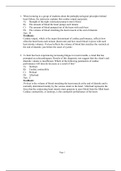
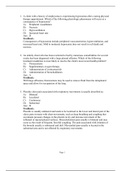
1. When lecturing to a group of students about the pathophysiological principles behind heart failure, the instructor explains that cardiac output represents: A) Strength of the right ventricular pump to move blood B) The amount of blood the heart pumps each minute C) The amount of blood pumped out of the heart with each beat D) The volume of blood stretching the heart muscle at the end of diastole Ans: B Feedback: Cardiac output, which is the major determinant of cardiac performance, reflects how often the heart beats each minute (heart rate) and how much blood it ejects with each beat (stroke volume). Preload reflects the volume of blood that stretches the ventricle at the end of diastole, just before the onset of systole. 2. A client has been experiencing increasing fatigue in recent months, a trend that has prompted an echocardiogram. Results of this diagnostic test suggest that the client's end-diastolic volume is insufficient. Which of the following parameters of cardiac performance will directly decrease as a result of this? A) Inotropy B) Cardiac contractility C) Preload D) Afterload Ans: C Feedback: Preload is the volume of blood stretching the heart muscle at the end of diastole and is normally determined mainly by the venous return to the heart. Afterload represents the force that the contracting heart muscle must generate to eject blood from the filled heart. Cardiac contractility, or inotropy, is the contractile performance of the heart. 3. One of the principal mechanisms by which the heart compensates for increased workload is: A) Myocardial hypertrophy B) Sodium and water retention C) Endothelin vasoconstrictors D) Ventricular wall tension increase Ans: A Feedback: The development of myocardial hypertrophy constitutes one of the principal mechanisms by which the heart compensates for an increase in workload. There are at least two types of endothelin receptors, and it is thought that the peptide may play a role in mediating noncompensatory pulmonary hypertension in persons with heart failure. One effect of a lowered cardiac output in heart failure is a noncompensatory reduction in renal blood flow and glomerular filtration rate, which leads to salt and water retention. Because increased wall tension increases myocardial oxygen requirements, it can produce noncompensatory ischemia and further impairment of cardiac function. 4. A client with heart failure asks, “Why am I taking a 'water pill' when it's my heart that is having a problem?” While educating the client about the Frank-Starling mechanism, which of the following explanations is most appropriate to share? A) “You must be drinking way too many liquids. Your kidneys cannot filter all that you are drinking during the day.” B) “Since your heart is not pumping efficiently, the kidneys are getting less blood flow; therefore, the kidneys are holding on to sodium and water.” C) “Your heart muscle is overstretched, so it's not able to pump all the blood out. The prescribed 'water pills' help by decreasing your weight.” D) “Since your heart function is impaired, the lungs are not able to oxygenate the blood and your kidneys are wearing out.” Ans: B Feedback: In heart failure with a reduced ejection fraction, a decrease in cardiac output and renal blood flow leads to increased sodium and water retention by the kidney with a resultant increase in vascular volume and venous return to the heart and an increase in ventricular end-diastolic volume. Drinking water may increase volume but is not the physiological reason for retention of fluid. Diuretics do decrease weight as a result of diuresis, but weight loss is not the purpose for giving diuretics. The lungs are not the primary cause of heart failure.
Written for
Document information
- Uploaded on
- February 18, 2021
- Number of pages
- 13
- Written in
- 2020/2021
- Type
- Exam (elaborations)
- Contains
- Questions & answers
Subjects
-
1 when lecturing to a group of students about the pathophysiological principles behind heart failure
-
the instructor explains that cardiac output represents a strength of the right ventricular pump

Also available in package deal