

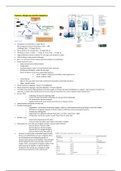
Practical 1 - Manage your own RAS + Background
• Ammonium concentration in mg/L NH4-N
NH4-N expresses amount N present in NH4+ = 78%
(→10mg/L NH4+ = 7.8 mg/L NH4-N)
• NO2 is 30.4% N → 25 mg/L NO2 = 7.6 mg/L NO2-N
• Nitrification step 1: 10 NH4+ + 7.8 NH4-N → 25.7 NO2- + 7.8 NO2-N
• High temperature and low salinity → more mg/L CO2 dissolves in water
• 16% of dietary crude protein is Nitrogen
• pH 7-7.5: not toxic for fish, around optimal conditions for nitrification
• Water treatment units
o Solids removal unit (sedimentation)
o Oxygenation
o Dissolved organic matter removal (heterotrophic bacteria)
o Nitrification (oxidation, makes the pH drop)
NH4-N → NO2-N → NO3-N by autotrophic bacteria
▪ NH4N → NO2N = AOB (ammonia (NH4+) oxidizing bacteria)
▪ NO2N → NO3N = NOB
o Denitrification
(NO3-N → N2 gas under anaerobic conditions by facultative autotrophic bacteria)
o Algae / aquatic weeds
• Waste production (kg/day) = Waste removal(kg/day)
• Waste production (kg/day) = feed load (kg/day) – Fish gain (kg/day)
• Fish tank: Flow rate (m3/kg feed/day): to provide oxygen, to remove dissolved metabolites, to support a fast transport of solids from
the tank, to create a flow speed (m/s) for muscle tone and respiration etc, and to maintain water temperature
• Sump + float
o Collecting, storing and supplying water
o Control of water temperature (heating unit, always before degassing)
o UV-treatment to decrease bacteria
o Supply chemicals for water quality maintenance or disease control
• Sedimentation tank/solids removal unit
• Biofilter/trickling filter
o Degradation: consumption of dissolved organic matter by heterotrophic bacteria growing on the plastic media
o Nitrification: biological oxidation of NH4N to NO2N to NO3N by chemo-autotrophic bacteria
o Aeration by trickling filter
o Degassing of CO2 (efficient with gas-liquid ratio = air flow : water flow = high)
o Temperature control by counter current flow of fan on warm days
• Biofilter sump
o Directs water by gravity to fish tanks
o Prevents water loss when water flow to fish tank is stopped
• Duckweed unit: roots take up inorganic nutrients, produce plant biomass
o Remove NH3-N + NH4-N (=TAN)
Remove NO2-N (=nitrite-nitrogen)
Remove NO3-N (=nitrate-nitrogen)
Remove PO4P (=ortho-phosphorus)
• Presence of solid waste or dissolved organic matter
(faeces and spilled feed) can have a negative effect
on nitrification by stimulating the growth of
heterotrophic bacteria in the biofilter. Heterotrophic
bacteria grow fast and consume large amounts of
oxygen. If the concentration of organic matter in the
water passing the biofilter is high the biofilter’s
nitrification rate will be low, resulting in a high
ammonia concentration in the culture tank
,• In water, NH3-N is in equilibrium with NH4+-N. This
equilibrium is determined by pH and temperature. Most
tests measure TAN (sum of ammonia NH3-N and ammonium
NH4+-N). To determine the NH3-N fraction of TAN the pH of
the fish tank effluent has to be measured. The higher the pH the higher the fraction of NH3 contributing to TAN
, Practical 2 – Create your own Catfish Farm
Harvesting frequency in influenced by labour costs, market demand and
practical reasons (density, stress to fish)
Stocking frequency should be the same as harvesting frequency but can be
limited by availability of fry/fingerlings and growth variation
Starting weight fry determined by husbandry and water quality demands.
Mortality and price
Harvest weight depends on market size, production costs and returns, risks
Mortality is related to growth interval, husbandry, culture tank design, grading
frequency, feeding method, water quality, nutrition and diseases
It is difficult to work with mortality by size class if one likes to calculate the biomass present on farm. It is more practical to calculate
the instantaneous mortality rate. With Z = instantaneous mortality
• Ammonium concentration in mg/L NH4-N
NH4-N expresses amount N present in NH4+ = 78%
(→10mg/L NH4+ = 7.8 mg/L NH4-N)
• NO2 is 30.4% N → 25 mg/L NO2 = 7.6 mg/L NO2-N
• Nitrification step 1: 10 NH4+ + 7.8 NH4-N → 25.7 NO2- + 7.8 NO2-N
• High temperature and low salinity → more mg/L CO2 dissolves in water
• 16% of dietary crude protein is Nitrogen
• pH 7-7.5: not toxic for fish, around optimal conditions for nitrification
• Water treatment units
o Solids removal unit (sedimentation)
o Oxygenation
o Dissolved organic matter removal (heterotrophic bacteria)
o Nitrification (oxidation, makes the pH drop)
NH4-N → NO2-N → NO3-N by autotrophic bacteria
▪ NH4N → NO2N = AOB (ammonia (NH4+) oxidizing bacteria)
▪ NO2N → NO3N = NOB
o Denitrification
(NO3-N → N2 gas under anaerobic conditions by facultative autotrophic bacteria)
o Algae / aquatic weeds
• Waste production (kg/day) = Waste removal(kg/day)
• Waste production (kg/day) = feed load (kg/day) – Fish gain (kg/day)
• Fish tank: Flow rate (m3/kg feed/day): to provide oxygen, to remove dissolved metabolites, to support a fast transport of solids from
the tank, to create a flow speed (m/s) for muscle tone and respiration etc, and to maintain water temperature
• Sump + float
o Collecting, storing and supplying water
o Control of water temperature (heating unit, always before degassing)
o UV-treatment to decrease bacteria
o Supply chemicals for water quality maintenance or disease control
• Sedimentation tank/solids removal unit
• Biofilter/trickling filter
o Degradation: consumption of dissolved organic matter by heterotrophic bacteria growing on the plastic media
o Nitrification: biological oxidation of NH4N to NO2N to NO3N by chemo-autotrophic bacteria
o Aeration by trickling filter
o Degassing of CO2 (efficient with gas-liquid ratio = air flow : water flow = high)
o Temperature control by counter current flow of fan on warm days
• Biofilter sump
o Directs water by gravity to fish tanks
o Prevents water loss when water flow to fish tank is stopped
• Duckweed unit: roots take up inorganic nutrients, produce plant biomass
o Remove NH3-N + NH4-N (=TAN)
Remove NO2-N (=nitrite-nitrogen)
Remove NO3-N (=nitrate-nitrogen)
Remove PO4P (=ortho-phosphorus)
• Presence of solid waste or dissolved organic matter
(faeces and spilled feed) can have a negative effect
on nitrification by stimulating the growth of
heterotrophic bacteria in the biofilter. Heterotrophic
bacteria grow fast and consume large amounts of
oxygen. If the concentration of organic matter in the
water passing the biofilter is high the biofilter’s
nitrification rate will be low, resulting in a high
ammonia concentration in the culture tank
,• In water, NH3-N is in equilibrium with NH4+-N. This
equilibrium is determined by pH and temperature. Most
tests measure TAN (sum of ammonia NH3-N and ammonium
NH4+-N). To determine the NH3-N fraction of TAN the pH of
the fish tank effluent has to be measured. The higher the pH the higher the fraction of NH3 contributing to TAN
, Practical 2 – Create your own Catfish Farm
Harvesting frequency in influenced by labour costs, market demand and
practical reasons (density, stress to fish)
Stocking frequency should be the same as harvesting frequency but can be
limited by availability of fry/fingerlings and growth variation
Starting weight fry determined by husbandry and water quality demands.
Mortality and price
Harvest weight depends on market size, production costs and returns, risks
Mortality is related to growth interval, husbandry, culture tank design, grading
frequency, feeding method, water quality, nutrition and diseases
It is difficult to work with mortality by size class if one likes to calculate the biomass present on farm. It is more practical to calculate
the instantaneous mortality rate. With Z = instantaneous mortality


