
Eralda Kurtulaj 181437
STRUCTURE AND FUNCTION OF NUCLEIC ACIDS
Unit 11: Genetics and genetic engineering
The deoxyribonucleic acid, also known as DNA, is the basic molecule of life in every living organism,
starting from humans to plants. It was originally found by Dr. WATSON and Dr. Crick in 1953 1. One of
the main functions it has, is to carry the unique genetic code that every organism needs for living,
developing, and reproducing. It carries the information from parents to child. The DNA molecules
are too long, and they can’t fit if they don’t have the right “packaging”, DNA form chromosomes by
coiling tightly. Every chromosome contains a single DNA molecule. Every human has usually 23 pairs
of chromosomes. It is composed by two polynucleotide chains that are twisted and take the shape of
a double helix. Each nucleotide found in the chain is made by a pentose (5 carbon) sugar, a nitrogen
organic base and a phosphate group.2
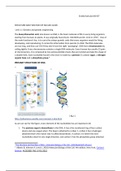
PRIMARY STRUCTURE OF DNA
( fig.1 )
http://jjshsscience.weebly.com/concept-1-dna.html
As we can see for the figure, every element of the nucleotides has an important role
1. The pentose sugar is deoxyribose in the DNA, it has a five numbered ring of four carbon
atoms and one oxygen atom. The base is attached to carbon 1, carbon 2 has a hydrogen
attached (that’s the reason why is called deoxyribose), in carbon 3 is where the next
nucleotides attach in one single direction, and carbon 5 has the phosphate group attached.
1
The Structure and Function of DNA - Molecular Biology of the Cell - NCBI Bookshelf (nih.gov)
2
Alberts B, Johnson A, Lewis J, 2002.Molecular Biology of the Cell. 4th edition. New York, Garland
Science. ACCESSED THE 17/01/2021
, 2. The phosphate group, also called base is usually attached to the 5 th carbon of the sugar, and
it is essential for the backbone structure. The phosphate group is the reason why both DNA
and RNA are negatively charged.
3. The nitrogen organic bases. There are two types of organic bases, which are the pyrimidine
and the purine The pyrimidines have a single ring structure that includes Cytosine (c) and
Thymine ( t ) and the purine that have a double ring structure, which are Adenine ( a ) and
Guanine ( g ). The base pairing in DNA is very specific, Adenine always pairs Thymine and
Cytosine always pairs with Guanine.
The outer edges are made from pentose sugar and phosphate groups, they form the sugar-
phosphate- backbone. So, the two strands of DNA are held together by the hydrogen bonds
between the bases, forming the “RUNGS” of the DNA double helix. We can say that the double helix
of DNA is antiparallel (they are parallel, but they run in different directions to each other). One of the
strands runs 5’ to 3’ and the other strand runs 3’ to 5’. We call them 5’ to 3’ because of the position
number of the carbon atoms in the pentose sugar of each molecule.
( fig 2.1) STRUCTURE OF NEUCLOETIDES
(fig.2.2) NUCLEOTIDE COMPONENTS
https://pmgbiology.com/2014/10/21/dna-structure-and-function-igcse-a-understanding
https://knowgenetics.org/nucleotides-and-bases/
Each base of the nucleotide is joined by one another by a covalent bond. The nucleotides are joined
to one another by a covalent bond. This bond between two nucleotides is called a phosphodiester
bond, this bond is formed between the phosphate group of one nucleotide and the hydroxyl group
on carbon 3 of the pentose sugar of the next nucleotide 3. When this bond is formed, water is
released and condensation occurs, and forms the molecule called dinucleotide, the bond can be
easily broken by adding water, which is a hydrolysis reaction.
As stated before the two polynucleotides strands are held together by hydrogen bonds between the
two bases. When these bases pair up the pairing is very specific and very important, reading the DNA
code will tell a cell how to make proteins, Adenine always pairs Thymine (A+ T) and Cytosine always
pairs with Guanine (G+C) . This pairing is very specific and other bases can’t pair up with each other
due to several factors, which are:
3
Nucleotide | biochemistry | Britannica
ACCESSED THE 22/01/2021
STRUCTURE AND FUNCTION OF NUCLEIC ACIDS
Unit 11: Genetics and genetic engineering
The deoxyribonucleic acid, also known as DNA, is the basic molecule of life in every living organism,
starting from humans to plants. It was originally found by Dr. WATSON and Dr. Crick in 1953 1. One of
the main functions it has, is to carry the unique genetic code that every organism needs for living,
developing, and reproducing. It carries the information from parents to child. The DNA molecules
are too long, and they can’t fit if they don’t have the right “packaging”, DNA form chromosomes by
coiling tightly. Every chromosome contains a single DNA molecule. Every human has usually 23 pairs
of chromosomes. It is composed by two polynucleotide chains that are twisted and take the shape of
a double helix. Each nucleotide found in the chain is made by a pentose (5 carbon) sugar, a nitrogen
organic base and a phosphate group.2
PRIMARY STRUCTURE OF DNA
( fig.1 )
http://jjshsscience.weebly.com/concept-1-dna.html
As we can see for the figure, every element of the nucleotides has an important role
1. The pentose sugar is deoxyribose in the DNA, it has a five numbered ring of four carbon
atoms and one oxygen atom. The base is attached to carbon 1, carbon 2 has a hydrogen
attached (that’s the reason why is called deoxyribose), in carbon 3 is where the next
nucleotides attach in one single direction, and carbon 5 has the phosphate group attached.
1
The Structure and Function of DNA - Molecular Biology of the Cell - NCBI Bookshelf (nih.gov)
2
Alberts B, Johnson A, Lewis J, 2002.Molecular Biology of the Cell. 4th edition. New York, Garland
Science. ACCESSED THE 17/01/2021
, 2. The phosphate group, also called base is usually attached to the 5 th carbon of the sugar, and
it is essential for the backbone structure. The phosphate group is the reason why both DNA
and RNA are negatively charged.
3. The nitrogen organic bases. There are two types of organic bases, which are the pyrimidine
and the purine The pyrimidines have a single ring structure that includes Cytosine (c) and
Thymine ( t ) and the purine that have a double ring structure, which are Adenine ( a ) and
Guanine ( g ). The base pairing in DNA is very specific, Adenine always pairs Thymine and
Cytosine always pairs with Guanine.
The outer edges are made from pentose sugar and phosphate groups, they form the sugar-
phosphate- backbone. So, the two strands of DNA are held together by the hydrogen bonds
between the bases, forming the “RUNGS” of the DNA double helix. We can say that the double helix
of DNA is antiparallel (they are parallel, but they run in different directions to each other). One of the
strands runs 5’ to 3’ and the other strand runs 3’ to 5’. We call them 5’ to 3’ because of the position
number of the carbon atoms in the pentose sugar of each molecule.
( fig 2.1) STRUCTURE OF NEUCLOETIDES
(fig.2.2) NUCLEOTIDE COMPONENTS
https://pmgbiology.com/2014/10/21/dna-structure-and-function-igcse-a-understanding
https://knowgenetics.org/nucleotides-and-bases/
Each base of the nucleotide is joined by one another by a covalent bond. The nucleotides are joined
to one another by a covalent bond. This bond between two nucleotides is called a phosphodiester
bond, this bond is formed between the phosphate group of one nucleotide and the hydroxyl group
on carbon 3 of the pentose sugar of the next nucleotide 3. When this bond is formed, water is
released and condensation occurs, and forms the molecule called dinucleotide, the bond can be
easily broken by adding water, which is a hydrolysis reaction.
As stated before the two polynucleotides strands are held together by hydrogen bonds between the
two bases. When these bases pair up the pairing is very specific and very important, reading the DNA
code will tell a cell how to make proteins, Adenine always pairs Thymine (A+ T) and Cytosine always
pairs with Guanine (G+C) . This pairing is very specific and other bases can’t pair up with each other
due to several factors, which are:
3
Nucleotide | biochemistry | Britannica
ACCESSED THE 22/01/2021


