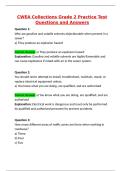
CWEA Collections Grade 2 Practice Test
Questions and Answers
Question 1:
Why are gasoline and volatile solvents objectionable when present in a
sewer?
a) They produce an explosion hazard
Correct Answer a) They produce an explosion hazard
Explanation: Gasoline and volatile solvents are highly flammable and
can cause explosions if mixed with air in the sewer system.
Question 2:
You should never attempt to install, troubleshoot, maintain, repair, or
replace electrical equipment unless:
a) You know what you are doing, are qualified, and are authorized
Correct Answer a) You know what you are doing, are qualified, and are
authorized
Explanation: Electrical work is dangerous and must only be performed
by qualified and authorized personnel to prevent accidents.
Question 3:
How many different areas of traffic zones are there when working in
roadways?
a) Three
b) Four
c) Five
,d) Six
Correct Answer c) Five
Explanation: The five traffic control zones include the advance warning
area, transition area, work zone, buffer zone, and termination area.
Question 4:
Why should hydrogen sulfide be controlled?
a) To protect sewers and structures from corrosion
Correct Answer a) To protect sewers and structures from corrosion
Explanation: Hydrogen sulfide is corrosive to pipes, structures, and
equipment, leading to costly repairs.
Question 5:
Personnel entering a Permit Required Confined Space must have the
following training:
a) First aid and CPR
b) Entry and rescue procedures
Correct Answer b) Entry and rescue procedures
Explanation: Proper training on entry and rescue is essential for safety
in permit-required confined spaces.
Question 6:
To find proper protective gear before application of a product, you
would:
, a) Look at the MSDS (Material Safety Data Sheet)
Correct Answer a) Look at the MSDS (Material Safety Data Sheet)
Explanation: The MSDS provides safety information, including
recommended protective equipment.
Question 7:
The gas most commonly associated with septic wastewater is:
a) Methane
b) Carbon dioxide
c) Hydrogen sulfide (H₂S)
d) Oxygen
Correct Answer c) Hydrogen sulfide (H₂S)
Explanation: Hydrogen sulfide is produced by the anaerobic
decomposition of organic matter in sewage.
Question 8:
The lack of an unpleasant odor in a structure does not always mean that
dangerous gases are not present because:
a) Some dangerous gases have no odor
Correct Answer a) Some dangerous gases have no odor
Explanation: Certain toxic or explosive gases are odorless, so odor alone
isn't a reliable safety indicator.
Questions and Answers
Question 1:
Why are gasoline and volatile solvents objectionable when present in a
sewer?
a) They produce an explosion hazard
Correct Answer a) They produce an explosion hazard
Explanation: Gasoline and volatile solvents are highly flammable and
can cause explosions if mixed with air in the sewer system.
Question 2:
You should never attempt to install, troubleshoot, maintain, repair, or
replace electrical equipment unless:
a) You know what you are doing, are qualified, and are authorized
Correct Answer a) You know what you are doing, are qualified, and are
authorized
Explanation: Electrical work is dangerous and must only be performed
by qualified and authorized personnel to prevent accidents.
Question 3:
How many different areas of traffic zones are there when working in
roadways?
a) Three
b) Four
c) Five
,d) Six
Correct Answer c) Five
Explanation: The five traffic control zones include the advance warning
area, transition area, work zone, buffer zone, and termination area.
Question 4:
Why should hydrogen sulfide be controlled?
a) To protect sewers and structures from corrosion
Correct Answer a) To protect sewers and structures from corrosion
Explanation: Hydrogen sulfide is corrosive to pipes, structures, and
equipment, leading to costly repairs.
Question 5:
Personnel entering a Permit Required Confined Space must have the
following training:
a) First aid and CPR
b) Entry and rescue procedures
Correct Answer b) Entry and rescue procedures
Explanation: Proper training on entry and rescue is essential for safety
in permit-required confined spaces.
Question 6:
To find proper protective gear before application of a product, you
would:
, a) Look at the MSDS (Material Safety Data Sheet)
Correct Answer a) Look at the MSDS (Material Safety Data Sheet)
Explanation: The MSDS provides safety information, including
recommended protective equipment.
Question 7:
The gas most commonly associated with septic wastewater is:
a) Methane
b) Carbon dioxide
c) Hydrogen sulfide (H₂S)
d) Oxygen
Correct Answer c) Hydrogen sulfide (H₂S)
Explanation: Hydrogen sulfide is produced by the anaerobic
decomposition of organic matter in sewage.
Question 8:
The lack of an unpleasant odor in a structure does not always mean that
dangerous gases are not present because:
a) Some dangerous gases have no odor
Correct Answer a) Some dangerous gases have no odor
Explanation: Certain toxic or explosive gases are odorless, so odor alone
isn't a reliable safety indicator.