

Lecture 9 – Hut 5,6
Chapter 19
Circadian rhythms function in internal organisation (synchronisation between cells, organs,
physiology) and external organisation (energy conservation, predator avoidance).
Circa-rhythms
Day - circadian
Year - circannual
Month - circalunar
Tides - circatidal
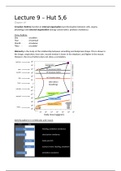
Allometry is the study of the relationship between something and bodymass/shape. This is shown in
the image, respiration, hear rate, muscle tension is lower in the elephant, and higher in the mouse.
However, the circa-rhythms does not show a correlation.
Activity patterns in vertebrates and reason
, Diurnal – active during daytime
Nocturnal – active during nighttime
Crepuscular – both nocturnal and diurnal
Endogenous clock
Free-run means that an organism relies completely on the endogenous clock, for example when the
day-night rhythm is taken away (keep in complete darkness). After the complete darkness, it adapts
the endogenous clock to the light-cycle —> re-entrainment.
This can be shown in an actogram which is a graphical representation of the activity of an animal that
has been isolated from environmental cues as to the time of day:
A zeitgeber is any external or environmental cue that entrains or synchronises the internal clock to
the earth’s 24-hour light/dark cycle and 12 month cycle.
Zeitgeber time 0 is the onset of light, zeitgeber time 12 , the onset of light and zeitgeber 24 is the
onset of light again.
In continuous darkness, circadian time 0 is the onset of light (subjective day), circadian time 12 is the
offset of light (subjective night) and circadian time 21 is the onset of light again (subjective day).
Characteristics of the circadian rhythm
- Endogenous: free-run under continuous conditions
- Entrainable: almost always by a 24-h light-dark cycle
- Genetic or molecular basis
- Cell autonomous
- Present in almost all organisms and all taxa
Photoperiodism
Photoperiodism is the physiological reactor of organisms to length of night or a dark period. Is are
responses to the relative lengths of light and dark periods:
- Measurement of day length
- Synchronisation of circannual rhythm
- Seasonality (molt, reproduction, hibernation)
- Anticipation of seasonal changes in environment
Chapter 19
Circadian rhythms function in internal organisation (synchronisation between cells, organs,
physiology) and external organisation (energy conservation, predator avoidance).
Circa-rhythms
Day - circadian
Year - circannual
Month - circalunar
Tides - circatidal
Allometry is the study of the relationship between something and bodymass/shape. This is shown in
the image, respiration, hear rate, muscle tension is lower in the elephant, and higher in the mouse.
However, the circa-rhythms does not show a correlation.
Activity patterns in vertebrates and reason
, Diurnal – active during daytime
Nocturnal – active during nighttime
Crepuscular – both nocturnal and diurnal
Endogenous clock
Free-run means that an organism relies completely on the endogenous clock, for example when the
day-night rhythm is taken away (keep in complete darkness). After the complete darkness, it adapts
the endogenous clock to the light-cycle —> re-entrainment.
This can be shown in an actogram which is a graphical representation of the activity of an animal that
has been isolated from environmental cues as to the time of day:
A zeitgeber is any external or environmental cue that entrains or synchronises the internal clock to
the earth’s 24-hour light/dark cycle and 12 month cycle.
Zeitgeber time 0 is the onset of light, zeitgeber time 12 , the onset of light and zeitgeber 24 is the
onset of light again.
In continuous darkness, circadian time 0 is the onset of light (subjective day), circadian time 12 is the
offset of light (subjective night) and circadian time 21 is the onset of light again (subjective day).
Characteristics of the circadian rhythm
- Endogenous: free-run under continuous conditions
- Entrainable: almost always by a 24-h light-dark cycle
- Genetic or molecular basis
- Cell autonomous
- Present in almost all organisms and all taxa
Photoperiodism
Photoperiodism is the physiological reactor of organisms to length of night or a dark period. Is are
responses to the relative lengths of light and dark periods:
- Measurement of day length
- Synchronisation of circannual rhythm
- Seasonality (molt, reproduction, hibernation)
- Anticipation of seasonal changes in environment


