1
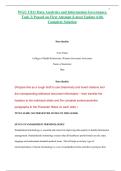
WGU C811 Data Analytics and Information Governance
Task 2| Passed on First Attempt |Latest Update with
Complete Solution
Data Quality
Your Name
College of Health Professions, Western Governors University
Name of Instructor
Date
Data Quality
(Prepare this as a rough draft to use Grammarly and insert citations and
the corresponding reference document information – then transfer the
headers to the individual slides and the complete sentences/entire
paragraphs to the Presenter Notes on each slide.)
TITLE SLIDE (NO PRESENTER NOTES ON THIS SLIDE)
SEVEN STANDARDIZED TERMINOLOGIES
Standardized terminology is essential and crucial in improving data quality in health information
management. Standardized terminology ensures that all healthcare professionals use the same
language and understand standard medical terms. This all helps avoid any type of
misinterpretation. Clinical terminology is a set of standardized terms and their synonyms that
, 2
record the patient's findings, events, circumstances, and interventions with details to support the
care the patient receives, decisions that are made, research, and, of course, quality improvement
(Oachs, P., & Watters, A., 2020). Standardized terminologies improve communication among all and
improve patient care. The seven standardized terminologies are as follows:
Common Procedural Terminology (CPT): The owner of Common Procedure Terminology
(CPT) is the American Medical Association (AMA). The AMA is responsible for developing and
maintaining CPT (Johns, M., 2015). The purpose of CPT is to provide a uniform language among
all medical staff and services that best accurately describes what services a patient may have
received. This is a reliable nationwide communication used by physicians, patients, and third
parties (Oachs, P., & Watters, A., 2020). CPT is very beneficial because any physician can
review the patient medical chart quickly and helps with claims processing.
Healthcare Common Procedure Coding System Level II Codes (HCPCS): The Healthcare
Common Procedure Coding System Level II Codes (HCPCS) is owned by CMS. The CMS
workgroup is responsible for any development or maintenance that needs to be performed (Johns,
M., 2015). HCPCS is used to report any services and supplies provided to the patient for
reimbursement purposes. HCPCS is used only in the outpatient or ambulatory setting. Level II
codes are for products, supplies, and services not included in the CPT codes and are five-
character alphanumeric codes (Oachs, P., & Watters, A., 2020). Using the HCPCS codes
correctly allows the healthcare provider to be accurately reimbursed for any additional services
outside of the CPT.
International Classification of Diseases, 10th Revision (ICD-10): The International
Classification of Diseases, 10th Revision (ICD-10) is owned by the World Health Organization
(WHO). The WHO is responsible for development and maintenance (Johns, M., 2015). The
ICD-10 is a classification system that captures clinical detail and specificity. The system was
designed to store and retrieve diagnostic information for compiling mortality and morbidity
WGU C811 Data Analytics and Information Governance
Task 2| Passed on First Attempt |Latest Update with
Complete Solution
Data Quality
Your Name
College of Health Professions, Western Governors University
Name of Instructor
Date
Data Quality
(Prepare this as a rough draft to use Grammarly and insert citations and
the corresponding reference document information – then transfer the
headers to the individual slides and the complete sentences/entire
paragraphs to the Presenter Notes on each slide.)
TITLE SLIDE (NO PRESENTER NOTES ON THIS SLIDE)
SEVEN STANDARDIZED TERMINOLOGIES
Standardized terminology is essential and crucial in improving data quality in health information
management. Standardized terminology ensures that all healthcare professionals use the same
language and understand standard medical terms. This all helps avoid any type of
misinterpretation. Clinical terminology is a set of standardized terms and their synonyms that
, 2
record the patient's findings, events, circumstances, and interventions with details to support the
care the patient receives, decisions that are made, research, and, of course, quality improvement
(Oachs, P., & Watters, A., 2020). Standardized terminologies improve communication among all and
improve patient care. The seven standardized terminologies are as follows:
Common Procedural Terminology (CPT): The owner of Common Procedure Terminology
(CPT) is the American Medical Association (AMA). The AMA is responsible for developing and
maintaining CPT (Johns, M., 2015). The purpose of CPT is to provide a uniform language among
all medical staff and services that best accurately describes what services a patient may have
received. This is a reliable nationwide communication used by physicians, patients, and third
parties (Oachs, P., & Watters, A., 2020). CPT is very beneficial because any physician can
review the patient medical chart quickly and helps with claims processing.
Healthcare Common Procedure Coding System Level II Codes (HCPCS): The Healthcare
Common Procedure Coding System Level II Codes (HCPCS) is owned by CMS. The CMS
workgroup is responsible for any development or maintenance that needs to be performed (Johns,
M., 2015). HCPCS is used to report any services and supplies provided to the patient for
reimbursement purposes. HCPCS is used only in the outpatient or ambulatory setting. Level II
codes are for products, supplies, and services not included in the CPT codes and are five-
character alphanumeric codes (Oachs, P., & Watters, A., 2020). Using the HCPCS codes
correctly allows the healthcare provider to be accurately reimbursed for any additional services
outside of the CPT.
International Classification of Diseases, 10th Revision (ICD-10): The International
Classification of Diseases, 10th Revision (ICD-10) is owned by the World Health Organization
(WHO). The WHO is responsible for development and maintenance (Johns, M., 2015). The
ICD-10 is a classification system that captures clinical detail and specificity. The system was
designed to store and retrieve diagnostic information for compiling mortality and morbidity