

van der Zee
Behavioural Neuroscience
Lecture 1&2 – Brain Anatomy
Misconceptions about the brain
1. We only use a part of our brain.
- We use all our neurons actively to some extent; long-term inactive neurons die
due to a lack of neurotrophic factors. Neurons provide each other with growth
factors to stay healthy.
2. Starting at the age of 25 neurons die progressively; at high age large numbers
of neurons are gone.
- Incorrect, recently developed methods for cell counting have shown that in
case of healthy, non-demented elderly only limited loss of neuros occurs (max
5%).
- The high loss of neurons can happen at an older age but only with a
neurodegenerative disease, e.g. Alzheimer or Parkinson’s.
3. After birth and the first years of brain development no new neurons are being
born in the brain.
- Incorrect, in at least three brain regions (hippocampus) production of new
neurons (neurogenesis) still takes place at all ages, although the production
is rather low at high age.
- Hippocampus = brain region used for learning and memory
o Dentate gyrus = part of the hippocampus were new neurons are born.
The central and peripheral nervous system
Central nervous system = the brain and the spinal cord
Peripheral nervous system = nervous system that sends and receives signal from
the brain to the whole body and the other way around.
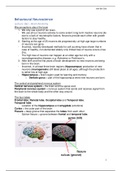
The four lobes
Frontal lobe, Parietal lobe, Occipital lobe and Temporal lobe.
Temporal lobe:
- Location of the hippocampus and amygdala (emotions)
Cortex = the outer part of the brain
Fissure = deep groove that separates the lobes from each other.
- Sylvian fissure = groove between frontal and temporal lobe.
1
, van der Zee
The shape of the skull is more or less the same as the shape of the brain.
Old and new phrenology
Phrenology = science of correlating the structure of the head with personality traits.
Old phrenology = an individual’s character and abilities could be deduced from the
size and shape of various bumps on the head.
- Skill at mathematics or tendency toward aggression were directly associated
with particular brain regions.
- Bumps on the skull indicated how fully developed each brain region was.
New phrenology = measure how active different parts of the brain are when a
person is performing a task.
- High threshold → only one part of the brain is visibly measured.
o But the whole brain is active but not at that rate.
- Lowering threshold → more parts of the brain are visibly measured.
2
, van der Zee
Broca: an example of localized function in the cerebrum
Broca’s area damage/lesions
- Motor (nonfluent) aphasia = a language disturbance in which a
person has difficulty speaking or repeating words but can
understand language
o Cannot speak properly
- Patients usually have problems speaking and repeating words
of sentences which they just heard.
Wernicke’s area damage/lesions
- Sensory aphasia; if you do not understand language (dyslexia).
o Symptoms such as poor auditory comprehension, relatively intact
repetition, and fluent speech with semantic paraphasia’s present.
- Spoken language of Wernicke’s patients usually sounds fluently but lacks
meaning.
Brain imaging
CT-scan = used for a quick study of major
issues in the brain, e.g. stroke.
- Computerized tomography
MRI scan = used for a detailed view and
important for recognizing structures.
- Magnetic resonance imaging
PET scan = used for activity of the brain
- Positron emission tomography
- Difficult to pinpoint were it is in the brain
- White, red, yellow: high activity
- Blue, black, green: low activity
fMRI scan = combines structural and activity
information.
- Functional magnetic resonance imaging
- 3D image
Psychopath’s brain has dark patches, which
suggest low activity in the orbital cortex, an
area of the brain responsible for moral decision
making. An inactive orbital cortex cannot
control the amygdala, which dictates
aggression.
- Orbital cortex: behind the eyes
- Careful with labeling people.
3
, van der Zee
Studying the human brain
Sections are necessary to study the human brain.
- Horizontal, sagittal, and coronal (frontal).
- Dorsal = upper part of the brain
- Ventral = lower part of the brain
- Rostral and caudal or anterior and posterior
Rat and mice brain show a lot of global similarities with the human brain. No
difference between a rat and human neuron.
4
, van der Zee
Grey matter = cell body of the neuron + dendrites
White matter = long axons with myelin sheaths
- Myelin sheaths important for speeding up transduction
Hippocampus
Cerebrum (cortex)
Not only neurons in the brain but also cells
5
, van der Zee
Ventricular system in the brain
4 ventricles in the brain:
- 1st and 2nd ventricle = lateral ventricles
- Produces CSF (~500 ml/day)
o Always pressure in the brain due to CSF overproduction
- Volume: ~150ml
- Replacement of CSF about 3 times/day
o To get toxic compounds out of the brain
o Quickly distribution of a certain compound
Flow of CSF through the ventricles
Obstruction in cerebral aqueduct → CSF cannot get away → waterhead/HOAX.
- Born with waterhead → shunt is placed to the abdominal cavity or to the heart.
6
Behavioural Neuroscience
Lecture 1&2 – Brain Anatomy
Misconceptions about the brain
1. We only use a part of our brain.
- We use all our neurons actively to some extent; long-term inactive neurons die
due to a lack of neurotrophic factors. Neurons provide each other with growth
factors to stay healthy.
2. Starting at the age of 25 neurons die progressively; at high age large numbers
of neurons are gone.
- Incorrect, recently developed methods for cell counting have shown that in
case of healthy, non-demented elderly only limited loss of neuros occurs (max
5%).
- The high loss of neurons can happen at an older age but only with a
neurodegenerative disease, e.g. Alzheimer or Parkinson’s.
3. After birth and the first years of brain development no new neurons are being
born in the brain.
- Incorrect, in at least three brain regions (hippocampus) production of new
neurons (neurogenesis) still takes place at all ages, although the production
is rather low at high age.
- Hippocampus = brain region used for learning and memory
o Dentate gyrus = part of the hippocampus were new neurons are born.
The central and peripheral nervous system
Central nervous system = the brain and the spinal cord
Peripheral nervous system = nervous system that sends and receives signal from
the brain to the whole body and the other way around.
The four lobes
Frontal lobe, Parietal lobe, Occipital lobe and Temporal lobe.
Temporal lobe:
- Location of the hippocampus and amygdala (emotions)
Cortex = the outer part of the brain
Fissure = deep groove that separates the lobes from each other.
- Sylvian fissure = groove between frontal and temporal lobe.
1
, van der Zee
The shape of the skull is more or less the same as the shape of the brain.
Old and new phrenology
Phrenology = science of correlating the structure of the head with personality traits.
Old phrenology = an individual’s character and abilities could be deduced from the
size and shape of various bumps on the head.
- Skill at mathematics or tendency toward aggression were directly associated
with particular brain regions.
- Bumps on the skull indicated how fully developed each brain region was.
New phrenology = measure how active different parts of the brain are when a
person is performing a task.
- High threshold → only one part of the brain is visibly measured.
o But the whole brain is active but not at that rate.
- Lowering threshold → more parts of the brain are visibly measured.
2
, van der Zee
Broca: an example of localized function in the cerebrum
Broca’s area damage/lesions
- Motor (nonfluent) aphasia = a language disturbance in which a
person has difficulty speaking or repeating words but can
understand language
o Cannot speak properly
- Patients usually have problems speaking and repeating words
of sentences which they just heard.
Wernicke’s area damage/lesions
- Sensory aphasia; if you do not understand language (dyslexia).
o Symptoms such as poor auditory comprehension, relatively intact
repetition, and fluent speech with semantic paraphasia’s present.
- Spoken language of Wernicke’s patients usually sounds fluently but lacks
meaning.
Brain imaging
CT-scan = used for a quick study of major
issues in the brain, e.g. stroke.
- Computerized tomography
MRI scan = used for a detailed view and
important for recognizing structures.
- Magnetic resonance imaging
PET scan = used for activity of the brain
- Positron emission tomography
- Difficult to pinpoint were it is in the brain
- White, red, yellow: high activity
- Blue, black, green: low activity
fMRI scan = combines structural and activity
information.
- Functional magnetic resonance imaging
- 3D image
Psychopath’s brain has dark patches, which
suggest low activity in the orbital cortex, an
area of the brain responsible for moral decision
making. An inactive orbital cortex cannot
control the amygdala, which dictates
aggression.
- Orbital cortex: behind the eyes
- Careful with labeling people.
3
, van der Zee
Studying the human brain
Sections are necessary to study the human brain.
- Horizontal, sagittal, and coronal (frontal).
- Dorsal = upper part of the brain
- Ventral = lower part of the brain
- Rostral and caudal or anterior and posterior
Rat and mice brain show a lot of global similarities with the human brain. No
difference between a rat and human neuron.
4
, van der Zee
Grey matter = cell body of the neuron + dendrites
White matter = long axons with myelin sheaths
- Myelin sheaths important for speeding up transduction
Hippocampus
Cerebrum (cortex)
Not only neurons in the brain but also cells
5
, van der Zee
Ventricular system in the brain
4 ventricles in the brain:
- 1st and 2nd ventricle = lateral ventricles
- Produces CSF (~500 ml/day)
o Always pressure in the brain due to CSF overproduction
- Volume: ~150ml
- Replacement of CSF about 3 times/day
o To get toxic compounds out of the brain
o Quickly distribution of a certain compound
Flow of CSF through the ventricles
Obstruction in cerebral aqueduct → CSF cannot get away → waterhead/HOAX.
- Born with waterhead → shunt is placed to the abdominal cavity or to the heart.
6


