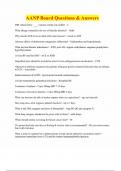
NASM STRETCHING AND FLEXIBILITY EXAM 2025 | ALL
100 QUESTIONS AND CORRECT ANSWERS | ALREADY
GRADED A+ | LATEST VERSION (JUST RELEASED)
Corrective Exercise & Flexibility Training | Key Domains: Scientific Principles of Flexibility
(Autogenic Inhibition, Reciprocal Inhibition), Types of Stretching (Static, Active-Isolated, Dynamic,
Myofascial), Assessment of Muscular Imbalance & Range of Motion, Integrated Flexibility
Continuum (Corrective, Active, Functional), Programming for Client Needs, Special Populations &
Contraindications, and Neuromuscular Science | Expert-Aligned Structure | Exam-Ready Format
Introduction
This structured NASM Stretching and Flexibility Exam for 2025 provides 100 high-quality
exam-style questions with correct answers and rationales. It emphasizes the evidence-based
application of the NASM Optimum Performance Training (OPT) model's Flexibility Training phase,
focusing on corrective exercise strategies, neuromuscular principles, and program design to
improve movement quality and reduce injury risk.
Answer Format
All correct answers must appear in bold and cyan blue, accompanied by concise rationales
explaining the neuromuscular science principle, the correct application of a stretching technique
within the OPT model, the appropriate assessment interpretation, and why alternative options are
contraindicated, inefficient, or misaligned with NASM's corrective exercise philosophy.
1. Which neuromuscular principle explains why holding a static stretch for 30 seconds can
increase muscle length?
A. Reciprocal inhibition
B. Autogenic inhibition
C. Altered reciprocal inhibition
D. Synergistic dominance
,B. Autogenic inhibition
Autogenic inhibition occurs when the Golgi tendon organ (GTO) senses prolonged tension and causes
the muscle to relax, allowing for increased length. This is the primary mechanism behind static
stretching in NASM's corrective flexibility phase.
2. According to NASM’s Integrated Flexibility Continuum, which type of stretching is most
appropriate for the Stabilization Endurance phase of the OPT model?
A. Dynamic stretching
B. Active-isolated stretching
C. Static stretching
D. Ballistic stretching
C. Static stretching
In the Stabilization Endurance phase (Phase 1 of OPT), corrective flexibility is emphasized, which
includes self-myofascial release (SMR) and static stretching to address muscle imbalances and improve
tissue extensibility.
3. Which assessment would best identify an overactive hip flexor complex?
A. Overhead squat assessment showing anterior pelvic tilt
B. Single-leg squat assessment showing knee valgus
C. Push-up assessment showing lumbar hyperextension
D. Loaded movement assessment showing asymmetry
A. Overhead squat assessment showing anterior pelvic tilt
,Anterior pelvic tilt during the overhead squat is a common indicator of overactive hip flexors (e.g.,
tensor fasciae latae, rectus femoris) and underactive gluteus maximus, per NASM’s movement
assessment guidelines.
4. What is the primary purpose of self-myofascial release (SMR) in NASM’s corrective
exercise strategy?
A. To increase muscle strength
B. To reduce neuromuscular hypertonicity and adhesions
C. To improve maximal power output
D. To enhance cardiovascular endurance
B. To reduce neuromuscular hypertonicity and adhesions
SMR uses tools like foam rollers to apply pressure to trigger points, stimulating the GTO and reducing
muscle spindle activity, which decreases tissue density and improves extensibility—key in NASM’s
corrective approach.
5. Which stretching technique is most appropriate for the Power phase of the OPT model?
A. Static stretching
B. Active-isolated stretching
C. Dynamic stretching
D. Ballistic stretching
C. Dynamic stretching
In the Power phase (Phase 5 of OPT), functional flexibility is emphasized, which includes dynamic
stretching to prepare the neuromuscular system for high-velocity, multiplanar movements without
reducing power output.
, 6. What is the recommended duration for holding a static stretch in NASM’s corrective
flexibility protocol?
A. 10–15 seconds
B. 20–30 seconds
C. 30–60 seconds
D. 60–90 seconds
C. 30–60 seconds
NASM recommends holding static stretches for 30–60 seconds to allow sufficient time for autogenic
inhibition to occur and achieve optimal lengthening of the targeted muscle.
7. Which principle explains why stretching the hip flexors may improve gluteal activation
during hip extension?
A. Autogenic inhibition
B. Reciprocal inhibition
C. Altered reciprocal inhibition
D. Neuromuscular efficiency
B. Reciprocal inhibition
Reciprocal inhibition describes the simultaneous relaxation of a muscle (agonist) when its antagonist
contracts. Stretching tight hip flexors reduces their neural drive, allowing the gluteus maximus
(antagonist) to contract more effectively during hip extension.
8. Which of the following is a contraindication for static stretching?
100 QUESTIONS AND CORRECT ANSWERS | ALREADY
GRADED A+ | LATEST VERSION (JUST RELEASED)
Corrective Exercise & Flexibility Training | Key Domains: Scientific Principles of Flexibility
(Autogenic Inhibition, Reciprocal Inhibition), Types of Stretching (Static, Active-Isolated, Dynamic,
Myofascial), Assessment of Muscular Imbalance & Range of Motion, Integrated Flexibility
Continuum (Corrective, Active, Functional), Programming for Client Needs, Special Populations &
Contraindications, and Neuromuscular Science | Expert-Aligned Structure | Exam-Ready Format
Introduction
This structured NASM Stretching and Flexibility Exam for 2025 provides 100 high-quality
exam-style questions with correct answers and rationales. It emphasizes the evidence-based
application of the NASM Optimum Performance Training (OPT) model's Flexibility Training phase,
focusing on corrective exercise strategies, neuromuscular principles, and program design to
improve movement quality and reduce injury risk.
Answer Format
All correct answers must appear in bold and cyan blue, accompanied by concise rationales
explaining the neuromuscular science principle, the correct application of a stretching technique
within the OPT model, the appropriate assessment interpretation, and why alternative options are
contraindicated, inefficient, or misaligned with NASM's corrective exercise philosophy.
1. Which neuromuscular principle explains why holding a static stretch for 30 seconds can
increase muscle length?
A. Reciprocal inhibition
B. Autogenic inhibition
C. Altered reciprocal inhibition
D. Synergistic dominance
,B. Autogenic inhibition
Autogenic inhibition occurs when the Golgi tendon organ (GTO) senses prolonged tension and causes
the muscle to relax, allowing for increased length. This is the primary mechanism behind static
stretching in NASM's corrective flexibility phase.
2. According to NASM’s Integrated Flexibility Continuum, which type of stretching is most
appropriate for the Stabilization Endurance phase of the OPT model?
A. Dynamic stretching
B. Active-isolated stretching
C. Static stretching
D. Ballistic stretching
C. Static stretching
In the Stabilization Endurance phase (Phase 1 of OPT), corrective flexibility is emphasized, which
includes self-myofascial release (SMR) and static stretching to address muscle imbalances and improve
tissue extensibility.
3. Which assessment would best identify an overactive hip flexor complex?
A. Overhead squat assessment showing anterior pelvic tilt
B. Single-leg squat assessment showing knee valgus
C. Push-up assessment showing lumbar hyperextension
D. Loaded movement assessment showing asymmetry
A. Overhead squat assessment showing anterior pelvic tilt
,Anterior pelvic tilt during the overhead squat is a common indicator of overactive hip flexors (e.g.,
tensor fasciae latae, rectus femoris) and underactive gluteus maximus, per NASM’s movement
assessment guidelines.
4. What is the primary purpose of self-myofascial release (SMR) in NASM’s corrective
exercise strategy?
A. To increase muscle strength
B. To reduce neuromuscular hypertonicity and adhesions
C. To improve maximal power output
D. To enhance cardiovascular endurance
B. To reduce neuromuscular hypertonicity and adhesions
SMR uses tools like foam rollers to apply pressure to trigger points, stimulating the GTO and reducing
muscle spindle activity, which decreases tissue density and improves extensibility—key in NASM’s
corrective approach.
5. Which stretching technique is most appropriate for the Power phase of the OPT model?
A. Static stretching
B. Active-isolated stretching
C. Dynamic stretching
D. Ballistic stretching
C. Dynamic stretching
In the Power phase (Phase 5 of OPT), functional flexibility is emphasized, which includes dynamic
stretching to prepare the neuromuscular system for high-velocity, multiplanar movements without
reducing power output.
, 6. What is the recommended duration for holding a static stretch in NASM’s corrective
flexibility protocol?
A. 10–15 seconds
B. 20–30 seconds
C. 30–60 seconds
D. 60–90 seconds
C. 30–60 seconds
NASM recommends holding static stretches for 30–60 seconds to allow sufficient time for autogenic
inhibition to occur and achieve optimal lengthening of the targeted muscle.
7. Which principle explains why stretching the hip flexors may improve gluteal activation
during hip extension?
A. Autogenic inhibition
B. Reciprocal inhibition
C. Altered reciprocal inhibition
D. Neuromuscular efficiency
B. Reciprocal inhibition
Reciprocal inhibition describes the simultaneous relaxation of a muscle (agonist) when its antagonist
contracts. Stretching tight hip flexors reduces their neural drive, allowing the gluteus maximus
(antagonist) to contract more effectively during hip extension.
8. Which of the following is a contraindication for static stretching?