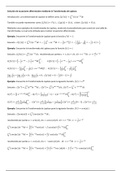
Solución de ecuaciones diferenciales mediante la Transformada de Laplace.
∞
Introducción. La transformada de Laplace se define como ℒ{𝑓(𝑡)} = ∫0 𝑓(𝑡)𝑒 −𝑠𝑡 𝑑𝑡
También se puede representar como ℒ{𝑓(𝑡)} = 𝐹(𝑠) , ℒ{𝑔(𝑡)} = 𝐺(𝑠), o bien ℒ{𝑦(𝑡)} = 𝑌(𝑠).
Mediante unos ejemplos de transformadas de Laplace, mostraré el procedimiento para construir una tabla de
transformadas, la cual será utilizada para resolver ecuaciones diferenciales.
Ejemplo. Encuentre la Transformada de Laplace para la función 𝑓(𝑡) = 1.
∞ 1 ∞ 1 1 1 1 1 1
Solución. ℒ{𝑓(𝑡)} = ∫0 (1)𝑒 −𝑠𝑡 𝑑𝑡 = − 𝑠 ∫0 −𝑠𝑒 −𝑠𝑡 𝑑𝑡 = − 𝑠 [𝑒 −𝑠𝑡 ]∞
0 = − 𝑠 [𝑒 ∞ − 𝑒 0 ] = − 𝑠 [−1] = 𝑠
Ejemplo. Encuentre la transformada de Laplace para la función 𝑓(𝑡) = 𝑡.
∞ −1 −𝑠𝑡
Solución. ℒ{𝑓(𝑡)} = ∫0 (𝑡)𝑒 −𝑠𝑡 𝑑𝑡 ; resolviendo por partes 𝑢 = 𝑡, 𝑑𝑢 = 𝑑𝑡; 𝑑𝑣 = 𝑒 −𝑠𝑡 𝑑𝑡 ; 𝑣 = 𝑠
𝑒
𝑡 −1 −𝑠𝑡 ∞ 𝑡 1 ∞
ℒ{𝑓(𝑡)} = [− 𝑒 −𝑠𝑡 − ∫ 𝑒 𝑑𝑡] ; ℒ{𝑓(𝑡)} = [− 𝑒 −𝑠𝑡 − 2 ∫ −𝑠 𝑒 −𝑠𝑡 𝑑𝑡]
𝑠 𝑠 0 𝑠 𝑠 0
𝑡 ∞ 1 𝑡 ∞ 1 1 ∞
ℒ{𝑓(𝑡)} = − [ ] − [∫ −𝑠 𝑒 −𝑠𝑡 𝑑𝑡]∞
0 ; ℒ{𝑓(𝑡)} = − [ ] − [ ]
𝑠𝑒 𝑠𝑡 0 𝑠2 𝑠𝑒 𝑠𝑡 0 𝑠2 𝑒 𝑠𝑡 0
𝑡 1 𝑡 1 1
lim 𝑠𝑒 𝑠𝑡 = lim 𝑠2 𝑒 𝑠𝑡 = 0 ; lim 𝑠𝑒 𝑠𝑡 = 0 ; ℒ{𝑓(𝑡)} = 0 − 𝑠2 [0 − 1] = 𝑠2
𝑡→∞ 𝑡→∞ 𝑡→0
Ejemplo. Encuentre la Transformada de Laplace para la siguiente función. 𝑓(𝑡) = 𝑒 𝑎𝑡
∞ ∞ ∞
Solución. ℒ{𝑒 𝑡 } = ∫0 (𝑒 𝑎𝑡 )𝑒 −𝑠𝑡 𝑑𝑡 ; ℒ{𝑒 𝑡 } = ∫0 (𝑒 𝑎𝑡−𝑠𝑡 )𝑑𝑡; ℒ{𝑒 𝑡 } = ∫0 𝑒 −(𝑠−𝑎)𝑡 𝑑𝑡
∞ ∞
∞ 1 𝑒 −(𝑠−𝑎)𝑡
ℒ{𝑒 𝑡 } = [∫ 𝑒 −(𝑠−𝑎)𝑡 𝑑𝑡]0 ; ℒ{𝑒 𝑡 } = [−(𝑠−𝑎) ∫ −(𝑠 − 𝑎)𝑒 −(𝑠−𝑎)𝑡 𝑑𝑡] ; ℒ{𝑒 𝑡 } = [ −(𝑠−𝑎) ]
0 0
−1 1 ∞ −1 1 1 −1 1
ℒ{𝑒 𝑡 } = (𝑠−𝑎) [𝑒 (𝑠−𝑎)𝑡 ] ; ℒ{𝑒 𝑡 } = (𝑠−𝑎) [𝑒 (𝑠−𝑎)∞ − 𝑒 (𝑠−𝑎)(0)]; ℒ{𝑒 𝑡 } = (𝑠−𝑎) [0 − 1] ; ℒ{𝑒 𝑡 } = (𝑠−𝑎)
0
Ejemplo. Encuentre la Transformada de Laplace para la siguiente función. 𝑓(𝑡) = 𝑠𝑒𝑛(𝑎𝑡)
∞
Solución. ℒ{𝑠𝑒𝑛(𝑎𝑡)} = ∫0 (𝑠𝑒𝑛(𝑎𝑡))𝑒 −𝑠𝑡 𝑑𝑡 ;
−1 −𝑠𝑡
resolviendo por partes 𝑢 = 𝑠𝑒𝑛(𝑎𝑡), 𝑑𝑢 = acos (𝑎𝑡)𝑑𝑡; 𝑑𝑣 = 𝑒 −𝑠𝑡 𝑑𝑡 ; 𝑣 = 𝑒
𝑠
∞ −1 −1 −𝑠𝑡 ∞
∫0 (𝑠𝑒𝑛(𝑎𝑡))𝑒 −𝑠𝑡 𝑑𝑡 = [ 𝑠 𝑒 −𝑠𝑡 𝑠𝑒𝑛(𝑎𝑡) − ∫ 𝑎cos(𝑎𝑡) 𝑠
𝑒 𝑑𝑡]
0
∞ −1 𝑎 ∞
∫0 (𝑠𝑒𝑛(𝑎𝑡))𝑒 −𝑠𝑡 𝑑𝑡 = [ 𝑠 𝑒 −𝑠𝑡 𝑠𝑒𝑛(𝑎𝑡) + 𝑠 ∫ cos(𝑎𝑡)𝑒 −𝑠𝑡 𝑑𝑡]
0
−1 −𝑠𝑡
resolviendo por partes 𝑢 = 𝑐𝑜𝑠(𝑎𝑡), 𝑑𝑢 = −𝑎sen (𝑎𝑡)𝑑𝑡; 𝑑𝑣 = 𝑒 −𝑠𝑡 𝑑𝑡 ; 𝑣 = 𝑠
𝑒
∞ −1 𝑎 −1 −1 −𝑠𝑡 ∞
∫0 (𝑠𝑒𝑛(𝑎𝑡))𝑒 −𝑠𝑡 𝑑𝑡 = [ 𝑠 𝑒 −𝑠𝑡 𝑠𝑒𝑛(𝑎𝑡) + 𝑠 ( 𝑠 𝑒 −𝑠𝑡 cos (𝑎t)𝑑𝑡 − ∫ 𝑠
𝑒 (−𝑎 sen(𝑎𝑡) 𝑑𝑡)]
0
, ∞ −1 ∞ 𝑎 ∞ 𝑎2 ∞
∫0 (𝑠𝑒𝑛(𝑎𝑡))𝑒 −𝑠𝑡 𝑑𝑡 = [ 𝑠 𝑒 −𝑠𝑡 𝑠𝑒𝑛(𝑎𝑡)] − [𝑠2 𝑒 −𝑠𝑡 cos (𝑎t)𝑑𝑡] − 𝑠2 ∫0 sen(𝑎𝑡) 𝑒 −𝑠𝑡 𝑑𝑡
0 0
𝑎2 ∞ ∞ −1 ∞ 𝑎 ∞
∫ sen(𝑎𝑡) 𝑒 −𝑠𝑡
𝑠2 0
+ ∫0 (𝑠𝑒𝑛(𝑎𝑡))𝑒 −𝑠𝑡 𝑑𝑡 = [ 𝑠 𝑒 −𝑠𝑡 𝑠𝑒𝑛(𝑎𝑡)] − [𝑠2 𝑒 −𝑠𝑡 cos (𝑎t)𝑑𝑡]
0 0
𝑎2 ∞ −1 ∞ 𝑎 ∞
[ 𝑠2 + 1] ∫0 sen(𝑎𝑡) 𝑒 −𝑠𝑡 𝑑𝑡 = [ 𝑠 𝑒 −𝑠𝑡 𝑠𝑒𝑛(𝑎𝑡)] − [𝑠2 𝑒 −𝑠𝑡 cos (𝑎t)𝑑𝑡]
0 0
∞ 𝑠2 −1 ∞ 𝑎 ∞
∫0 sen(𝑎𝑡) 𝑒 −𝑠𝑡 𝑑𝑡 = 𝑠2 +𝑎2 [ 𝑠 𝑒 −𝑠𝑡 𝑠𝑒𝑛(𝑎𝑡)] − [𝑠2 𝑒 −𝑠𝑡 cos (𝑎t)𝑑𝑡]
0 0
∞ −𝑠 𝑠𝑒𝑛(𝑎𝑡) ∞ 𝑎 𝑐𝑜𝑠(𝑎𝑡) ∞
∫0 sen(𝑎𝑡) 𝑒 −𝑠𝑡 𝑑𝑡 = 𝑠2 +𝑎2 [ 𝑒 𝑠𝑡
] − 𝑠2 +𝑎2 [ 𝑒 𝑠𝑡
]
0 0
∞ −𝑠 𝑠𝑒𝑛(𝑎(∞)) 𝑠𝑒𝑛(0𝑎) ∞ 𝑎 𝑐𝑜𝑠(𝑎(∞) 𝑐𝑜𝑠(0) ∞
∫0 sen(𝑎𝑡) 𝑒 −𝑠𝑡 𝑑𝑡 = 𝑠2 +𝑎2 [ 𝑒 𝑠∞ − 𝑒0
] − 𝑠2 +𝑎2 [ 𝑒 𝑠(∞)
− ]
𝑒 𝑠(0) 0
0
∞ −𝑠 𝑎 𝑎
∫0 sen(𝑎𝑡) 𝑒 −𝑠𝑡 𝑑𝑡 = 𝑠2 +𝑎2 [0 − 0] − 𝑠2 +𝑎2 [0 − 1] = 𝑠2 +𝑎2
Ejemplo. Encuentre la Transformada de Laplace para la siguiente función. 𝑓(𝑡) = 𝑐𝑜𝑠(𝑎𝑡)
∞
Solución. ℒ{𝑐𝑜𝑠(𝑎𝑡)} = ∫0 (𝑐𝑜𝑠(𝑎𝑡))𝑒 −𝑠𝑡 𝑑𝑡 ;
−1 −𝑠𝑡
resolviendo por partes 𝑢 = 𝑐𝑜𝑠(𝑎𝑡), 𝑑𝑢 = −𝑎sen (𝑎𝑡)𝑑𝑡; 𝑑𝑣 = 𝑒 −𝑠𝑡 𝑑𝑡 ; 𝑣 = 𝑠
𝑒
∞ −1 −1 −𝑠𝑡 ∞
∫0 (𝑐𝑜𝑠(𝑎𝑡))𝑒 −𝑠𝑡 𝑑𝑡 = [ 𝑠 𝑒 −𝑠𝑡 𝑐𝑜𝑠(𝑎𝑡) − ∫ 𝑎sen(𝑎𝑡) 𝑠
𝑒 𝑑𝑡]
0
∞ −1 ∞ 𝑎
∫0 (𝑐𝑜𝑠(𝑎𝑡))𝑒 −𝑠𝑡 𝑑𝑡 = [ 𝑠 𝑒 −𝑠𝑡 𝑐𝑜𝑠(𝑎𝑡)] + 𝑠 [∫ sen(𝑎𝑡) 𝑒 −𝑠𝑡 𝑑𝑡]∞
0
0
−1 −𝑠𝑡
resolviendo por partes 𝑢 = 𝑠𝑒𝑛(𝑎𝑡), 𝑑𝑢 = 𝑎cos (𝑎𝑡)𝑑𝑡; 𝑑𝑣 = 𝑒 −𝑠𝑡 𝑑𝑡 ; 𝑣 = 𝑠
𝑒
∞ −𝑐𝑜𝑠(𝑎𝑡) ∞ 𝑎 sen (𝑎t) ∞ 𝑎2 ∞
∫0 (𝑐𝑜𝑠(𝑎𝑡))𝑒 −𝑠𝑡 𝑑𝑡 = [ 𝑠𝑒 𝑠𝑡
] − 𝑠2 [ 𝑒 𝑠𝑡
] − 𝑠2 ∫0 cos (𝑎t)𝑒 −𝑠𝑡 𝑑𝑡
0 0
𝑎2 ∞ ∞ −𝑐𝑜𝑠(𝑎𝑡) ∞ 𝑎 sen (𝑎t) ∞
∫ cos (𝑎t)𝑒 −𝑠𝑡 𝑑𝑡 + ∫0 (𝑐𝑜𝑠(𝑎𝑡))𝑒 −𝑠𝑡 𝑑𝑡 = [ ] − [ 𝑒 𝑠𝑡 ]
𝑠2 0 𝑠𝑒 𝑠𝑡 0 𝑠2 0
𝑎2 ∞ −𝑐𝑜𝑠(𝑎𝑡) ∞ 𝑎 sen (𝑎t) ∞
[ 𝑠2 + 1] ∫0 cos (𝑎t)𝑒 −𝑠𝑡 𝑑𝑡 = [ 𝑠𝑒 𝑠𝑡
] − 𝑠2 [ 𝑒 𝑠𝑡
]
0 0
∞ 𝑠 −𝑐𝑜𝑠(𝑎𝑡) ∞ 𝑎 sen (𝑎t) ∞
∫0 cos (𝑎t)𝑒 −𝑠𝑡 𝑑𝑡 = 𝑠2 +𝑎2 [ 𝑒 𝑠𝑡
] −
𝑠2 +𝑎2
[ 𝑒 𝑠𝑡
]
0 0
∞ −𝑠 𝑐𝑜𝑠(𝑎(∞)) 𝑐𝑜𝑠(0) ∞ 𝑎 𝑠𝑒𝑛(𝑎(∞) 𝑠𝑒𝑛(0) ∞
∫0 cos(𝑎𝑡) 𝑒 −𝑠𝑡 𝑑𝑡 = 𝑠2 +𝑎2 [ 𝑒 𝑠∞ − 𝑒0 0
] − 𝑠2 +𝑎2 [ 𝑒 𝑠(∞) − ]
𝑒 𝑠(0) 0
∞ −𝑠 𝑎 𝑠
∫0 cos(𝑎𝑡) 𝑒 −𝑠𝑡 𝑑𝑡 = 𝑠2 +𝑎2 [0 − 1] − 𝑠2 +𝑎2 [0 − 0] = 𝑠2 +𝑎2
La transformada inversa de la place si ℒ{𝑓(𝑡)} = 𝐹(𝑠) , entonces 𝑓(𝑡) = ℒ −1 {𝐹(𝑠)}
1 1 1
Así ℒ −1 {𝑠 } = 1 , ℒ −1 {𝑠2 } = 𝑡 , ℒ −1 {𝑠−𝑎} = 𝑒 𝑎𝑡 , etc
∞
Introducción. La transformada de Laplace se define como ℒ{𝑓(𝑡)} = ∫0 𝑓(𝑡)𝑒 −𝑠𝑡 𝑑𝑡
También se puede representar como ℒ{𝑓(𝑡)} = 𝐹(𝑠) , ℒ{𝑔(𝑡)} = 𝐺(𝑠), o bien ℒ{𝑦(𝑡)} = 𝑌(𝑠).
Mediante unos ejemplos de transformadas de Laplace, mostraré el procedimiento para construir una tabla de
transformadas, la cual será utilizada para resolver ecuaciones diferenciales.
Ejemplo. Encuentre la Transformada de Laplace para la función 𝑓(𝑡) = 1.
∞ 1 ∞ 1 1 1 1 1 1
Solución. ℒ{𝑓(𝑡)} = ∫0 (1)𝑒 −𝑠𝑡 𝑑𝑡 = − 𝑠 ∫0 −𝑠𝑒 −𝑠𝑡 𝑑𝑡 = − 𝑠 [𝑒 −𝑠𝑡 ]∞
0 = − 𝑠 [𝑒 ∞ − 𝑒 0 ] = − 𝑠 [−1] = 𝑠
Ejemplo. Encuentre la transformada de Laplace para la función 𝑓(𝑡) = 𝑡.
∞ −1 −𝑠𝑡
Solución. ℒ{𝑓(𝑡)} = ∫0 (𝑡)𝑒 −𝑠𝑡 𝑑𝑡 ; resolviendo por partes 𝑢 = 𝑡, 𝑑𝑢 = 𝑑𝑡; 𝑑𝑣 = 𝑒 −𝑠𝑡 𝑑𝑡 ; 𝑣 = 𝑠
𝑒
𝑡 −1 −𝑠𝑡 ∞ 𝑡 1 ∞
ℒ{𝑓(𝑡)} = [− 𝑒 −𝑠𝑡 − ∫ 𝑒 𝑑𝑡] ; ℒ{𝑓(𝑡)} = [− 𝑒 −𝑠𝑡 − 2 ∫ −𝑠 𝑒 −𝑠𝑡 𝑑𝑡]
𝑠 𝑠 0 𝑠 𝑠 0
𝑡 ∞ 1 𝑡 ∞ 1 1 ∞
ℒ{𝑓(𝑡)} = − [ ] − [∫ −𝑠 𝑒 −𝑠𝑡 𝑑𝑡]∞
0 ; ℒ{𝑓(𝑡)} = − [ ] − [ ]
𝑠𝑒 𝑠𝑡 0 𝑠2 𝑠𝑒 𝑠𝑡 0 𝑠2 𝑒 𝑠𝑡 0
𝑡 1 𝑡 1 1
lim 𝑠𝑒 𝑠𝑡 = lim 𝑠2 𝑒 𝑠𝑡 = 0 ; lim 𝑠𝑒 𝑠𝑡 = 0 ; ℒ{𝑓(𝑡)} = 0 − 𝑠2 [0 − 1] = 𝑠2
𝑡→∞ 𝑡→∞ 𝑡→0
Ejemplo. Encuentre la Transformada de Laplace para la siguiente función. 𝑓(𝑡) = 𝑒 𝑎𝑡
∞ ∞ ∞
Solución. ℒ{𝑒 𝑡 } = ∫0 (𝑒 𝑎𝑡 )𝑒 −𝑠𝑡 𝑑𝑡 ; ℒ{𝑒 𝑡 } = ∫0 (𝑒 𝑎𝑡−𝑠𝑡 )𝑑𝑡; ℒ{𝑒 𝑡 } = ∫0 𝑒 −(𝑠−𝑎)𝑡 𝑑𝑡
∞ ∞
∞ 1 𝑒 −(𝑠−𝑎)𝑡
ℒ{𝑒 𝑡 } = [∫ 𝑒 −(𝑠−𝑎)𝑡 𝑑𝑡]0 ; ℒ{𝑒 𝑡 } = [−(𝑠−𝑎) ∫ −(𝑠 − 𝑎)𝑒 −(𝑠−𝑎)𝑡 𝑑𝑡] ; ℒ{𝑒 𝑡 } = [ −(𝑠−𝑎) ]
0 0
−1 1 ∞ −1 1 1 −1 1
ℒ{𝑒 𝑡 } = (𝑠−𝑎) [𝑒 (𝑠−𝑎)𝑡 ] ; ℒ{𝑒 𝑡 } = (𝑠−𝑎) [𝑒 (𝑠−𝑎)∞ − 𝑒 (𝑠−𝑎)(0)]; ℒ{𝑒 𝑡 } = (𝑠−𝑎) [0 − 1] ; ℒ{𝑒 𝑡 } = (𝑠−𝑎)
0
Ejemplo. Encuentre la Transformada de Laplace para la siguiente función. 𝑓(𝑡) = 𝑠𝑒𝑛(𝑎𝑡)
∞
Solución. ℒ{𝑠𝑒𝑛(𝑎𝑡)} = ∫0 (𝑠𝑒𝑛(𝑎𝑡))𝑒 −𝑠𝑡 𝑑𝑡 ;
−1 −𝑠𝑡
resolviendo por partes 𝑢 = 𝑠𝑒𝑛(𝑎𝑡), 𝑑𝑢 = acos (𝑎𝑡)𝑑𝑡; 𝑑𝑣 = 𝑒 −𝑠𝑡 𝑑𝑡 ; 𝑣 = 𝑒
𝑠
∞ −1 −1 −𝑠𝑡 ∞
∫0 (𝑠𝑒𝑛(𝑎𝑡))𝑒 −𝑠𝑡 𝑑𝑡 = [ 𝑠 𝑒 −𝑠𝑡 𝑠𝑒𝑛(𝑎𝑡) − ∫ 𝑎cos(𝑎𝑡) 𝑠
𝑒 𝑑𝑡]
0
∞ −1 𝑎 ∞
∫0 (𝑠𝑒𝑛(𝑎𝑡))𝑒 −𝑠𝑡 𝑑𝑡 = [ 𝑠 𝑒 −𝑠𝑡 𝑠𝑒𝑛(𝑎𝑡) + 𝑠 ∫ cos(𝑎𝑡)𝑒 −𝑠𝑡 𝑑𝑡]
0
−1 −𝑠𝑡
resolviendo por partes 𝑢 = 𝑐𝑜𝑠(𝑎𝑡), 𝑑𝑢 = −𝑎sen (𝑎𝑡)𝑑𝑡; 𝑑𝑣 = 𝑒 −𝑠𝑡 𝑑𝑡 ; 𝑣 = 𝑠
𝑒
∞ −1 𝑎 −1 −1 −𝑠𝑡 ∞
∫0 (𝑠𝑒𝑛(𝑎𝑡))𝑒 −𝑠𝑡 𝑑𝑡 = [ 𝑠 𝑒 −𝑠𝑡 𝑠𝑒𝑛(𝑎𝑡) + 𝑠 ( 𝑠 𝑒 −𝑠𝑡 cos (𝑎t)𝑑𝑡 − ∫ 𝑠
𝑒 (−𝑎 sen(𝑎𝑡) 𝑑𝑡)]
0
, ∞ −1 ∞ 𝑎 ∞ 𝑎2 ∞
∫0 (𝑠𝑒𝑛(𝑎𝑡))𝑒 −𝑠𝑡 𝑑𝑡 = [ 𝑠 𝑒 −𝑠𝑡 𝑠𝑒𝑛(𝑎𝑡)] − [𝑠2 𝑒 −𝑠𝑡 cos (𝑎t)𝑑𝑡] − 𝑠2 ∫0 sen(𝑎𝑡) 𝑒 −𝑠𝑡 𝑑𝑡
0 0
𝑎2 ∞ ∞ −1 ∞ 𝑎 ∞
∫ sen(𝑎𝑡) 𝑒 −𝑠𝑡
𝑠2 0
+ ∫0 (𝑠𝑒𝑛(𝑎𝑡))𝑒 −𝑠𝑡 𝑑𝑡 = [ 𝑠 𝑒 −𝑠𝑡 𝑠𝑒𝑛(𝑎𝑡)] − [𝑠2 𝑒 −𝑠𝑡 cos (𝑎t)𝑑𝑡]
0 0
𝑎2 ∞ −1 ∞ 𝑎 ∞
[ 𝑠2 + 1] ∫0 sen(𝑎𝑡) 𝑒 −𝑠𝑡 𝑑𝑡 = [ 𝑠 𝑒 −𝑠𝑡 𝑠𝑒𝑛(𝑎𝑡)] − [𝑠2 𝑒 −𝑠𝑡 cos (𝑎t)𝑑𝑡]
0 0
∞ 𝑠2 −1 ∞ 𝑎 ∞
∫0 sen(𝑎𝑡) 𝑒 −𝑠𝑡 𝑑𝑡 = 𝑠2 +𝑎2 [ 𝑠 𝑒 −𝑠𝑡 𝑠𝑒𝑛(𝑎𝑡)] − [𝑠2 𝑒 −𝑠𝑡 cos (𝑎t)𝑑𝑡]
0 0
∞ −𝑠 𝑠𝑒𝑛(𝑎𝑡) ∞ 𝑎 𝑐𝑜𝑠(𝑎𝑡) ∞
∫0 sen(𝑎𝑡) 𝑒 −𝑠𝑡 𝑑𝑡 = 𝑠2 +𝑎2 [ 𝑒 𝑠𝑡
] − 𝑠2 +𝑎2 [ 𝑒 𝑠𝑡
]
0 0
∞ −𝑠 𝑠𝑒𝑛(𝑎(∞)) 𝑠𝑒𝑛(0𝑎) ∞ 𝑎 𝑐𝑜𝑠(𝑎(∞) 𝑐𝑜𝑠(0) ∞
∫0 sen(𝑎𝑡) 𝑒 −𝑠𝑡 𝑑𝑡 = 𝑠2 +𝑎2 [ 𝑒 𝑠∞ − 𝑒0
] − 𝑠2 +𝑎2 [ 𝑒 𝑠(∞)
− ]
𝑒 𝑠(0) 0
0
∞ −𝑠 𝑎 𝑎
∫0 sen(𝑎𝑡) 𝑒 −𝑠𝑡 𝑑𝑡 = 𝑠2 +𝑎2 [0 − 0] − 𝑠2 +𝑎2 [0 − 1] = 𝑠2 +𝑎2
Ejemplo. Encuentre la Transformada de Laplace para la siguiente función. 𝑓(𝑡) = 𝑐𝑜𝑠(𝑎𝑡)
∞
Solución. ℒ{𝑐𝑜𝑠(𝑎𝑡)} = ∫0 (𝑐𝑜𝑠(𝑎𝑡))𝑒 −𝑠𝑡 𝑑𝑡 ;
−1 −𝑠𝑡
resolviendo por partes 𝑢 = 𝑐𝑜𝑠(𝑎𝑡), 𝑑𝑢 = −𝑎sen (𝑎𝑡)𝑑𝑡; 𝑑𝑣 = 𝑒 −𝑠𝑡 𝑑𝑡 ; 𝑣 = 𝑠
𝑒
∞ −1 −1 −𝑠𝑡 ∞
∫0 (𝑐𝑜𝑠(𝑎𝑡))𝑒 −𝑠𝑡 𝑑𝑡 = [ 𝑠 𝑒 −𝑠𝑡 𝑐𝑜𝑠(𝑎𝑡) − ∫ 𝑎sen(𝑎𝑡) 𝑠
𝑒 𝑑𝑡]
0
∞ −1 ∞ 𝑎
∫0 (𝑐𝑜𝑠(𝑎𝑡))𝑒 −𝑠𝑡 𝑑𝑡 = [ 𝑠 𝑒 −𝑠𝑡 𝑐𝑜𝑠(𝑎𝑡)] + 𝑠 [∫ sen(𝑎𝑡) 𝑒 −𝑠𝑡 𝑑𝑡]∞
0
0
−1 −𝑠𝑡
resolviendo por partes 𝑢 = 𝑠𝑒𝑛(𝑎𝑡), 𝑑𝑢 = 𝑎cos (𝑎𝑡)𝑑𝑡; 𝑑𝑣 = 𝑒 −𝑠𝑡 𝑑𝑡 ; 𝑣 = 𝑠
𝑒
∞ −𝑐𝑜𝑠(𝑎𝑡) ∞ 𝑎 sen (𝑎t) ∞ 𝑎2 ∞
∫0 (𝑐𝑜𝑠(𝑎𝑡))𝑒 −𝑠𝑡 𝑑𝑡 = [ 𝑠𝑒 𝑠𝑡
] − 𝑠2 [ 𝑒 𝑠𝑡
] − 𝑠2 ∫0 cos (𝑎t)𝑒 −𝑠𝑡 𝑑𝑡
0 0
𝑎2 ∞ ∞ −𝑐𝑜𝑠(𝑎𝑡) ∞ 𝑎 sen (𝑎t) ∞
∫ cos (𝑎t)𝑒 −𝑠𝑡 𝑑𝑡 + ∫0 (𝑐𝑜𝑠(𝑎𝑡))𝑒 −𝑠𝑡 𝑑𝑡 = [ ] − [ 𝑒 𝑠𝑡 ]
𝑠2 0 𝑠𝑒 𝑠𝑡 0 𝑠2 0
𝑎2 ∞ −𝑐𝑜𝑠(𝑎𝑡) ∞ 𝑎 sen (𝑎t) ∞
[ 𝑠2 + 1] ∫0 cos (𝑎t)𝑒 −𝑠𝑡 𝑑𝑡 = [ 𝑠𝑒 𝑠𝑡
] − 𝑠2 [ 𝑒 𝑠𝑡
]
0 0
∞ 𝑠 −𝑐𝑜𝑠(𝑎𝑡) ∞ 𝑎 sen (𝑎t) ∞
∫0 cos (𝑎t)𝑒 −𝑠𝑡 𝑑𝑡 = 𝑠2 +𝑎2 [ 𝑒 𝑠𝑡
] −
𝑠2 +𝑎2
[ 𝑒 𝑠𝑡
]
0 0
∞ −𝑠 𝑐𝑜𝑠(𝑎(∞)) 𝑐𝑜𝑠(0) ∞ 𝑎 𝑠𝑒𝑛(𝑎(∞) 𝑠𝑒𝑛(0) ∞
∫0 cos(𝑎𝑡) 𝑒 −𝑠𝑡 𝑑𝑡 = 𝑠2 +𝑎2 [ 𝑒 𝑠∞ − 𝑒0 0
] − 𝑠2 +𝑎2 [ 𝑒 𝑠(∞) − ]
𝑒 𝑠(0) 0
∞ −𝑠 𝑎 𝑠
∫0 cos(𝑎𝑡) 𝑒 −𝑠𝑡 𝑑𝑡 = 𝑠2 +𝑎2 [0 − 1] − 𝑠2 +𝑎2 [0 − 0] = 𝑠2 +𝑎2
La transformada inversa de la place si ℒ{𝑓(𝑡)} = 𝐹(𝑠) , entonces 𝑓(𝑡) = ℒ −1 {𝐹(𝑠)}
1 1 1
Así ℒ −1 {𝑠 } = 1 , ℒ −1 {𝑠2 } = 𝑡 , ℒ −1 {𝑠−𝑎} = 𝑒 𝑎𝑡 , etc