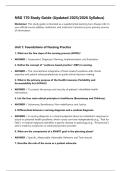
NSG 170 Study Guide (Updated 2025/2026 Syllabus)
Disclaimer: This study guide is intended as a supplemental learning tool. Always refer to
your official course syllabus, textbooks, and instructor's lectures as your primary sources
of information.
Unit 1: Foundations of Nursing Practice
1. What are the five steps of the nursing process (ADPIE)?
ANSWER ✓ Assessment, Diagnosis, Planning, Implementation, and Evaluation.
2. Define the concept of "evidence-based practice" (EBP) in nursing.
ANSWER ✓ The conscientious integration of best research evidence with clinical
expertise and patient values/preferences to guide clinical decision-making.
3. What is the primary purpose of the Health Insurance Portability and
Accountability Act (HIPAA)?
ANSWER ✓ To protect the privacy and security of patients' identifiable health
information.
4. List the four main ethical principles in healthcare (Beauchamp and Childress).
ANSWER ✓ Autonomy, Beneficence, Non-maleficence, and Justice.
5. Differentiate between a nursing diagnosis and a medical diagnosis.
ANSWER ✓ A nursing diagnosis is a clinical judgment about an individual's response to
actual or potential health problems, which nurses can treat independently (e.g., "Risk for
Falls"). A medical diagnosis identifies a specific disease or pathology (e.g., "Pneumonia")
and is made by a physician or advanced practice provider.
6. What are the components of a SMART goal in the planning phase?
ANSWER ✓ Specific, Measurable, Attainable, Relevant, and Time-bound.
7. Describe the role of the nurse as a patient advocate.
, ANSWER ✓ Protecting the patient's rights, providing information for informed consent,
and supporting the patient's wishes and decisions regarding their care, even when they
differ from the healthcare team's recommendations.
8. What is "informed consent," and who is responsible for obtaining it?
ANSWER ✓ A process where a patient is informed of the risks, benefits, and alternatives
of a procedure/treatment and voluntarily agrees to it. The provider performing the
procedure is legally responsible for obtaining consent; the nurse's role is to witness the
signature and ensure the patient appears competent and informed.
9. Define "scope of practice" for a registered nurse.
ANSWER ✓ The activities, functions, and responsibilities that an RN is educated,
competent, and legally authorized to perform, as defined by state nursing practice acts.
10. What is "delegation" in nursing, and what factors must be considered?
ANSWER ✓ The process of transferring a task to a qualified individual while retaining
accountability for the outcome. Factors include the "Five Rights of Delegation": Right
Task, Right Circumstance, Right Person, Right Direction/Communication, and Right
Supervision/Evaluation.
Unit 2: Health Assessment & Vital Signs
11. What is the normal range for adult oral temperature?
ANSWER ✓ 36°C - 38°C (96.8°F - 100.4°F), with 37°C (98.6°F) being average.
12. Define tachycardia and bradycardia.
ANSWER ✓ Tachycardia is a heart rate greater than 100 beats per minute (bpm) in an
adult. Bradycardia is a heart rate less than 60 bpm in an adult.
13. Describe Korotkoff sounds and what Phase I and Phase V indicate.
ANSWER ✓ Sounds heard during auscultatory blood pressure measurement. Phase I
(first clear tapping sound) marks systolic pressure. Phase V (disappearance of sound)
marks diastolic pressure in adults.
Disclaimer: This study guide is intended as a supplemental learning tool. Always refer to
your official course syllabus, textbooks, and instructor's lectures as your primary sources
of information.
Unit 1: Foundations of Nursing Practice
1. What are the five steps of the nursing process (ADPIE)?
ANSWER ✓ Assessment, Diagnosis, Planning, Implementation, and Evaluation.
2. Define the concept of "evidence-based practice" (EBP) in nursing.
ANSWER ✓ The conscientious integration of best research evidence with clinical
expertise and patient values/preferences to guide clinical decision-making.
3. What is the primary purpose of the Health Insurance Portability and
Accountability Act (HIPAA)?
ANSWER ✓ To protect the privacy and security of patients' identifiable health
information.
4. List the four main ethical principles in healthcare (Beauchamp and Childress).
ANSWER ✓ Autonomy, Beneficence, Non-maleficence, and Justice.
5. Differentiate between a nursing diagnosis and a medical diagnosis.
ANSWER ✓ A nursing diagnosis is a clinical judgment about an individual's response to
actual or potential health problems, which nurses can treat independently (e.g., "Risk for
Falls"). A medical diagnosis identifies a specific disease or pathology (e.g., "Pneumonia")
and is made by a physician or advanced practice provider.
6. What are the components of a SMART goal in the planning phase?
ANSWER ✓ Specific, Measurable, Attainable, Relevant, and Time-bound.
7. Describe the role of the nurse as a patient advocate.
, ANSWER ✓ Protecting the patient's rights, providing information for informed consent,
and supporting the patient's wishes and decisions regarding their care, even when they
differ from the healthcare team's recommendations.
8. What is "informed consent," and who is responsible for obtaining it?
ANSWER ✓ A process where a patient is informed of the risks, benefits, and alternatives
of a procedure/treatment and voluntarily agrees to it. The provider performing the
procedure is legally responsible for obtaining consent; the nurse's role is to witness the
signature and ensure the patient appears competent and informed.
9. Define "scope of practice" for a registered nurse.
ANSWER ✓ The activities, functions, and responsibilities that an RN is educated,
competent, and legally authorized to perform, as defined by state nursing practice acts.
10. What is "delegation" in nursing, and what factors must be considered?
ANSWER ✓ The process of transferring a task to a qualified individual while retaining
accountability for the outcome. Factors include the "Five Rights of Delegation": Right
Task, Right Circumstance, Right Person, Right Direction/Communication, and Right
Supervision/Evaluation.
Unit 2: Health Assessment & Vital Signs
11. What is the normal range for adult oral temperature?
ANSWER ✓ 36°C - 38°C (96.8°F - 100.4°F), with 37°C (98.6°F) being average.
12. Define tachycardia and bradycardia.
ANSWER ✓ Tachycardia is a heart rate greater than 100 beats per minute (bpm) in an
adult. Bradycardia is a heart rate less than 60 bpm in an adult.
13. Describe Korotkoff sounds and what Phase I and Phase V indicate.
ANSWER ✓ Sounds heard during auscultatory blood pressure measurement. Phase I
(first clear tapping sound) marks systolic pressure. Phase V (disappearance of sound)
marks diastolic pressure in adults.