Financial Services Analytics
Introduction
KBC took big steps in digitalization with Kate. Kate is a personal digital assistant.
Kate can do the work of 300 people, but that doesn’t mean they let 300 employees leave.
Employees can focus on more complex customer interactions.
What can we learn from this?
A key skill in finance and risk is that you learn to extract business value from data for financial
applications
➔ This is a very relevant and timely skill in the era of digitalisation
!!! EXAMEN !!!
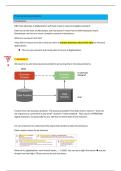
We need to try and solve business problems by turning them into data problems.
It starts from the business problem. The business problem that Kate tries to solve is: “how can
we respond our customers at any time?” Solution = Kate (chatbot). They say it’s a PERSONAL
digital assistant, so especially for you. Behind it a whole data driven solution.
It’s very important to understand the steps that transform data into decisions.
Data creates values for all divisions
Wave of AI, digitalisation, new fintech banks, … in 2020. You can try to fight the waves ➔ but you
always lose that fight. OR you can try to surf that wave.
,What changed?
Opportunity of the 21st century: Abundance of data
➔ How to extract value from all the data that is available. So how to select from all the
excess of data what information is useful
1) Change in technology
2) Change in consumer behavior
• Require personalization
• Require low costs
• Embrace digitalization
Consumers need to accept that user data is used for corporate purposes. They also have to
accept to interact with robots.
People have trust in information technology firms, because of that digital financial services can
be done
3) Change in regulation
Regulation is shifting towards more ownership rights to the customer
,Every transaction you do digital, leaves data. Who is the owner of that data? ➔ If the bank owns
that data: problem, because only the bank has your data
SOLUTION: EU directives
the revised Payment Services EU Directive (PSD2): Banks are required to provide access to
payment accounts for Third Party Providers (TPPs).
CONSEQUENCE: more competition and less power for the incumbent bank in contrast with the
challenger banks.
4) Change in competition
Traditional banks operate in payment, lending and deposits. New entrants have specialized in
one service.
(Example: Apple pay, Google Pay, …)
Traditional banks have more regional focus, while new entrants (like Revolut) operate online only
and have a more global focus.
Introduction to the course
In this course we use the program R. In R, there are many packages with useful functions for
financial data analysis.
SCT = submission correctness tests ➔ if you made a mistake, you get feedback immediately
when you send something in
, Introduction to R
You can enter codes in the script of an R file. When you select the code and press run selection,
the code will be executed.
You can create objects, calculate
In R everything is an object. An object has a name and we assign it a value using a "left arrow"
<- (less than, hyphen ➔ <- )
R has different data types:
- Logical: Boolean → TRUE OR FALSE
- Character → text, something you type between brackets
- Numeric → numbers (you can just type it without brackets)
R has different data structures:
- Vector
- Matrix
- Data frame
Selection of elements in an object:
• For one-dimensional objects we only need to indicate the position within square
bracket []
• For two-dimensional object we need to indicate the row and the column with
square bracket [,]
Conclusion of the course: Unlock value for companies, consumers, and society by surfing
multiple waves: domain specific of a financial analyst and technical skills of junior data scientist
From times series data to actionable insights
In this course we learn to use data everyone has (stock prices) and transform the data into
actionable signals useful for risk assessment and investment decisions (analysis).
You can go from ID to solution in just a few lines of codes
Examples of transformations possible:
Introduction
KBC took big steps in digitalization with Kate. Kate is a personal digital assistant.
Kate can do the work of 300 people, but that doesn’t mean they let 300 employees leave.
Employees can focus on more complex customer interactions.
What can we learn from this?
A key skill in finance and risk is that you learn to extract business value from data for financial
applications
➔ This is a very relevant and timely skill in the era of digitalisation
!!! EXAMEN !!!
We need to try and solve business problems by turning them into data problems.
It starts from the business problem. The business problem that Kate tries to solve is: “how can
we respond our customers at any time?” Solution = Kate (chatbot). They say it’s a PERSONAL
digital assistant, so especially for you. Behind it a whole data driven solution.
It’s very important to understand the steps that transform data into decisions.
Data creates values for all divisions
Wave of AI, digitalisation, new fintech banks, … in 2020. You can try to fight the waves ➔ but you
always lose that fight. OR you can try to surf that wave.
,What changed?
Opportunity of the 21st century: Abundance of data
➔ How to extract value from all the data that is available. So how to select from all the
excess of data what information is useful
1) Change in technology
2) Change in consumer behavior
• Require personalization
• Require low costs
• Embrace digitalization
Consumers need to accept that user data is used for corporate purposes. They also have to
accept to interact with robots.
People have trust in information technology firms, because of that digital financial services can
be done
3) Change in regulation
Regulation is shifting towards more ownership rights to the customer
,Every transaction you do digital, leaves data. Who is the owner of that data? ➔ If the bank owns
that data: problem, because only the bank has your data
SOLUTION: EU directives
the revised Payment Services EU Directive (PSD2): Banks are required to provide access to
payment accounts for Third Party Providers (TPPs).
CONSEQUENCE: more competition and less power for the incumbent bank in contrast with the
challenger banks.
4) Change in competition
Traditional banks operate in payment, lending and deposits. New entrants have specialized in
one service.
(Example: Apple pay, Google Pay, …)
Traditional banks have more regional focus, while new entrants (like Revolut) operate online only
and have a more global focus.
Introduction to the course
In this course we use the program R. In R, there are many packages with useful functions for
financial data analysis.
SCT = submission correctness tests ➔ if you made a mistake, you get feedback immediately
when you send something in
, Introduction to R
You can enter codes in the script of an R file. When you select the code and press run selection,
the code will be executed.
You can create objects, calculate
In R everything is an object. An object has a name and we assign it a value using a "left arrow"
<- (less than, hyphen ➔ <- )
R has different data types:
- Logical: Boolean → TRUE OR FALSE
- Character → text, something you type between brackets
- Numeric → numbers (you can just type it without brackets)
R has different data structures:
- Vector
- Matrix
- Data frame
Selection of elements in an object:
• For one-dimensional objects we only need to indicate the position within square
bracket []
• For two-dimensional object we need to indicate the row and the column with
square bracket [,]
Conclusion of the course: Unlock value for companies, consumers, and society by surfing
multiple waves: domain specific of a financial analyst and technical skills of junior data scientist
From times series data to actionable insights
In this course we learn to use data everyone has (stock prices) and transform the data into
actionable signals useful for risk assessment and investment decisions (analysis).
You can go from ID to solution in just a few lines of codes
Examples of transformations possible: