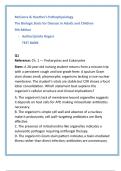
McCance & Huether’s Pathophysiology
The Biologic Basis for Disease in Adults and Children
9th Edition
• Author(s)Julia Rogers
TEST BANK
1)
Reference
Ch. 1 — Prokaryotes and Eukaryotes
Stem (2–4 sentences)
A 68-year-old man with poorly controlled type 2 diabetes
presents with a painful, erythematous foot ulcer. Wound
culture grows gram-negative bacilli that form biofilm in 48
hours. The nurse notes the pathogen reproduces quickly and
lacks membrane-bound organelles. Which cellular feature best
explains the organism’s rapid adaptation and biofilm formation?
Options
A. A nuclear membrane that enables rapid transcriptional
regulation.
B. Membrane-bound mitochondria providing robust ATP for
biofilm synthesis.
C. Single circular chromosome with plasmids facilitating
horizontal gene transfer.
,D. Endoplasmic reticulum enabling complex secretion of
extracellular polymeric substances.
Correct Answer
C
Rationales
Correct (C): Prokaryotes (gram-negative bacilli) lack membrane-
bound organelles and commonly possess a single circular
chromosome plus plasmids. Plasmids carry genes for antibiotic
resistance and biofilm-forming factors; horizontal gene transfer
(conjugation, transformation) allows rapid adaptation — a
mechanistic explanation consistent with McCance’s discussion
of prokaryotic genetics. This explains quick acquisition of
biofilm and virulence traits, and is the safest interpretation.
A (incorrect): A nuclear membrane is a eukaryotic feature; the
pathogen lacks it, so nuclear membrane–based transcriptional
regulation doesn’t apply.
B (incorrect): Mitochondria are absent in prokaryotes; energy
for biofilm synthesis comes from cytoplasmic metabolism, not
mitochondria.
D (incorrect): The endoplasmic reticulum is a eukaryotic
organelle; prokaryotes secrete via simpler mechanisms
(secretion systems), so ER-based secretion is not the
mechanism.
Teaching Point
Plasmids enable rapid prokaryotic adaptation and spread of
biofilm/antibiotic resistance genes.
,Citation (APA)
Rogers, J., et al. (2023). Pathophysiology: The Biologic Basis for
Disease in Adults and Children (9th ed.). Ch. 1.
2)
Reference
Ch. 1 — Cellular Functions
Stem
A 45-year-old woman complains of fatigue and easy bruising.
Labs: hemoglobin 9.1 g/dL, platelets 48,000/µL, neutrophils
low. Bone marrow biopsy shows hypocellularity with decreased
hematopoietic precursors. Which altered cellular function best
accounts for her pancytopenia?
Options
A. Increased cellular differentiation from stem cells into all
lineages.
B. Impaired proliferative capacity of hematopoietic stem cells
(cell cycle arrest).
C. Excessive autophagy of mature blood cells in circulation.
D. Enhanced phagocytic activity of splenic macrophages
without marrow involvement.
Correct Answer
B
Rationales
Correct (B): Pancytopenia with marrow hypocellularity points to
, impaired proliferation/differentiation of hematopoietic stem
cells — a problem in cell cycle progression or stem cell pool
(G0/G1 arrest or DNA damage checkpoint activation). McCance
links decreased proliferative capacity and cell cycle arrest to
reduced tissue cellularity and organ dysfunction; this
mechanism explains multi-lineage cytopenias.
A (incorrect): Increased differentiation would raise, not lower,
peripheral counts.
C (incorrect): Autophagy affects intracellular organelle turnover
and would not selectively cause hypocellular marrow;
peripheral destruction doesn’t explain decreased marrow
precursors.
D (incorrect): Splenic sequestration can cause cytopenias but
marrow hypocellularity demonstrates production failure rather
than peripheral destruction.
Teaching Point
Cell cycle arrest of stem cells causes marrow failure and
pancytopenia — production failure, not peripheral destruction.
Citation (APA)
Rogers, J., et al. (2023). Pathophysiology: The Biologic Basis for
Disease in Adults and Children (9th ed.). Ch. 1.
3)
The Biologic Basis for Disease in Adults and Children
9th Edition
• Author(s)Julia Rogers
TEST BANK
1)
Reference
Ch. 1 — Prokaryotes and Eukaryotes
Stem (2–4 sentences)
A 68-year-old man with poorly controlled type 2 diabetes
presents with a painful, erythematous foot ulcer. Wound
culture grows gram-negative bacilli that form biofilm in 48
hours. The nurse notes the pathogen reproduces quickly and
lacks membrane-bound organelles. Which cellular feature best
explains the organism’s rapid adaptation and biofilm formation?
Options
A. A nuclear membrane that enables rapid transcriptional
regulation.
B. Membrane-bound mitochondria providing robust ATP for
biofilm synthesis.
C. Single circular chromosome with plasmids facilitating
horizontal gene transfer.
,D. Endoplasmic reticulum enabling complex secretion of
extracellular polymeric substances.
Correct Answer
C
Rationales
Correct (C): Prokaryotes (gram-negative bacilli) lack membrane-
bound organelles and commonly possess a single circular
chromosome plus plasmids. Plasmids carry genes for antibiotic
resistance and biofilm-forming factors; horizontal gene transfer
(conjugation, transformation) allows rapid adaptation — a
mechanistic explanation consistent with McCance’s discussion
of prokaryotic genetics. This explains quick acquisition of
biofilm and virulence traits, and is the safest interpretation.
A (incorrect): A nuclear membrane is a eukaryotic feature; the
pathogen lacks it, so nuclear membrane–based transcriptional
regulation doesn’t apply.
B (incorrect): Mitochondria are absent in prokaryotes; energy
for biofilm synthesis comes from cytoplasmic metabolism, not
mitochondria.
D (incorrect): The endoplasmic reticulum is a eukaryotic
organelle; prokaryotes secrete via simpler mechanisms
(secretion systems), so ER-based secretion is not the
mechanism.
Teaching Point
Plasmids enable rapid prokaryotic adaptation and spread of
biofilm/antibiotic resistance genes.
,Citation (APA)
Rogers, J., et al. (2023). Pathophysiology: The Biologic Basis for
Disease in Adults and Children (9th ed.). Ch. 1.
2)
Reference
Ch. 1 — Cellular Functions
Stem
A 45-year-old woman complains of fatigue and easy bruising.
Labs: hemoglobin 9.1 g/dL, platelets 48,000/µL, neutrophils
low. Bone marrow biopsy shows hypocellularity with decreased
hematopoietic precursors. Which altered cellular function best
accounts for her pancytopenia?
Options
A. Increased cellular differentiation from stem cells into all
lineages.
B. Impaired proliferative capacity of hematopoietic stem cells
(cell cycle arrest).
C. Excessive autophagy of mature blood cells in circulation.
D. Enhanced phagocytic activity of splenic macrophages
without marrow involvement.
Correct Answer
B
Rationales
Correct (B): Pancytopenia with marrow hypocellularity points to
, impaired proliferation/differentiation of hematopoietic stem
cells — a problem in cell cycle progression or stem cell pool
(G0/G1 arrest or DNA damage checkpoint activation). McCance
links decreased proliferative capacity and cell cycle arrest to
reduced tissue cellularity and organ dysfunction; this
mechanism explains multi-lineage cytopenias.
A (incorrect): Increased differentiation would raise, not lower,
peripheral counts.
C (incorrect): Autophagy affects intracellular organelle turnover
and would not selectively cause hypocellular marrow;
peripheral destruction doesn’t explain decreased marrow
precursors.
D (incorrect): Splenic sequestration can cause cytopenias but
marrow hypocellularity demonstrates production failure rather
than peripheral destruction.
Teaching Point
Cell cycle arrest of stem cells causes marrow failure and
pancytopenia — production failure, not peripheral destruction.
Citation (APA)
Rogers, J., et al. (2023). Pathophysiology: The Biologic Basis for
Disease in Adults and Children (9th ed.). Ch. 1.
3)