

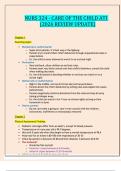
NURS 324 - CARE OF THE CHILD ATI
(2026 REVIEW UPDATE)
Chapter 1
Parenting styles:
Dictatorial or authoritarian
o Super strict parents, it’s their way or the highway
o Parents try to control their child’s behaviors through unquestioned rules or
expectations
o Ex. the child is never allowed to watch tv on a school night
Permissive
o Very laid back, allow children to set their rules
o Parents exert very little control over their child’s behaviors; consult the child
when making decisions
o Ex. the child assists in deciding whether or not they can watch tv on a
school night
Democratic or authoritative
o Right in the middle, not too strict but also not too permissive
o Parents direct the child’s behaviors by setting rules and explain the reason
behind them
o Parents negatively reinforce deviations from the rules and may do so by
taking privileges away
o Ex. the child can watch tv for 1 hour on school nights as long as their
homework is done
Passive parents
o Do not care what is going on, don’t even consult with the children.
Uninvolved, indifferent or emotionally removed
Chapter 2
Physical Assessment Findings
Pediatric vital signs differ from an adult’s, except for blood pressure.
Temperature of a one year old is 99.9 degrees
Not until 5 years old when they begin to have a normal temperature of 98.6
Pulse rate for an infant is 80-180 with respirations of 30-35
Infant bp systolic is between 65-80 and their diastolic is between 40 & 50
The fontanels*
o Should be flat and soft
o Posterior: closes between 6 & 8 weeks
o Anterior closes between 12 & 18 months
Infant can have 6-8 teeth by one year of age
There will be 20 deciduous teeth and 32 permeant teeth
, Reflexes*
o Moro reflex: present from birth to four months. Allowing the head and
trunk of the infant to fall backwards. The arms and legs symmetrically
extend and abduct, and fingers form a C shape.
o Rooting: stroking the infant’s cheek or edge of mouth causes the infant to
turn their head to that side and suck. Birth to 4 months.
o Palmar grasp: placing an object in the infant’s palm and the infant grasps the
object. Birth to 3 months.
o Plantar: by touching the sole of the infant’s foot the toes curl downward.
Birth to 8 months.
o Startle: by making a loud noise the infant abducts arms and hands remained
clenched. Birth to 4 months.
o Tonic neck: by turning the infants head to one side the infant will extend the
arm and leg on that side and flex the opposite side. Birth to 3-4 months.
o Babinski: by stroking the outer edge of the sole up toward the toes the infant
will fan its toes upward and out. Birth to 1 year.
o Stepping: by holding the infant upright with its feet touching the surface the
infant will make stepping movements. Birth to 4 weeks.
Cranial nerves
o 1 is olfactory
o 2 is optic
o 3 oculomotor
o 4 trochlear: ability of eye to look down and in
o 5 trigeminal: have child close eye and they will detect you touching their
face
o 6 abducens: the ability to look laterally with the eyes
o 7 facial: symmetry facial movements
o 8 vestibulocochlear/acoustic: checking hearing
o 9 glossopharyngeal: checking for intact gag reflex
o 10 vagus: checking for swallowing
o 11 spinal accessory: can move shoulders symmetrically
o 12 hypoglossal: tongue is midline and can move in all directions
Ooh ooh ooh to touch and feel very good velvet such heaven
Some say marry money but my brother says big brains matter most
Chapter 3
Physical Development:
Doubles by 6 months; triples by 1 year*
Downloaded by zena ahmad ()
, 2.5 cm (1 in) per month for the first 6 months
Length increases by 50% by 12 months of age
First teeth erupt between 6-10 months
Age Gross motor Fine motor
1 month Demonstrates head lag Strong grasp
2 months Lifts head up when prone Holds hands in an open
position, grasp reflex fading
3 months Raises head and shoulders No longer has a grasp
when prone, slight head lag reflex, keeps hands open
loosely.
4 months Rolls from back to side Grasps with both hands
5 months Rolls from front to back Uses palmar grasp
6 months Rolls from back to front Holds bottle
7 months Bears full weight on feet. Moves objects from hand
Sits leaning forward on to hand
both hands
8 months Sits unsupported Begins using pincer grip
9 months Pulls to standing position. Has crude pincer grip.
Creeps on hands and knees Dominant hand preference
evident
10 months Changes from prone to Grasps rattle by its hand
sitting position
11 months Cruises or walks while Places objects into a
holding on to something. container. Neat pincer
Walks with one hand held. grasp.
12 months Sits down from a standing Tries to build a two-block
position without assistance tower w/o success. Can
turn pages in a book.
Cognitive Development: Piaget
From birth to 24 months they are in the sensorimotor stage
Object permanence occurs around 9 months of age.
Language Development:
Should be able to say 3-5 words by age 1 and they know the concept of no.
Erickson:
From birth to 1 year is trust vs. mistrust.
Is the caretaker meeting the needs of the infant?
Separations anxiety occurs around 4-8 months of age
Stranger fear occurs around 6-8 months of age
Downloaded by zena ahmad ()
, Toys:
Rattles, blocks, brightly colored toys, playing patty cake, reading books, mirrors,
and playing with balls.
Immunizations:
Birth: hep B
2 months: 2nd hep B, IPV (inactivated polio), RV (rotavirus), PCV (pneumococcal),
DTaP, Hib (haemophilus influenza type B)
4 months: all of the above minus the hep B
6 months: all including hep B
Should also get flu between 6 months and 1 year
Nutrition:
Breastmilk for the first 6 months
No solids until 4 to 6 months, iron fortified rice cereal
Do not need juice or water during first year of life**
Introduce new foods one at a time over a 4 to 7 day period to observe for allergies
Never leave unattended in bathtub
Stay in rear facing cars seat until two years of age
Crib slats should be no more than 6 cm apart, keep pillows out of crib
On back to sleep*
Chapter 4:
Quadruple weight by 30 months of age
Grow 3 inches per year
Head and chest circumference should be equal around 2 years of age
Age Gross Motor Fine Motor
15 months Walks without help. Creeps Uses a cup. Builds a tower
up stairs of 2 blocks
18 months Runs clumsily, falls often, Manages a spoon. Turns
throws ball overhead, pages in a book two or
jumps in place with both three at a time, build a
feet. Pushes and pulls toys tower of 3-4 blocks
Downloaded by zena ahmad ()
(2026 REVIEW UPDATE)
Chapter 1
Parenting styles:
Dictatorial or authoritarian
o Super strict parents, it’s their way or the highway
o Parents try to control their child’s behaviors through unquestioned rules or
expectations
o Ex. the child is never allowed to watch tv on a school night
Permissive
o Very laid back, allow children to set their rules
o Parents exert very little control over their child’s behaviors; consult the child
when making decisions
o Ex. the child assists in deciding whether or not they can watch tv on a
school night
Democratic or authoritative
o Right in the middle, not too strict but also not too permissive
o Parents direct the child’s behaviors by setting rules and explain the reason
behind them
o Parents negatively reinforce deviations from the rules and may do so by
taking privileges away
o Ex. the child can watch tv for 1 hour on school nights as long as their
homework is done
Passive parents
o Do not care what is going on, don’t even consult with the children.
Uninvolved, indifferent or emotionally removed
Chapter 2
Physical Assessment Findings
Pediatric vital signs differ from an adult’s, except for blood pressure.
Temperature of a one year old is 99.9 degrees
Not until 5 years old when they begin to have a normal temperature of 98.6
Pulse rate for an infant is 80-180 with respirations of 30-35
Infant bp systolic is between 65-80 and their diastolic is between 40 & 50
The fontanels*
o Should be flat and soft
o Posterior: closes between 6 & 8 weeks
o Anterior closes between 12 & 18 months
Infant can have 6-8 teeth by one year of age
There will be 20 deciduous teeth and 32 permeant teeth
, Reflexes*
o Moro reflex: present from birth to four months. Allowing the head and
trunk of the infant to fall backwards. The arms and legs symmetrically
extend and abduct, and fingers form a C shape.
o Rooting: stroking the infant’s cheek or edge of mouth causes the infant to
turn their head to that side and suck. Birth to 4 months.
o Palmar grasp: placing an object in the infant’s palm and the infant grasps the
object. Birth to 3 months.
o Plantar: by touching the sole of the infant’s foot the toes curl downward.
Birth to 8 months.
o Startle: by making a loud noise the infant abducts arms and hands remained
clenched. Birth to 4 months.
o Tonic neck: by turning the infants head to one side the infant will extend the
arm and leg on that side and flex the opposite side. Birth to 3-4 months.
o Babinski: by stroking the outer edge of the sole up toward the toes the infant
will fan its toes upward and out. Birth to 1 year.
o Stepping: by holding the infant upright with its feet touching the surface the
infant will make stepping movements. Birth to 4 weeks.
Cranial nerves
o 1 is olfactory
o 2 is optic
o 3 oculomotor
o 4 trochlear: ability of eye to look down and in
o 5 trigeminal: have child close eye and they will detect you touching their
face
o 6 abducens: the ability to look laterally with the eyes
o 7 facial: symmetry facial movements
o 8 vestibulocochlear/acoustic: checking hearing
o 9 glossopharyngeal: checking for intact gag reflex
o 10 vagus: checking for swallowing
o 11 spinal accessory: can move shoulders symmetrically
o 12 hypoglossal: tongue is midline and can move in all directions
Ooh ooh ooh to touch and feel very good velvet such heaven
Some say marry money but my brother says big brains matter most
Chapter 3
Physical Development:
Doubles by 6 months; triples by 1 year*
Downloaded by zena ahmad ()
, 2.5 cm (1 in) per month for the first 6 months
Length increases by 50% by 12 months of age
First teeth erupt between 6-10 months
Age Gross motor Fine motor
1 month Demonstrates head lag Strong grasp
2 months Lifts head up when prone Holds hands in an open
position, grasp reflex fading
3 months Raises head and shoulders No longer has a grasp
when prone, slight head lag reflex, keeps hands open
loosely.
4 months Rolls from back to side Grasps with both hands
5 months Rolls from front to back Uses palmar grasp
6 months Rolls from back to front Holds bottle
7 months Bears full weight on feet. Moves objects from hand
Sits leaning forward on to hand
both hands
8 months Sits unsupported Begins using pincer grip
9 months Pulls to standing position. Has crude pincer grip.
Creeps on hands and knees Dominant hand preference
evident
10 months Changes from prone to Grasps rattle by its hand
sitting position
11 months Cruises or walks while Places objects into a
holding on to something. container. Neat pincer
Walks with one hand held. grasp.
12 months Sits down from a standing Tries to build a two-block
position without assistance tower w/o success. Can
turn pages in a book.
Cognitive Development: Piaget
From birth to 24 months they are in the sensorimotor stage
Object permanence occurs around 9 months of age.
Language Development:
Should be able to say 3-5 words by age 1 and they know the concept of no.
Erickson:
From birth to 1 year is trust vs. mistrust.
Is the caretaker meeting the needs of the infant?
Separations anxiety occurs around 4-8 months of age
Stranger fear occurs around 6-8 months of age
Downloaded by zena ahmad ()
, Toys:
Rattles, blocks, brightly colored toys, playing patty cake, reading books, mirrors,
and playing with balls.
Immunizations:
Birth: hep B
2 months: 2nd hep B, IPV (inactivated polio), RV (rotavirus), PCV (pneumococcal),
DTaP, Hib (haemophilus influenza type B)
4 months: all of the above minus the hep B
6 months: all including hep B
Should also get flu between 6 months and 1 year
Nutrition:
Breastmilk for the first 6 months
No solids until 4 to 6 months, iron fortified rice cereal
Do not need juice or water during first year of life**
Introduce new foods one at a time over a 4 to 7 day period to observe for allergies
Never leave unattended in bathtub
Stay in rear facing cars seat until two years of age
Crib slats should be no more than 6 cm apart, keep pillows out of crib
On back to sleep*
Chapter 4:
Quadruple weight by 30 months of age
Grow 3 inches per year
Head and chest circumference should be equal around 2 years of age
Age Gross Motor Fine Motor
15 months Walks without help. Creeps Uses a cup. Builds a tower
up stairs of 2 blocks
18 months Runs clumsily, falls often, Manages a spoon. Turns
throws ball overhead, pages in a book two or
jumps in place with both three at a time, build a
feet. Pushes and pulls toys tower of 3-4 blocks
Downloaded by zena ahmad ()


