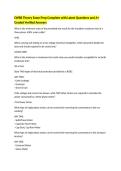
(NEWEST 2026-2027) QKA-1 EXAM QUESTIONS
AND ALL ANSWERS VERIFIED
Which of the following best sums up how Roth contributions to a 401(k) plan
are taxed?
1) The profits and donations are taxable in the year they were made.
2) If certain requirements are met, the earnings may be subject to a tax fee, and
the donation is taxable in the year it is made.
3) The profits are subject to annual taxes at the time of earning.
4) The donations are taxed in the year of distribution and deductible in the year
of contribution. ANSWER 2) Contributions to a Roth are taxed in the year they
are made and tax-free upon distribution. If the five-year holding period has
passed and the distribution is due to death, disability, or reaching the age of
59.5, the earnings may be distributed tax-free.
Which of the following describes a method of making after-tax contributions to
a plan in addition to payroll deduction?
1) Using a cheque or other personal payment.
2) No other approach is appropriate.
3) By choosing to have the employer make an after-tax match contribution.
4) Redefining a loan that has fallen into default. - ANSWER 1) After-tax
contributions can be made to the plan either personally or through payroll
withholding.
Determine the participant's maximum elective deferral in 2020 based on the
following information:
The plan is a calendar-year 401(k) that permits the maximum amount to be
deferred.
The participant is 35 years old, and they will receive $50,000 in compensation.
-Elective deferrals are the only contribution in 2020; the answer is $19,500. In
2020, the deferral cap is $19,500. Up to 100% of compensation or the lesser of
that sum may be deferred by participants. Only participants who have reached
, the age of 50 are eligible to make catch-up payments.
Which of the following describes the timeframe for adding deferrals to a plan
with 150 participants once they are withheld?
1) As soon as it is administratively possible
2) Seven working days
3) Twenty-five business days
4) By the quarter's end—ANSWER 1) Deferrals must be deposited as soon as it
is administratively possible, but no later than 15 days following the withheld
month. Plans with fewer than 100 participants are eligible for a safe harbour for
seven working days following the withholding of the payments.
Determine the participant's maximum elective deferral in 2020 based on the
following data:
-The plan is a calendar-year 401(k) that permits catch-up contributions and the
maximum deferral amount.
The participant is 55 years old; their compensation is $100,000; their response
is $26,000. The maximum optional deferral is equal to 100% of pay or $19,500,
whichever is lower. An additional $6,500 in catch-up payments may be made by
those over 50.
Which of the following claims about employer nonelective contributions being
cross-tested is true?
1) Only when a plan isn't top-heavy can a cross-tested allocation be applied.
2) Younger workers may receive a greater allocation than older workers with
the same income under a cross-tested allocation.
3) Employees must be divided into age-based groups in order to conduct cross-
testing.
4) A cross-tested allocation is not a safe harbour allocation method that is based
on design. - REPLY 4) A designed-based safe harbour allocation is not a cross-
tested allocation approach. To prove that allocations do not favour HCEs,
nondiscrimination testing must be carried out annually.
The calendar-year 401(k) plan offered by Beta, Inc. allows for a discretionary
employer nonelective contribution. A approved discrepancy approach that
complies with the design-based safe harbour is used to distribute the nonelective
contribution. Calculate the 2020 allotment to Participant A:
-TWB is $137,700 for 2020.
-The integration level is $1 plus 80% of the TWB for 2020.
-The employer has chosen to contribute a $100,000 nonelective contribution for
2020.
-The total remuneration is $570,000; participant A's compensation is $250,000.
- REPLY
AND ALL ANSWERS VERIFIED
Which of the following best sums up how Roth contributions to a 401(k) plan
are taxed?
1) The profits and donations are taxable in the year they were made.
2) If certain requirements are met, the earnings may be subject to a tax fee, and
the donation is taxable in the year it is made.
3) The profits are subject to annual taxes at the time of earning.
4) The donations are taxed in the year of distribution and deductible in the year
of contribution. ANSWER 2) Contributions to a Roth are taxed in the year they
are made and tax-free upon distribution. If the five-year holding period has
passed and the distribution is due to death, disability, or reaching the age of
59.5, the earnings may be distributed tax-free.
Which of the following describes a method of making after-tax contributions to
a plan in addition to payroll deduction?
1) Using a cheque or other personal payment.
2) No other approach is appropriate.
3) By choosing to have the employer make an after-tax match contribution.
4) Redefining a loan that has fallen into default. - ANSWER 1) After-tax
contributions can be made to the plan either personally or through payroll
withholding.
Determine the participant's maximum elective deferral in 2020 based on the
following information:
The plan is a calendar-year 401(k) that permits the maximum amount to be
deferred.
The participant is 35 years old, and they will receive $50,000 in compensation.
-Elective deferrals are the only contribution in 2020; the answer is $19,500. In
2020, the deferral cap is $19,500. Up to 100% of compensation or the lesser of
that sum may be deferred by participants. Only participants who have reached
, the age of 50 are eligible to make catch-up payments.
Which of the following describes the timeframe for adding deferrals to a plan
with 150 participants once they are withheld?
1) As soon as it is administratively possible
2) Seven working days
3) Twenty-five business days
4) By the quarter's end—ANSWER 1) Deferrals must be deposited as soon as it
is administratively possible, but no later than 15 days following the withheld
month. Plans with fewer than 100 participants are eligible for a safe harbour for
seven working days following the withholding of the payments.
Determine the participant's maximum elective deferral in 2020 based on the
following data:
-The plan is a calendar-year 401(k) that permits catch-up contributions and the
maximum deferral amount.
The participant is 55 years old; their compensation is $100,000; their response
is $26,000. The maximum optional deferral is equal to 100% of pay or $19,500,
whichever is lower. An additional $6,500 in catch-up payments may be made by
those over 50.
Which of the following claims about employer nonelective contributions being
cross-tested is true?
1) Only when a plan isn't top-heavy can a cross-tested allocation be applied.
2) Younger workers may receive a greater allocation than older workers with
the same income under a cross-tested allocation.
3) Employees must be divided into age-based groups in order to conduct cross-
testing.
4) A cross-tested allocation is not a safe harbour allocation method that is based
on design. - REPLY 4) A designed-based safe harbour allocation is not a cross-
tested allocation approach. To prove that allocations do not favour HCEs,
nondiscrimination testing must be carried out annually.
The calendar-year 401(k) plan offered by Beta, Inc. allows for a discretionary
employer nonelective contribution. A approved discrepancy approach that
complies with the design-based safe harbour is used to distribute the nonelective
contribution. Calculate the 2020 allotment to Participant A:
-TWB is $137,700 for 2020.
-The integration level is $1 plus 80% of the TWB for 2020.
-The employer has chosen to contribute a $100,000 nonelective contribution for
2020.
-The total remuneration is $570,000; participant A's compensation is $250,000.
- REPLY