BIOM 570 Module 2 Questions & Answers 100%
Verified (Grade A+)
Save
Terms in this set (77)
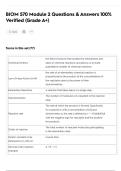
the field of science that studies the mechanisms and
Chemical Kinetics rates of chemical reactions, and allows us to build
quantitative models of chemical reactions.
the rate of an elementary chemical reaction is
proportional to the product of the concentrations of
Law of Mass Action (LMA)
the reactants raise to the power of their
stoichiometries.
Elementary Reactions A reaction that takes place in a single step.
The number of molecules of a reactant in the reaction
Stoichiometries
step.
The rate at which the product is formed. Specifically
for a species A with a concentration of [A] and
Reaction rate stoichiometry a, the rate is defined as r = +-(1/a)d[A]/dt
with the negative sign for reactants and the positive
for products.
The total number of reactant molecules participating
Order of reaction
in the elementary step.
Kinetic constant k has inverse time
dimensions or units of...
Second order reaction A + B --> C
example
, What is the order of this 4
reaction? A + 2B + C --> D
Equilibrium (or steady- When rates of change of concentrations become zero
state)
If k is the kinetic rate Never, because these are 2 different types of
constant of a 1st order reactions so the dimensions for k are different.
reaction A-->B, and k1 is
the kinetic rate constant of
a second order reaction A
+ C --> D, under what
conditions is k1 = k?
If k is the kinetic rate Yes, because the reaction rates have the same units.
constant of a 1st order
reaction A-->B, and k1 is
the kinetic rate constant of
a second order reaction A
+ C --> D, can the reaction
rate of the first reaction
ever be equal to the
reaction rate of the
second reaction?
In a chemical reaction the mass of the reactants is
Mass conservation
always equal to the mass of the products.
1/k - the time it takes for the concentration of A to
Half-life/time constant
drop to 1/3 the initial
The half life of Radon 222 Infinite
is the time taken for a full
chamber of it to decay to
1/2 the initial
concentration and is only
3.8 days. What is the time
taken for Radon 222 in this
chamber to decay exactly
to zero?
Verified (Grade A+)
Save
Terms in this set (77)
the field of science that studies the mechanisms and
Chemical Kinetics rates of chemical reactions, and allows us to build
quantitative models of chemical reactions.
the rate of an elementary chemical reaction is
proportional to the product of the concentrations of
Law of Mass Action (LMA)
the reactants raise to the power of their
stoichiometries.
Elementary Reactions A reaction that takes place in a single step.
The number of molecules of a reactant in the reaction
Stoichiometries
step.
The rate at which the product is formed. Specifically
for a species A with a concentration of [A] and
Reaction rate stoichiometry a, the rate is defined as r = +-(1/a)d[A]/dt
with the negative sign for reactants and the positive
for products.
The total number of reactant molecules participating
Order of reaction
in the elementary step.
Kinetic constant k has inverse time
dimensions or units of...
Second order reaction A + B --> C
example
, What is the order of this 4
reaction? A + 2B + C --> D
Equilibrium (or steady- When rates of change of concentrations become zero
state)
If k is the kinetic rate Never, because these are 2 different types of
constant of a 1st order reactions so the dimensions for k are different.
reaction A-->B, and k1 is
the kinetic rate constant of
a second order reaction A
+ C --> D, under what
conditions is k1 = k?
If k is the kinetic rate Yes, because the reaction rates have the same units.
constant of a 1st order
reaction A-->B, and k1 is
the kinetic rate constant of
a second order reaction A
+ C --> D, can the reaction
rate of the first reaction
ever be equal to the
reaction rate of the
second reaction?
In a chemical reaction the mass of the reactants is
Mass conservation
always equal to the mass of the products.
1/k - the time it takes for the concentration of A to
Half-life/time constant
drop to 1/3 the initial
The half life of Radon 222 Infinite
is the time taken for a full
chamber of it to decay to
1/2 the initial
concentration and is only
3.8 days. What is the time
taken for Radon 222 in this
chamber to decay exactly
to zero?