BLP WS 8/9
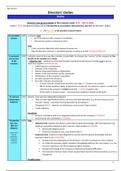
Directors’ Duties
Duties
Directors owe general duties to the company under s170 – 182 CA 2006.
Under 170(4), the general duties will be interpreted in accordance with previous case law on directors’ duties.
For step four of the question structure below
To act within s171 A director must:
powers Act in accordance with company’s constitution
Only exercise powers conferred on them
Test:
Courts ascertain objectively what purpose of power was
Was this directors’ primary or substantial purpose in acting as he did? (Howard Smith Ltd)
To promote s172 A director must act in a way they consider, in good faith, to promote the “success” of the company for the
the success benefit of the members as a whole
of the = subjective test – whether he at the time thought it would promote the success (thus hard to prove)
company Must have regard to: (s172(1)(a)-(f))
Likely long-term consequences
Interests of the employees
Need to foster good business relationships
Impact on the environment and the community
Maintenance of the company’s reputation
Act fairly between the members
Any other relevant circumstances
In board minutes, should show that they have taken s172 factors into account.
NB: in certain situations (likely to become/are insolvent), the directors need to consider the
interests of the company’s creditors primarily – s172(3) recognises this.
At this point, to preserve assets – excessive loans would be in breach at this point.
To exercise s173 Director must exercise independent judgment
independent o They can take legal/financial advice, but must not fetter discretion. E.g. do not contract out the
judgment decision making – may fetter/restrain discretion by not doing so.
o Delegation (MA5) – allowed, but allowing too much power? Must monitor .
o Undue influence
Exceptions:
Acting in accordance with an arrangement entered into by the company (s173(2)(a))
Authorised by the constitution (s173(2)(b))
To exercise s174 Test:
due care, Objective limb: whether the director acted with the general knowledge, skill and experience that
skill and might be reasonably expected of such a person in their position (s174(2)(b))
diligence Reasonably diligent person
Assess each
Minimum standard of care, even if don’t have it
director Subjective limb: whether D acted diligently by a person with D’s general knowledge, skill and
separately – experience that he has (s174(2)(b))
may have
different Standard will vary depending on the directors’ role and circumstances of the company
outcomes So, if director possesses higher standard of knowledge/skill than the role requires, e.g. has
20 years’ experience, he will be judged at higher standard
Standard will change if the company is experiencing financial difficulties
Non-executive directors have a lower standard than someone who has worked as a D for a
long period
Possible issues:
1
, BLP WS 8/9
o Delegation: this does not allow a D to escape liability, must exercise powers of supervision
adequately and this depends on facts – Re Barings plc
o Inactive Director: director who is totally inactive will be in breach of this duty and may be may be
liable for other Ds’ wrongdoing due to inactivity – Lexis Holdings
o Service Contract: does director have employment contract? Has he breached a term of that?
Consider any breach of a term of this.
To avoid s175 s175(1): Director must avoid a situation in which he has or risks having a direct/indirect conflict of
conflicts of interest. Indirect conflict or even possible conflict can trigger duty – very wide
interest s175(2): In particular, must not make a profit from being director (immaterial whether company could
have taken advantage of the opportunity) unless company authorised
Exceptions - duty is not breached where:
s175(3): the interest is created by a contract between the company and director – see s177 and
s182 instead)
s175(4)(b): the board authorised the matter giving rise to the conflict (but s175(5) and (6) –
separate procedure and what steps should follow):
Check articles that it isn’t barred: subsection 5
Director in question cannot be counted in quorum: subsection 6
s175(4)(a): the situation cannot reasonably be regarded as giving rise to a conflict
Examples of corporate opportunities:
Director obtains info about new business opportunity by means of having been a director, then uses info to
own personal advantage by entering into contract in new name = breach.
D invests after a company decides not to.
Must account to company for the profits made and pay back because they obtained the
opportunity to invest only because they were D’s (Regal Hastings)
D resigns and then takes up the opportunity.
Liable for breach of this duty and must account to any profits made (Cooley)
Time is a factor; if the resignation was long before, then there is likely no breach (Island Expert)
D sets up a competing company.
If a D poaches a company’s clients, they have exploited opportunities that rightly belonged to the
company.
Must account for profits made (CMS Dolphin)
Not to s176 If benefits given to you because you are a director, or for doing/not doing anything as a director, then you
accept must not accept (s176(1))
benefits
from third Exception:
parties s176(4): This duty is not infringed if acceptance of the benefit cannot reasonably be regarded as
likely to give rise to conflict of interest.
However, corporate hospitality is generally allowed (although facts – excessive: when out
of ordinary) – although question under Bribery Act 2010 that it may be potentially
problem
Articles can allow acceptance of such benefit
To declare s177 If a director of a company is in any way, directly or indirectly, interested in a proposed transaction or
interest in arrangement with the company, he must declare the nature and extent of that interest to the other
proposed directors.
transaction
or Exceptions:
arrangemen s 177(5) does not require a director to declare his interest when that director is not aware of the
t interest or the transaction or arrangement in question – but he’s assumed to know what he ought
to know – constructive notice.
s 177(6) does not require the declaration of an interest which…
(6)(a) cannot reasonably be regarded as likely to give rise of a conflict,
(6)(b) of which the directors are already aware or ought to be reasonably aware,
(6)(c) or if it involves the director’s service contract the terms of which have been or will be
2
Directors’ Duties
Duties
Directors owe general duties to the company under s170 – 182 CA 2006.
Under 170(4), the general duties will be interpreted in accordance with previous case law on directors’ duties.
For step four of the question structure below
To act within s171 A director must:
powers Act in accordance with company’s constitution
Only exercise powers conferred on them
Test:
Courts ascertain objectively what purpose of power was
Was this directors’ primary or substantial purpose in acting as he did? (Howard Smith Ltd)
To promote s172 A director must act in a way they consider, in good faith, to promote the “success” of the company for the
the success benefit of the members as a whole
of the = subjective test – whether he at the time thought it would promote the success (thus hard to prove)
company Must have regard to: (s172(1)(a)-(f))
Likely long-term consequences
Interests of the employees
Need to foster good business relationships
Impact on the environment and the community
Maintenance of the company’s reputation
Act fairly between the members
Any other relevant circumstances
In board minutes, should show that they have taken s172 factors into account.
NB: in certain situations (likely to become/are insolvent), the directors need to consider the
interests of the company’s creditors primarily – s172(3) recognises this.
At this point, to preserve assets – excessive loans would be in breach at this point.
To exercise s173 Director must exercise independent judgment
independent o They can take legal/financial advice, but must not fetter discretion. E.g. do not contract out the
judgment decision making – may fetter/restrain discretion by not doing so.
o Delegation (MA5) – allowed, but allowing too much power? Must monitor .
o Undue influence
Exceptions:
Acting in accordance with an arrangement entered into by the company (s173(2)(a))
Authorised by the constitution (s173(2)(b))
To exercise s174 Test:
due care, Objective limb: whether the director acted with the general knowledge, skill and experience that
skill and might be reasonably expected of such a person in their position (s174(2)(b))
diligence Reasonably diligent person
Assess each
Minimum standard of care, even if don’t have it
director Subjective limb: whether D acted diligently by a person with D’s general knowledge, skill and
separately – experience that he has (s174(2)(b))
may have
different Standard will vary depending on the directors’ role and circumstances of the company
outcomes So, if director possesses higher standard of knowledge/skill than the role requires, e.g. has
20 years’ experience, he will be judged at higher standard
Standard will change if the company is experiencing financial difficulties
Non-executive directors have a lower standard than someone who has worked as a D for a
long period
Possible issues:
1
, BLP WS 8/9
o Delegation: this does not allow a D to escape liability, must exercise powers of supervision
adequately and this depends on facts – Re Barings plc
o Inactive Director: director who is totally inactive will be in breach of this duty and may be may be
liable for other Ds’ wrongdoing due to inactivity – Lexis Holdings
o Service Contract: does director have employment contract? Has he breached a term of that?
Consider any breach of a term of this.
To avoid s175 s175(1): Director must avoid a situation in which he has or risks having a direct/indirect conflict of
conflicts of interest. Indirect conflict or even possible conflict can trigger duty – very wide
interest s175(2): In particular, must not make a profit from being director (immaterial whether company could
have taken advantage of the opportunity) unless company authorised
Exceptions - duty is not breached where:
s175(3): the interest is created by a contract between the company and director – see s177 and
s182 instead)
s175(4)(b): the board authorised the matter giving rise to the conflict (but s175(5) and (6) –
separate procedure and what steps should follow):
Check articles that it isn’t barred: subsection 5
Director in question cannot be counted in quorum: subsection 6
s175(4)(a): the situation cannot reasonably be regarded as giving rise to a conflict
Examples of corporate opportunities:
Director obtains info about new business opportunity by means of having been a director, then uses info to
own personal advantage by entering into contract in new name = breach.
D invests after a company decides not to.
Must account to company for the profits made and pay back because they obtained the
opportunity to invest only because they were D’s (Regal Hastings)
D resigns and then takes up the opportunity.
Liable for breach of this duty and must account to any profits made (Cooley)
Time is a factor; if the resignation was long before, then there is likely no breach (Island Expert)
D sets up a competing company.
If a D poaches a company’s clients, they have exploited opportunities that rightly belonged to the
company.
Must account for profits made (CMS Dolphin)
Not to s176 If benefits given to you because you are a director, or for doing/not doing anything as a director, then you
accept must not accept (s176(1))
benefits
from third Exception:
parties s176(4): This duty is not infringed if acceptance of the benefit cannot reasonably be regarded as
likely to give rise to conflict of interest.
However, corporate hospitality is generally allowed (although facts – excessive: when out
of ordinary) – although question under Bribery Act 2010 that it may be potentially
problem
Articles can allow acceptance of such benefit
To declare s177 If a director of a company is in any way, directly or indirectly, interested in a proposed transaction or
interest in arrangement with the company, he must declare the nature and extent of that interest to the other
proposed directors.
transaction
or Exceptions:
arrangemen s 177(5) does not require a director to declare his interest when that director is not aware of the
t interest or the transaction or arrangement in question – but he’s assumed to know what he ought
to know – constructive notice.
s 177(6) does not require the declaration of an interest which…
(6)(a) cannot reasonably be regarded as likely to give rise of a conflict,
(6)(b) of which the directors are already aware or ought to be reasonably aware,
(6)(c) or if it involves the director’s service contract the terms of which have been or will be
2