

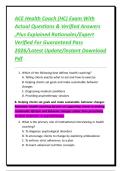
ACE Health Coach (HC) Exam With
Actual Questions & Verified Answers
,Plus Explained Rationales/Expert
Verified For Guaranteed Pass
2026/Latest Update/Instant Download
Pdf
1. Which of the following best defines health coaching?
A. Telling clients exactly what to eat and how to exercise
B. Helping clients set goals and make sustainable behavior
changes
C. Diagnosing medical conditions
D. Providing psychotherapy sessions
B. Helping clients set goals and make sustainable behavior changes
Rationale: Health coaching focuses on supporting clients in making
sustainable lifestyle and behavior changes rather than prescribing
medical treatment or psychotherapy.
2. What is the primary role of motivational interviewing in health
coaching?
A. To diagnose psychological disorders
B. To encourage clients to change by exploring ambivalence
C. To enforce strict adherence to a plan
D. To teach advanced nutrition concepts
,B. To encourage clients to change by exploring ambivalence
Rationale: Motivational interviewing is a client-centered approach
used to explore ambivalence and elicit intrinsic motivation for
behavior change.
3. Which model is commonly used to assess a client’s readiness
for behavior change?
A. Transtheoretical Model
B. Health Belief Model
C. Social Cognitive Theory
D. Theory of Planned Behavior
A. Transtheoretical Model
Rationale: The Transtheoretical Model (TTM) outlines stages of
change, helping coaches tailor interventions based on a client’s
readiness.
4. Which of the following is an example of a SMART goal?
A. Exercise more
B. Lose weight
C. Walk 30 minutes, 5 days per week for 8 weeks
D. Eat healthier
C. Walk 30 minutes, 5 days per week for 8 weeks
Rationale: SMART goals are Specific, Measurable, Achievable,
Relevant, and Time-bound, like walking 30 minutes per day 5 days
per week.
5. In health coaching, “self-efficacy” refers to:
A. A client’s belief in their ability to succeed
B. The coach’s ability to motivate clients
C. The number of goals a client achieves
D. A client’s physical fitness level
,A. A client’s belief in their ability to succeed
Rationale: Self-efficacy is a key predictor of behavior change,
reflecting the client’s confidence in their ability to take action.
6. Which of the following strategies is most effective for
maintaining behavior change?
A. Providing ongoing support and accountability
B. Using fear-based messaging
C. Setting overly ambitious goals
D. Punishing non-compliance
A. Providing ongoing support and accountability
Rationale: Continuous support, reinforcement, and accountability
help clients maintain new habits over time.
7. Which communication technique is most important for building
rapport with clients?
A. Active listening
B. Lecturing
C. Interrupting to provide advice
D. Using medical jargon
A. Active listening
Rationale: Active listening fosters trust, understanding, and a
strong coach-client relationship, essential for effective behavior
change.
8. Which of the following reflects intrinsic motivation?
A. Exercising to impress others
B. Eating healthy to feel more energetic
C. Following a program because of a friend’s pressure
D. Losing weight to avoid punishment
, B. Eating healthy to feel more energetic
Rationale: Intrinsic motivation comes from personal values or
enjoyment, rather than external rewards or pressures.
9. What is the primary purpose of a health assessment?
A. To create a medical diagnosis
B. To identify a client’s current health behaviors and readiness
to change
C. To replace a physical examination
D. To determine exact caloric needs
B. To identify a client’s current health behaviors and readiness to
change
Rationale: Health assessments provide baseline information and
help coaches design personalized behavior-change strategies.
10. Which principle emphasizes small, gradual changes over
time?
A. Behavior substitution
B. Shaping
C. Punishment
D. Extinction
B. Shaping
Rationale: Shaping involves reinforcing small steps toward a larger
behavior goal, increasing the likelihood of sustained change.
11. Which of the following is a key component of motivational
interviewing?
A. Confrontation
B. Open-ended questions
C. Providing long lectures
D. Ignoring client ambivalence
Actual Questions & Verified Answers
,Plus Explained Rationales/Expert
Verified For Guaranteed Pass
2026/Latest Update/Instant Download
1. Which of the following best defines health coaching?
A. Telling clients exactly what to eat and how to exercise
B. Helping clients set goals and make sustainable behavior
changes
C. Diagnosing medical conditions
D. Providing psychotherapy sessions
B. Helping clients set goals and make sustainable behavior changes
Rationale: Health coaching focuses on supporting clients in making
sustainable lifestyle and behavior changes rather than prescribing
medical treatment or psychotherapy.
2. What is the primary role of motivational interviewing in health
coaching?
A. To diagnose psychological disorders
B. To encourage clients to change by exploring ambivalence
C. To enforce strict adherence to a plan
D. To teach advanced nutrition concepts
,B. To encourage clients to change by exploring ambivalence
Rationale: Motivational interviewing is a client-centered approach
used to explore ambivalence and elicit intrinsic motivation for
behavior change.
3. Which model is commonly used to assess a client’s readiness
for behavior change?
A. Transtheoretical Model
B. Health Belief Model
C. Social Cognitive Theory
D. Theory of Planned Behavior
A. Transtheoretical Model
Rationale: The Transtheoretical Model (TTM) outlines stages of
change, helping coaches tailor interventions based on a client’s
readiness.
4. Which of the following is an example of a SMART goal?
A. Exercise more
B. Lose weight
C. Walk 30 minutes, 5 days per week for 8 weeks
D. Eat healthier
C. Walk 30 minutes, 5 days per week for 8 weeks
Rationale: SMART goals are Specific, Measurable, Achievable,
Relevant, and Time-bound, like walking 30 minutes per day 5 days
per week.
5. In health coaching, “self-efficacy” refers to:
A. A client’s belief in their ability to succeed
B. The coach’s ability to motivate clients
C. The number of goals a client achieves
D. A client’s physical fitness level
,A. A client’s belief in their ability to succeed
Rationale: Self-efficacy is a key predictor of behavior change,
reflecting the client’s confidence in their ability to take action.
6. Which of the following strategies is most effective for
maintaining behavior change?
A. Providing ongoing support and accountability
B. Using fear-based messaging
C. Setting overly ambitious goals
D. Punishing non-compliance
A. Providing ongoing support and accountability
Rationale: Continuous support, reinforcement, and accountability
help clients maintain new habits over time.
7. Which communication technique is most important for building
rapport with clients?
A. Active listening
B. Lecturing
C. Interrupting to provide advice
D. Using medical jargon
A. Active listening
Rationale: Active listening fosters trust, understanding, and a
strong coach-client relationship, essential for effective behavior
change.
8. Which of the following reflects intrinsic motivation?
A. Exercising to impress others
B. Eating healthy to feel more energetic
C. Following a program because of a friend’s pressure
D. Losing weight to avoid punishment
, B. Eating healthy to feel more energetic
Rationale: Intrinsic motivation comes from personal values or
enjoyment, rather than external rewards or pressures.
9. What is the primary purpose of a health assessment?
A. To create a medical diagnosis
B. To identify a client’s current health behaviors and readiness
to change
C. To replace a physical examination
D. To determine exact caloric needs
B. To identify a client’s current health behaviors and readiness to
change
Rationale: Health assessments provide baseline information and
help coaches design personalized behavior-change strategies.
10. Which principle emphasizes small, gradual changes over
time?
A. Behavior substitution
B. Shaping
C. Punishment
D. Extinction
B. Shaping
Rationale: Shaping involves reinforcing small steps toward a larger
behavior goal, increasing the likelihood of sustained change.
11. Which of the following is a key component of motivational
interviewing?
A. Confrontation
B. Open-ended questions
C. Providing long lectures
D. Ignoring client ambivalence


