
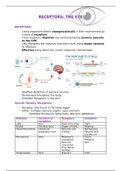
RECEPTORS: THE EYE
RECEPTORS:
- Living organisms detect changes(stimuli) in their environment by
means of receptors
- From receptors, impulses are conducted along sensory neurons
to the CNS
- CNS interprets the impulses and then travel along motor neurons
to effectors.
- Effectors bring about the correct response: Homeostasis
General Receptors:
- Modified dendrites of sensory neurons
- Distributed throughout the body
- Example: Receptors in the skin
Special Sensory Receptors:
- Receptor cells found in the head region
- Either: Complex sensory organs: eyes and ears
Epithelial structures: taste buds, olfactory epithelium
Stimulus Location of Receptors Sensation
receptors
Light Eye Rods and cones Sight
Sound Cochlea (ear) Organ of Corti Hearing
Head Movements Vestibular Maculae and Maintaining
apparatus (ear) Cristae balance and
equilibrium
Mechanical Skin Meissner’s Touch
corpuscles Pressure
Pacinian Pain
corpuscles
Free nerve
endings
Temperature Skin Krause’s Cold
, corpuscles Heat
Ruffini’s
corpuscles
Chemicals Nose Olfactory cells Smell
Chemicals Tongue Taste cells in Taste
papillae
HUMAN EYE
LOCATION
- Eyeball fits into a bony socket, anteriorly in the cranium
- Held in position by 6 external muscles: Control eye movement
- Posteriorly fatty tissue cushions it
Eyelashes and eyelids
Glands of Meiboom
EXTERNAL EYE FEAUTURES
- Eyelids and eyelashes:
Protect the eye from dust, too much light and foreign bodies
- Tear duct:
Drains excess fluid into nasal cavity
- Lachrymal Gland:
Produces salty tears which wash away dust(1) and keep conjunctiva
moist(2)
- Glands of Meiboom:
Secrete oily fluid to lubricate the eyeball
INTERNAL EYE FEAUTURES
, LAYERS OF THE WALL OF THE EYE
1.OUTER FIBROUS COAT
Parts Structure Functions
Conjuncti Delicate mucous membrane 1. Its has pain receptors that
va that covers the front of the reflexively cause the eyelids
eye and lines the eyelids. to close preventing foreign
bodies from entering.
2. Produces lubricating mucus
that prevents the eyes from
drying out.
Sclera Tough white inelastic layer, 1. Protects internal parts of the
made up of connective eye.
tissue and covers the 2. Provides points of attachment
posterior 5/6 of the eyeball. for the 6 extrinsic eye
muscles.
3. Inelastic: Helps maintain the
shape of the eye.
Cornea Continuation of the sclera 1. Transparent: Allows light rays
and occupies the front 1/6 to pass through to the light-
of the eyeball. sensitive cells.
More convex than the rest 2. Causes converging refraction
of the eyeball. pf these light rays. GREATEST
Transparent: no blood REFRACTION
vessels. 3. Conjunctiva has many pain
Covered by the conjunctiva. receptors which enables the
eyelids to close reflexively
when foreign matter touches
the eye surface.
RECEPTORS:
- Living organisms detect changes(stimuli) in their environment by
means of receptors
- From receptors, impulses are conducted along sensory neurons
to the CNS
- CNS interprets the impulses and then travel along motor neurons
to effectors.
- Effectors bring about the correct response: Homeostasis
General Receptors:
- Modified dendrites of sensory neurons
- Distributed throughout the body
- Example: Receptors in the skin
Special Sensory Receptors:
- Receptor cells found in the head region
- Either: Complex sensory organs: eyes and ears
Epithelial structures: taste buds, olfactory epithelium
Stimulus Location of Receptors Sensation
receptors
Light Eye Rods and cones Sight
Sound Cochlea (ear) Organ of Corti Hearing
Head Movements Vestibular Maculae and Maintaining
apparatus (ear) Cristae balance and
equilibrium
Mechanical Skin Meissner’s Touch
corpuscles Pressure
Pacinian Pain
corpuscles
Free nerve
endings
Temperature Skin Krause’s Cold
, corpuscles Heat
Ruffini’s
corpuscles
Chemicals Nose Olfactory cells Smell
Chemicals Tongue Taste cells in Taste
papillae
HUMAN EYE
LOCATION
- Eyeball fits into a bony socket, anteriorly in the cranium
- Held in position by 6 external muscles: Control eye movement
- Posteriorly fatty tissue cushions it
Eyelashes and eyelids
Glands of Meiboom
EXTERNAL EYE FEAUTURES
- Eyelids and eyelashes:
Protect the eye from dust, too much light and foreign bodies
- Tear duct:
Drains excess fluid into nasal cavity
- Lachrymal Gland:
Produces salty tears which wash away dust(1) and keep conjunctiva
moist(2)
- Glands of Meiboom:
Secrete oily fluid to lubricate the eyeball
INTERNAL EYE FEAUTURES
, LAYERS OF THE WALL OF THE EYE
1.OUTER FIBROUS COAT
Parts Structure Functions
Conjuncti Delicate mucous membrane 1. Its has pain receptors that
va that covers the front of the reflexively cause the eyelids
eye and lines the eyelids. to close preventing foreign
bodies from entering.
2. Produces lubricating mucus
that prevents the eyes from
drying out.
Sclera Tough white inelastic layer, 1. Protects internal parts of the
made up of connective eye.
tissue and covers the 2. Provides points of attachment
posterior 5/6 of the eyeball. for the 6 extrinsic eye
muscles.
3. Inelastic: Helps maintain the
shape of the eye.
Cornea Continuation of the sclera 1. Transparent: Allows light rays
and occupies the front 1/6 to pass through to the light-
of the eyeball. sensitive cells.
More convex than the rest 2. Causes converging refraction
of the eyeball. pf these light rays. GREATEST
Transparent: no blood REFRACTION
vessels. 3. Conjunctiva has many pain
Covered by the conjunctiva. receptors which enables the
eyelids to close reflexively
when foreign matter touches
the eye surface.



