

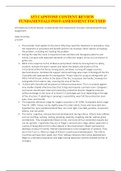
ATI CAPSTONE CONTENT REVIEW FUNDAMENTALS POST -ASSESSMENT FOCUSED ATI Capstone Content Review: Fundamentals Post -Assessment Focused, Individualized Review Assignment Jodie Crutchley 2/13/19 1. The provider must explain to the client: Why they need the treatment or procedure , How the treatment or procedure will benefit and the risk involved , Other options of treating the problem, including not treating the problem 2. During this step the nurse is required to look and data and, Recognize patterns and trends , Compare with expected standards or reference ranges , Arrive at a conclusion to guide care 3. RACE is the response to fire; R=Rescue and protect clients by moving them to safety , A=Alarm. Activate the alarm system and report the details and location of fire , C=Contain/confine the fire by closing doors, windows, turnin g off oxygen sou rces, electrical devices. Ventilate life support clients with bag valve mask , E=Extinguish the fire if possible with appropriate fire extinguisher. Proper step s for using an extinguisher are PASS: P=Pull the pin, A=Aim at the base of the fi re, S=squeeze the handle, S=sweep the extinguisher from side to side, covering the area of the fire 4. A client with Varicella will be placed on Airborne precautions. This is to protect against very smaller droplet infections (less that 5cmg) and requires a private room. Caregivers and nurses should wear mask and respiratory protection devices. Negative pressure airflow exchange in the room of at least 6 -12 exchanges per hour depending on the age of the structure. If splashing or spraying is a possibility, wear full face protection (over eyes, nose, and mouth). 5. The expected reference range for oxygen saturation is 95 -100%. Acceptable levels range from 91 -100%. Values can be slightly lower for older adults, those who have dark skin, hypothermia, poor peripheral blood flow, too much light, low HGB, jaundice, movement, edema, and nail polish. 6. The motor, cognitive, and psychosocial development during infancy. Infants have reflexes such as; startling, sucking, rooting, grasping, yawning, coughing, p lantar, palmar grasp and Babinski. They are generally flexed at rest, and move all four extremities equally but can be sporadic. Cognitively they are in Piaget’s sensorimotor stage, where separation is a sense of being distinct from other objects in the en vironment. Object permanence develops at about 9 months. Mental representation is the recognition of symbols. They are in the Trust vs. Mistrust stage of Erikson’s psychosocial development. The infants trust they will have their needs met. Their reflexes i nfluence their social development. Begin to understand separation and begin having separation anxiety followed by fear of strangers.
Vista previa 1 fuera de 2 páginas
Otro
ATI Capstone Content Review | Fundamentals Post-Assessment Focused | REVIEWED LATEST
Vista previa 1 fuera de 2 páginas
1. The provider must explain to the client: Why they need the treatment or procedure, How the treatment or procedure will benefit and the risk involved, Other options of treating the problem, including not treating the problem 2. During this step the nurse is required to look and data and, Recognize patterns and trends, Compare with expected standards or reference ranges, Arrive at a conclusion to guide care 3. RACE is the response to fire; R=Rescue and protect clients by moving them to safety, A=Alarm. Activate the alarm system and report the details and location of fire, C=Contain/confine the fire by closing doors, windows, turning off oxygen sources, electrical devices. Ventilate life support clients with bag valve mask, E=Extinguish the fire if possible with appropriate fire extinguisher. Proper steps for using an extinguisher are PASS: P=Pull the pin, A=Aim at the base of the fire, S=squeeze the handle, S=sweep the extinguisher from side to side, covering the area of the fire 4. A client with Varicella will be placed on Airborne precautions. This is to protect against very smaller droplet infections (less that 5cmg) and requires a private room. Caregivers and nurses should wear mask and respiratory protection devices. Negative pressure airflow exchange in the room of at least 6-12 exchanges per hour depending on the age of the structure. If splashing or spraying is a possibility, wear full face protection (over eyes, nose, and mouth). 5. The expected reference range for oxygen saturation is 95-100%. Acceptable levels range from 91-100%. Values can be slightly lower for older adults, those who have dark skin, hypothermia, poor peripheral blood flow, too much light, low HGB, jaundice, movement, edema, and nail polish. 6. The motor, cognitive, and psychosocial development during infancy. Infants have reflexes such as; startling, sucking, rooting, grasping, yawning, coughing, plantar, palmar grasp and Babinski. They are generally flexed at rest, and move all four extremities equally but can be sporadic. Cognitively they are in Piaget’s sensorimotor stage, where separation is a sense of being distinct from other objects in the environment. Object permanence develops at about 9 months. Mental representation is the recognition of symbols. They are in the Trust vs. Mistrust stage of Erikson’s psychosocial development. The infants trust they will have their needs met. Their reflexes influence their social development. Begin to understand separation and begin having separation anxiety followed by fear of strangers. 7. Five expected physical assessment findings in an older adult
Vista previa del contenido
Información del documento
- Subido en
- 9 de febrero de 2021
- Número de páginas
- 2
- Escrito en
- 2020/2021
- Tipo
- Otro
- Personaje
- Desconocido
$14.99
¿Documento equivocado? Cámbialo gratis
Dentro de los 14 días posteriores a la compra y antes de descargarlo, puedes elegir otro documento. Puedes gastar el importe de nuevo.
Escrito por estudiantes que aprobaron
Inmediatamente disponible después del pago
Leer en línea o como PDF

Los indicadores de reputación están sujetos a la cantidad de artículos vendidos por una tarifa y las reseñas que ha recibido por esos documentos. Hay tres niveles: Bronce, Plata y Oro. Cuanto mayor reputación, más podrás confiar en la calidad del trabajo del vendedor.
