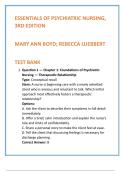
PADI (Open Water Diver) Final Exam Review
Newest Version 2026/2027 Questions with Answers
1) If an object is neutrally buoyant (does not sink or float) in fresh water, the same
object placed into salt water would
A sink.
B either sink or float.
C do nothing.
D float. - Answer>>-D
2) I blow up a balloon, tie it off, and take it to the bottom of the swimming pool.
What will happen to the balloon and the air inside it?
A The balloon will get bigger and the air inside the balloon will be less dense
(molecules move further apart).
B The balloon will get smaller and the air inside the balloon will be more dense
(molecules move closer together).
C The balloon will get bigger and the air inside the balloon will be more dense.
D The balloon will get smaller and the air inside the balloon will be less dense. -
Answer>>-B
3) I turn a glass upside down, trap the air in it by putting it in water, and then I take
the glass down to 10 meters. The air space would
A become half the size it was at the surface.
B not change in size.
C become 1/3 the size it was at the surface.
D become 2/3 the size it was at the surface. - Answer>>-A
4) If I am not able to equalize (clear) my body air spaces, it may be because I have
A seasickness.
B heart disease and high blood pressure.
C a cold, allergy or another medical problem.
D anxiety. - Answer>>-C
5) If my ears or sinuses hurt while I am descending (going down), it usually means
, A my air spaces are equalized.
B my mask strap is too tight.
C I am feeling a squeeze and need to equalize.
D my mask is too small. - Answer>>-C
6) The best place for me to position an alternate air source is
A loose by my side so I can find it fast.
B in the triangle area formed by my chin and the lower corners of my rib cage.
C to the base of my cylinder.
D to the back of my BCD between my shoulder blades and waist. - Answer>>-B
7) Lung overexpansion injuries can be caused by
A scuba diving without a buddy.
B continuing a dive when not properly weighted.
C not drinking enough water before scuba diving.
D holding my breath while scuba diving. - Answer>>-D
8) If my cylinder of air lasts 60 minutes while I am at the surface breathing
normally, assuming all else is the same, how long will it last at 20 meters breathing
normally?
A 60 minutes
B 20 minutes
C 15 minutes
D 12 minutes - Answer>>-B
9) How often should I take my scuba cylinder to be visually inspected by my dive
center?
A Once a year.
B Once every two years.
C Every six months.
D Every five years. - Answer>>-A
10) The difference between DIN valves and yoke valves is that DIN valves
A are made from durable plastic.
Newest Version 2026/2027 Questions with Answers
1) If an object is neutrally buoyant (does not sink or float) in fresh water, the same
object placed into salt water would
A sink.
B either sink or float.
C do nothing.
D float. - Answer>>-D
2) I blow up a balloon, tie it off, and take it to the bottom of the swimming pool.
What will happen to the balloon and the air inside it?
A The balloon will get bigger and the air inside the balloon will be less dense
(molecules move further apart).
B The balloon will get smaller and the air inside the balloon will be more dense
(molecules move closer together).
C The balloon will get bigger and the air inside the balloon will be more dense.
D The balloon will get smaller and the air inside the balloon will be less dense. -
Answer>>-B
3) I turn a glass upside down, trap the air in it by putting it in water, and then I take
the glass down to 10 meters. The air space would
A become half the size it was at the surface.
B not change in size.
C become 1/3 the size it was at the surface.
D become 2/3 the size it was at the surface. - Answer>>-A
4) If I am not able to equalize (clear) my body air spaces, it may be because I have
A seasickness.
B heart disease and high blood pressure.
C a cold, allergy or another medical problem.
D anxiety. - Answer>>-C
5) If my ears or sinuses hurt while I am descending (going down), it usually means
, A my air spaces are equalized.
B my mask strap is too tight.
C I am feeling a squeeze and need to equalize.
D my mask is too small. - Answer>>-C
6) The best place for me to position an alternate air source is
A loose by my side so I can find it fast.
B in the triangle area formed by my chin and the lower corners of my rib cage.
C to the base of my cylinder.
D to the back of my BCD between my shoulder blades and waist. - Answer>>-B
7) Lung overexpansion injuries can be caused by
A scuba diving without a buddy.
B continuing a dive when not properly weighted.
C not drinking enough water before scuba diving.
D holding my breath while scuba diving. - Answer>>-D
8) If my cylinder of air lasts 60 minutes while I am at the surface breathing
normally, assuming all else is the same, how long will it last at 20 meters breathing
normally?
A 60 minutes
B 20 minutes
C 15 minutes
D 12 minutes - Answer>>-B
9) How often should I take my scuba cylinder to be visually inspected by my dive
center?
A Once a year.
B Once every two years.
C Every six months.
D Every five years. - Answer>>-A
10) The difference between DIN valves and yoke valves is that DIN valves
A are made from durable plastic.