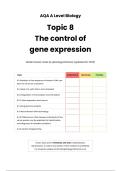
AQA A Level Biology
Topic 8
The control of
gene expression
Model answer notes by @biologywitholivia (updated for 2025)
Topic Understand Memorise Practise
8.1 Alteration of the sequence of bases in DNA can
alter the structure of proteins
8.2.1 Most of a cell’s DNA is not translated
8.2.2 Regulation of transcription and translation
8.2.3 Gene expression and cancer
8.3 Using genome projects
8.4.1 Recombinant DNA technology
8.4.2 Differences in DNA between individuals of the
same species can be exploited for identification
and diagnosis of heritable conditions
8.4.3 Genetic fingerprinting
These notes are for PERSONAL USE ONLY. Redistribution,
reproduction, or sale of any portion of this material is prohibited.
For enquiries, please email
,More GCSE & A Level Biology resources available at stan.store/biologywitholivia Copyright © 2025 Biology with Olivia
8.1 The alteration of the sequence of
bases in DNA can alter the structure of
proteins
What is a gene mutation?
● A change in the base sequence of DNA (on chromosomes)
● Can arise spontaneously during DNA replication (interphase)
What is a mutagenic agent?
A factor that increases rate of mutation, eg. ultraviolet (UV) light or alpha particles
Explain how a gene mutation can lead to the production of
a non-functional protein or enzyme (general)
1. Changes sequence of base triplets in DNA so changes sequence of codons on mRNA
2. So changes sequence of amino acids in the encoded polypeptide
3. So changes position of hydrogen / ionic / disulphide bonds (between amino acids)
4. So changes tertiary structure (shape) of protein
5. Enzymes - active site changes shape so substrate can’t bind, enzyme-substrate complex can’t form
Describe the different types of gene mutations
Substitution A base / nucleotide is replaced by a different base / nucleotide in DNA Students
should be
Addition 1 or more bases / nucleotides are added to the DNA base sequence able to
relate the
Deletion 1 or more bases / nucleotides are lost from the DNA base sequence
nature of a
Duplication A sequence of DNA bases / nucleotides is repeated / copied gene
mutation to
Inversion A sequence of bases / nucleotides detaches from the DNA sequence, its effect on
then rejoins at the same position in the reverse order the
encoded
Translocation A sequence of DNA bases / nucleotides detaches and is inserted at a
polypeptide.
different location within the same or a different chromosome
Explain why not all gene mutations affect the order of amino acids
● Some substitutions change only 1 triplet code / codon which could still code for the same amino acid
○ As the genetic code is degenerate (an amino acid can be coded for by more than one triplet)
● Some occur in introns which do not code for amino acids as they are removed during splicing
2
, More GCSE & A Level Biology resources available at stan.store/biologywitholivia Copyright © 2025 Biology with Olivia
Explain why a change in amino acid sequence is not always harmful
● May not change tertiary structure of protein (if position of ionic / disulphide / H bonds don’t change)
● May positively change the properties of the protein, giving the organism a selective advantage
Explain what is meant by a frameshift
● Occurs when mutations (addition, deletion, duplication or translocation)
change the number of nucleotides / bases by a number not divisible by 3
● This shifts the way the genetic code is read, so all the DNA triplets / mRNA
codons downstream from the mutation change (so significant effects)
Effects on the encoded polypeptide are significant
Explain how mutations can lead to production of shorter polypeptides
● Deletion or translocation → triplet(s) / codon(s) missing so amino acid(s) missing
● Substitution, addition, deletion, duplication, inversion or translocation → premature stop triplet / codon
(doesn’t code for amino acids; terminates translation) so amino acids missing at end of polypeptide
Exam insight: common mistakes ❌
Mistake Explanation
“A mutation is a change in Genes are made of DNA, which has a nucleotide base sequence that codes
amino acid sequence of a for a sequence of amino acids in a polypeptide. Mutations change this base
gene” sequence and this results in a change in amino acid sequence
of a polypeptide.
“A gene mutation can lead to Genes do not determine which amino acids are produced - amino acids
a new amino acid being already exist in cells. Instead, each gene has the code for the order in which
formed or produced.” these amino acids need to be joined together in translation to form a
particular polypeptide. So, a gene mutation can lead to a different sequence
of amino acids being formed, but not new amino acids themselves.
“Mutations change the 3D Always mention the term tertiary structure and the change in the position of
structure of a protein.” hydrogen bonds, ionic bonds and disulphide bridges.
“All mutations are harmful.” A mutation may result in the formation of a new, advantageous allele that
results in change in polypeptide that positively affects the properties of the
protein, giving an organism a selective advantage.
3
Topic 8
The control of
gene expression
Model answer notes by @biologywitholivia (updated for 2025)
Topic Understand Memorise Practise
8.1 Alteration of the sequence of bases in DNA can
alter the structure of proteins
8.2.1 Most of a cell’s DNA is not translated
8.2.2 Regulation of transcription and translation
8.2.3 Gene expression and cancer
8.3 Using genome projects
8.4.1 Recombinant DNA technology
8.4.2 Differences in DNA between individuals of the
same species can be exploited for identification
and diagnosis of heritable conditions
8.4.3 Genetic fingerprinting
These notes are for PERSONAL USE ONLY. Redistribution,
reproduction, or sale of any portion of this material is prohibited.
For enquiries, please email
,More GCSE & A Level Biology resources available at stan.store/biologywitholivia Copyright © 2025 Biology with Olivia
8.1 The alteration of the sequence of
bases in DNA can alter the structure of
proteins
What is a gene mutation?
● A change in the base sequence of DNA (on chromosomes)
● Can arise spontaneously during DNA replication (interphase)
What is a mutagenic agent?
A factor that increases rate of mutation, eg. ultraviolet (UV) light or alpha particles
Explain how a gene mutation can lead to the production of
a non-functional protein or enzyme (general)
1. Changes sequence of base triplets in DNA so changes sequence of codons on mRNA
2. So changes sequence of amino acids in the encoded polypeptide
3. So changes position of hydrogen / ionic / disulphide bonds (between amino acids)
4. So changes tertiary structure (shape) of protein
5. Enzymes - active site changes shape so substrate can’t bind, enzyme-substrate complex can’t form
Describe the different types of gene mutations
Substitution A base / nucleotide is replaced by a different base / nucleotide in DNA Students
should be
Addition 1 or more bases / nucleotides are added to the DNA base sequence able to
relate the
Deletion 1 or more bases / nucleotides are lost from the DNA base sequence
nature of a
Duplication A sequence of DNA bases / nucleotides is repeated / copied gene
mutation to
Inversion A sequence of bases / nucleotides detaches from the DNA sequence, its effect on
then rejoins at the same position in the reverse order the
encoded
Translocation A sequence of DNA bases / nucleotides detaches and is inserted at a
polypeptide.
different location within the same or a different chromosome
Explain why not all gene mutations affect the order of amino acids
● Some substitutions change only 1 triplet code / codon which could still code for the same amino acid
○ As the genetic code is degenerate (an amino acid can be coded for by more than one triplet)
● Some occur in introns which do not code for amino acids as they are removed during splicing
2
, More GCSE & A Level Biology resources available at stan.store/biologywitholivia Copyright © 2025 Biology with Olivia
Explain why a change in amino acid sequence is not always harmful
● May not change tertiary structure of protein (if position of ionic / disulphide / H bonds don’t change)
● May positively change the properties of the protein, giving the organism a selective advantage
Explain what is meant by a frameshift
● Occurs when mutations (addition, deletion, duplication or translocation)
change the number of nucleotides / bases by a number not divisible by 3
● This shifts the way the genetic code is read, so all the DNA triplets / mRNA
codons downstream from the mutation change (so significant effects)
Effects on the encoded polypeptide are significant
Explain how mutations can lead to production of shorter polypeptides
● Deletion or translocation → triplet(s) / codon(s) missing so amino acid(s) missing
● Substitution, addition, deletion, duplication, inversion or translocation → premature stop triplet / codon
(doesn’t code for amino acids; terminates translation) so amino acids missing at end of polypeptide
Exam insight: common mistakes ❌
Mistake Explanation
“A mutation is a change in Genes are made of DNA, which has a nucleotide base sequence that codes
amino acid sequence of a for a sequence of amino acids in a polypeptide. Mutations change this base
gene” sequence and this results in a change in amino acid sequence
of a polypeptide.
“A gene mutation can lead to Genes do not determine which amino acids are produced - amino acids
a new amino acid being already exist in cells. Instead, each gene has the code for the order in which
formed or produced.” these amino acids need to be joined together in translation to form a
particular polypeptide. So, a gene mutation can lead to a different sequence
of amino acids being formed, but not new amino acids themselves.
“Mutations change the 3D Always mention the term tertiary structure and the change in the position of
structure of a protein.” hydrogen bonds, ionic bonds and disulphide bridges.
“All mutations are harmful.” A mutation may result in the formation of a new, advantageous allele that
results in change in polypeptide that positively affects the properties of the
protein, giving an organism a selective advantage.
3