NUR 445 Exam 2 Study Guide Questions & Answers Latest Update 100% Solved
NUR 445 Exam 2 Study Guide Questions & Answers
Latest Update 100% Solved
Cardiac
ECG interpretation
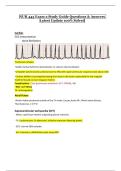
Atrial fibrillation:
Treatment includes:
• Stable! Antiarrhythmics (beta blocker or calcium channel blocker
• Unstable! Synchronized cardioversion for Afib with rapid ventricular response (rate above 100)
• Cardiac ablation (scarring/destroying the tissue in the heart responsible for the irregular
rhythm) Should correct irregular rhythm.
Complications : Clots (pulmonary embolism, DVT, STROKE, MI)
–ECG- no P Wave
TX: anticoagulants
Atrial Flutter
• Atrial rhythm produced outside of the S A node, Causes,Acute M I, Mitral valve disease,
Thyrotoxicosis, C O P D
Supraventricular tachycardia (SVT)
- What: rapid heart rhythm originating above ventricles
- TX: cardioversion, IV adenosine, Valsalva maneuver (bearing down).
- ECG: narrow QRS complex
- Act: telemetry, defibrillator pads, keep NPO
NUR 445 Exam 2 Study Guide Questions & Answers Latest Update 100% Solved
, NUR 445 Exam 2 Study Guide Questions & Answers Latest Update 100% Solved
ST elevation
- What: occlusion of one or more coronary arteries
- TX: PCI, anticoagulants, beta-blockers, ACEi, ARB, CABG
Pulseless ventricular tachycardia (V-tach)
What: 3 or more PVCs in a row
- Act: CALL CODE!!!
- Treatment: CPR, early defibrillation
- Risk factors: acidosis, CAD, HF, frequent PVCs
‒V T with a pulse – Antiarrhythmic medication, electrolyte replacement, cardioversion
‒Pulseless V T – call a code, Cardiopulmonary resuscitation and early defibrillation.
Ventricular Fibrillation
Lethal dysrhythmia
Treatment- BEGIN CPR!!!
Bradycardia
-What: sinus rhythm with rate < 60
NUR 445 Exam 2 Study Guide Questions & Answers Latest Update 100% Solved
NUR 445 Exam 2 Study Guide Questions & Answers
Latest Update 100% Solved
Cardiac
ECG interpretation
Atrial fibrillation:
Treatment includes:
• Stable! Antiarrhythmics (beta blocker or calcium channel blocker
• Unstable! Synchronized cardioversion for Afib with rapid ventricular response (rate above 100)
• Cardiac ablation (scarring/destroying the tissue in the heart responsible for the irregular
rhythm) Should correct irregular rhythm.
Complications : Clots (pulmonary embolism, DVT, STROKE, MI)
–ECG- no P Wave
TX: anticoagulants
Atrial Flutter
• Atrial rhythm produced outside of the S A node, Causes,Acute M I, Mitral valve disease,
Thyrotoxicosis, C O P D
Supraventricular tachycardia (SVT)
- What: rapid heart rhythm originating above ventricles
- TX: cardioversion, IV adenosine, Valsalva maneuver (bearing down).
- ECG: narrow QRS complex
- Act: telemetry, defibrillator pads, keep NPO
NUR 445 Exam 2 Study Guide Questions & Answers Latest Update 100% Solved
, NUR 445 Exam 2 Study Guide Questions & Answers Latest Update 100% Solved
ST elevation
- What: occlusion of one or more coronary arteries
- TX: PCI, anticoagulants, beta-blockers, ACEi, ARB, CABG
Pulseless ventricular tachycardia (V-tach)
What: 3 or more PVCs in a row
- Act: CALL CODE!!!
- Treatment: CPR, early defibrillation
- Risk factors: acidosis, CAD, HF, frequent PVCs
‒V T with a pulse – Antiarrhythmic medication, electrolyte replacement, cardioversion
‒Pulseless V T – call a code, Cardiopulmonary resuscitation and early defibrillation.
Ventricular Fibrillation
Lethal dysrhythmia
Treatment- BEGIN CPR!!!
Bradycardia
-What: sinus rhythm with rate < 60
NUR 445 Exam 2 Study Guide Questions & Answers Latest Update 100% Solved