Page |1
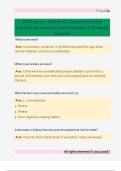
NSG 3100 - Exam #3 Questions and
Correct Answers/ Latest Update / Already
Graded
What is enuresis?
Ans: Involuntary urination in children beyond the age when
normal bladder control is established
What is secondary enuresis?
Ans: Child who has established proper bladder control for a
period of 6 months, but who has since lapsed back to wett ing
the bed
What factors may cause secondary enuresis? (4)
Ans: 1. Constipation
2. Stress
3. Illness
4. Poor daytime voiding habits
A decrease in kidney function puts the patient at risk for what?
Ans: Toxicity from medication if excretion rates are longer
All rights reserved © 2025/ 2026 |
, Page |2
The most noticeable changes with age are related to what?
Ans: Bladder (urgency & frequency)
What causes changes in urinary urgency & frequency in men?
Ans: Enlarged prostate gland
What causes changes in urinary urgency & frequency in women?
Ans: Weakened muscles supporting the bladder and of the
urethral sphincter after menopause (results from decreased
estrogen levels)
What interventions could be done to help the patient have more
consistent urination? (5)
Ans: 1. Medications
2. Surgery
3. Behavioral training
4. Safe/easy access to bathroom
5. Habit training (scheduled time)
Urinary habits depend on what? (3)
Ans: 1. Social cultural
All rights reserved © 2025/ 2026 |
, Page |3
2. Personal habits
3. Physical abilities
Which factors affect urination? (7)
Ans: 1. Developmental
2. Psychosocial
3. Fluid & food intake
4. Medications
5. Muscle tone
6. Pathologic conditions
7. Surgical & diagnostic procedures
Urinary elimination is affected by what? (5)
Ans: 1. Kidneys
2. Ureters
3. Bladder
4. Urethra
5. Pelvic floor
How do medications affect urination?
Ans: 1. Meds affecting ANS cause retention
All rights reserved © 2025/ 2026 |
, Page |4
2. Diuretics increase urine formation by preventing
reabsorption of water & electrolytes
How does muscle tone affect urination?
Ans: Muscle tone is needed to maintain the stretch &
contractility of the detrusor muscle so the bladder can fill &
empty completely
What is the difference between stress & urge incontinence?
Ans: Stress: loss of urine control during activities that increase
intra-abdominal pressure (coughing, sneezing, laughing, or
exercise)
Urge: a sudden strong urge to void, followed by a rapid bladder
contraction
What is overflow incontinence?
Ans: Inability to empty bladder completely, resulting in a
constant dribbling of urine or frequency in urination
How does alcohol increase urination?
Ans: Inhibits the production of ADH
All rights reserved © 2025/ 2026 |
NSG 3100 - Exam #3 Questions and
Correct Answers/ Latest Update / Already
Graded
What is enuresis?
Ans: Involuntary urination in children beyond the age when
normal bladder control is established
What is secondary enuresis?
Ans: Child who has established proper bladder control for a
period of 6 months, but who has since lapsed back to wett ing
the bed
What factors may cause secondary enuresis? (4)
Ans: 1. Constipation
2. Stress
3. Illness
4. Poor daytime voiding habits
A decrease in kidney function puts the patient at risk for what?
Ans: Toxicity from medication if excretion rates are longer
All rights reserved © 2025/ 2026 |
, Page |2
The most noticeable changes with age are related to what?
Ans: Bladder (urgency & frequency)
What causes changes in urinary urgency & frequency in men?
Ans: Enlarged prostate gland
What causes changes in urinary urgency & frequency in women?
Ans: Weakened muscles supporting the bladder and of the
urethral sphincter after menopause (results from decreased
estrogen levels)
What interventions could be done to help the patient have more
consistent urination? (5)
Ans: 1. Medications
2. Surgery
3. Behavioral training
4. Safe/easy access to bathroom
5. Habit training (scheduled time)
Urinary habits depend on what? (3)
Ans: 1. Social cultural
All rights reserved © 2025/ 2026 |
, Page |3
2. Personal habits
3. Physical abilities
Which factors affect urination? (7)
Ans: 1. Developmental
2. Psychosocial
3. Fluid & food intake
4. Medications
5. Muscle tone
6. Pathologic conditions
7. Surgical & diagnostic procedures
Urinary elimination is affected by what? (5)
Ans: 1. Kidneys
2. Ureters
3. Bladder
4. Urethra
5. Pelvic floor
How do medications affect urination?
Ans: 1. Meds affecting ANS cause retention
All rights reserved © 2025/ 2026 |
, Page |4
2. Diuretics increase urine formation by preventing
reabsorption of water & electrolytes
How does muscle tone affect urination?
Ans: Muscle tone is needed to maintain the stretch &
contractility of the detrusor muscle so the bladder can fill &
empty completely
What is the difference between stress & urge incontinence?
Ans: Stress: loss of urine control during activities that increase
intra-abdominal pressure (coughing, sneezing, laughing, or
exercise)
Urge: a sudden strong urge to void, followed by a rapid bladder
contraction
What is overflow incontinence?
Ans: Inability to empty bladder completely, resulting in a
constant dribbling of urine or frequency in urination
How does alcohol increase urination?
Ans: Inhibits the production of ADH
All rights reserved © 2025/ 2026 |