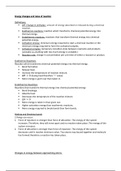
Energy changes and rates of reaction
Definitions:
ΔH Change in enthalpy: amount of energy absorbed or released during a chemical
reaction.
Exothermic reactions: reaction which transforms chemical potential energy into
thermal energy.
Endothermic reactions: reactions that transform thermal energy into chemical
potential energy.
Activation energy: minimum energy required to start a chemical reaction or the
minimum energy required to form the activated complex.
Activated complex: temporary transition state between reactants and products
(unstable as anything with too much energy is unstable.)
Reaction rate: change in concentration per unit time of either a reactant or product.
Exothermic Reactions
Reaction which transforms chemical potential energy into thermal energy.
Bond formation.
Release heat.
Increase the temperature of reaction mixture.
ΔH < 0 (losing heat therefore “-“ value)
More energy is given out than taken in.
Endothermic Reactions
Reactions that transform thermal energy into chemical potential energy.
Bond breakage.
Absorbs heat.
Decreases the temperature of the reaction mixture.
ΔH > 0
More energy is taken in than given out.
Higher activation energy than exothermic reactions.
More energy required to break bonds than form bonds.
Making and Breaking bonds
2 things can occur:
1. Force of repulsion is stronger than force of attraction. The energy of the system
increases. Therefore, they will move apart and no reaction takes place. The energy of the
system increases.
2. Force of attraction is stronger than force of repulsion. The energy of the system
decreases until it reaches minimum value. Two atoms stay bound together and molecule
has formed therefore a reaction has taken place.
Changes in energy between approaching atoms
Definitions:
ΔH Change in enthalpy: amount of energy absorbed or released during a chemical
reaction.
Exothermic reactions: reaction which transforms chemical potential energy into
thermal energy.
Endothermic reactions: reactions that transform thermal energy into chemical
potential energy.
Activation energy: minimum energy required to start a chemical reaction or the
minimum energy required to form the activated complex.
Activated complex: temporary transition state between reactants and products
(unstable as anything with too much energy is unstable.)
Reaction rate: change in concentration per unit time of either a reactant or product.
Exothermic Reactions
Reaction which transforms chemical potential energy into thermal energy.
Bond formation.
Release heat.
Increase the temperature of reaction mixture.
ΔH < 0 (losing heat therefore “-“ value)
More energy is given out than taken in.
Endothermic Reactions
Reactions that transform thermal energy into chemical potential energy.
Bond breakage.
Absorbs heat.
Decreases the temperature of the reaction mixture.
ΔH > 0
More energy is taken in than given out.
Higher activation energy than exothermic reactions.
More energy required to break bonds than form bonds.
Making and Breaking bonds
2 things can occur:
1. Force of repulsion is stronger than force of attraction. The energy of the system
increases. Therefore, they will move apart and no reaction takes place. The energy of the
system increases.
2. Force of attraction is stronger than force of repulsion. The energy of the system
decreases until it reaches minimum value. Two atoms stay bound together and molecule
has formed therefore a reaction has taken place.
Changes in energy between approaching atoms