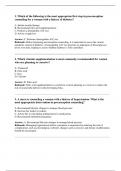
Evolve Elsevier HESI Med-Surg Practice Exam
(2025/2026) — 150 High-Level Nursing Questions,
Correct Answers & Full Rationales
1. A 68-year-old client is admitted with acute decompensated heart failure. The nurse
notes the client is sitting upright, using accessory muscles, and coughing
pink-tinged sputum. Which assessment finding requires immediate intervention?
A. Oxygen saturation 88% on 6 L via nasal cannula
B. Bilateral crackles to mid-lung fields
C. Blood pressure 160/90 mmHg
D. Heart rate 110 beats/min
Correct Answer: A
Rationale: Pink-tinged sputum and hypoxemia (SpO₂ < 90%) indicate severe pulmonary
edema and impending respiratory failure. Oxygenation is the first priority per the ABC
framework. While crackles, hypertension, and tachycardia are concerning, they are not as
immediately life-threatening as hypoxemia. Increasing FiO₂, initiating BiPAP, or
preparing for intubation takes precedence. The other options reflect compensatory
mechanisms or secondary issues that can be addressed once oxygenation improves.
2. The nurse is caring for a client 8 hours post-CABG. The client suddenly complains
of chest pain, and the cardiac monitor shows ST-segment elevation in leads II, III,
and aVF. Which action should the nurse take first?
A. Administer morphine sulfate 2 mg IV
B. Obtain a 12-lead ECG
C. Check the graft pulses and chest tube output
D. Call the cardiac surgery team
Correct Answer: B
,Rationale: New ST-elevation 8 hours post-CABG suggests acute graft occlusion or
spasm. A 12-lead ECG confirms the territory and documents the event for urgent
catheterization or re-operation. While alerting the team is essential, objective data must
precede phone calls to facilitate rapid decision-making. Morphine treats pain but does not
address the underlying ischemia. Checking graft pulses is subjective and less sensitive
than ECG.
3. A client with a history of COPD is receiving mechanical ventilation. The ABG
results are pH 7.48, PaCO₂ 48 mmHg, PaO₂ 70 mmHg, HCO₃ 32 mEq/L. Which
ventilator change should the nurse anticipate?
A. Increase FiO₂
B. Decrease tidal volume
C. Increase respiratory rate
D. Administer sodium bicarbonate
Correct Answer: B
Rationale: The ABG shows compensated respiratory alkalosis with an elevated HCO₃,
indicating the client is being over-ventilated relative to their chronic hypercapnic
baseline. Reducing tidal volume allows PaCO₂ to rise toward the client’s usual set-point,
preventing alkalemia-induced arrhythmias and cerebral vasoconstriction. Increasing FiO₂
is unnecessary because PaO₂ is adequate. Raising the rate would worsen alkalosis.
Bicarbonate is contraindicated in alkalotic states.
4. The nurse is assessing a client with DKA who has just been admitted. Which
laboratory value is the best indicator that the insulin infusion is effective?
A. Glucose decreasing 50 mg/dL/hr
B. pH increasing from 7.20 to 7.32
C. Serum bicarbonate rising
D. Anion gap narrowing
Correct Answer: D
,Rationale: The anion gap reflects the resolution of ketoacidosis, the primary defect in
DKA. As insulin suppresses lipolysis and ketone production, the gap normalizes,
indicating true metabolic recovery. Glucose falls faster than ketones, so a dropping
glucose alone can mask ongoing acidosis. pH and bicarbonate improve as the gap closes,
but they are secondary markers. Targeting anion gap ≤ 12 mEq/L guides when to
transition to subcutaneous insulin.
5. A client with acute pancreatitis is complaining of severe epigastric pain that
radiates to the back. Which intervention should the nurse implement first?
A. Administer IV morphine 4 mg
B. Start a clear liquid diet
C. Insert an NG tube to low suction
D. Place the client in high-Fowler’s position
Correct Answer: A
Rationale: Pain control is a priority to reduce sympathetic stimulation, improve
ventilation, and prevent splinting. Morphine or hydromorphone is safe and does not
spasm the sphincter of Oddi contrary to older myths. Oral intake is withheld initially,
making diet and NG tube secondary. Positioning may provide comfort but does not
address the pain source.
6. A client with a subarachnoid hemorrhage is being monitored for vasospasm.
Which assessment finding is the earliest indicator of vasospasm?
A. Decreased level of consciousness
B. New right-arm weakness
C. Sudden severe headache
D. Temperature 38.5°C
Correct Answer: A
Rationale: Vasospasm typically presents as a fluctuating or declining level of
consciousness before focal deficits appear, due to global reduction in cerebral perfusion.
, New focal weakness reflects established ischemia. Re-bleed causes sudden headache but
is distinct from vasospasm. Fever is nonspecific and may relate to blood in CSF.
7. The nurse is caring for a client with Guillain-Barré syndrome who is experiencing
ascending weakness. Which assessment is most important for detecting impending
respiratory failure?
A. Hand grip strength
B. Ability to lift head off pillow
C. Oxygen saturation on room air
D. Arterial blood gas pH
Correct Answer: B
Rationale: Bulbar and diaphragmatic weakness precedes desaturation in neuromuscular
respiratory failure. Testing neck flexion (head lift) fatigues earlier than peripheral
muscles and predicts need for intubation better than SpO₂, which remains normal until
critical hypoventilation occurs. ABG is invasive and lags behind clinical signs.
8. A client with a pulmonary embolism is started on a heparin infusion. The PTT is
42 seconds (goal 60–80). The physician orders an additional 400 units/hr. What
should the nurse do?
A. Increase the infusion by 400 units/hr and recheck PTT in 6 hours
B. Question the order because it exceeds protocol limits
C. Administer a one-time IV bolus of 80 units/kg
D. Document the increase and monitor for bleeding
Correct Answer: A
Rationale: Sub-therapeutic anticoagulation increases the risk of clot extension and
recurrence. Most hospital protocols allow incremental increases in infusion rate based on
a nomogram. A 400 unit/hr increase is typically within safe limits for a sub-therapeutic
PTT. Rechecking in 6 hours ensures the client reaches target without overshooting. Bolus
dosing is usually reserved for initial sub-therapeutic results, not incremental adjustments.
(2025/2026) — 150 High-Level Nursing Questions,
Correct Answers & Full Rationales
1. A 68-year-old client is admitted with acute decompensated heart failure. The nurse
notes the client is sitting upright, using accessory muscles, and coughing
pink-tinged sputum. Which assessment finding requires immediate intervention?
A. Oxygen saturation 88% on 6 L via nasal cannula
B. Bilateral crackles to mid-lung fields
C. Blood pressure 160/90 mmHg
D. Heart rate 110 beats/min
Correct Answer: A
Rationale: Pink-tinged sputum and hypoxemia (SpO₂ < 90%) indicate severe pulmonary
edema and impending respiratory failure. Oxygenation is the first priority per the ABC
framework. While crackles, hypertension, and tachycardia are concerning, they are not as
immediately life-threatening as hypoxemia. Increasing FiO₂, initiating BiPAP, or
preparing for intubation takes precedence. The other options reflect compensatory
mechanisms or secondary issues that can be addressed once oxygenation improves.
2. The nurse is caring for a client 8 hours post-CABG. The client suddenly complains
of chest pain, and the cardiac monitor shows ST-segment elevation in leads II, III,
and aVF. Which action should the nurse take first?
A. Administer morphine sulfate 2 mg IV
B. Obtain a 12-lead ECG
C. Check the graft pulses and chest tube output
D. Call the cardiac surgery team
Correct Answer: B
,Rationale: New ST-elevation 8 hours post-CABG suggests acute graft occlusion or
spasm. A 12-lead ECG confirms the territory and documents the event for urgent
catheterization or re-operation. While alerting the team is essential, objective data must
precede phone calls to facilitate rapid decision-making. Morphine treats pain but does not
address the underlying ischemia. Checking graft pulses is subjective and less sensitive
than ECG.
3. A client with a history of COPD is receiving mechanical ventilation. The ABG
results are pH 7.48, PaCO₂ 48 mmHg, PaO₂ 70 mmHg, HCO₃ 32 mEq/L. Which
ventilator change should the nurse anticipate?
A. Increase FiO₂
B. Decrease tidal volume
C. Increase respiratory rate
D. Administer sodium bicarbonate
Correct Answer: B
Rationale: The ABG shows compensated respiratory alkalosis with an elevated HCO₃,
indicating the client is being over-ventilated relative to their chronic hypercapnic
baseline. Reducing tidal volume allows PaCO₂ to rise toward the client’s usual set-point,
preventing alkalemia-induced arrhythmias and cerebral vasoconstriction. Increasing FiO₂
is unnecessary because PaO₂ is adequate. Raising the rate would worsen alkalosis.
Bicarbonate is contraindicated in alkalotic states.
4. The nurse is assessing a client with DKA who has just been admitted. Which
laboratory value is the best indicator that the insulin infusion is effective?
A. Glucose decreasing 50 mg/dL/hr
B. pH increasing from 7.20 to 7.32
C. Serum bicarbonate rising
D. Anion gap narrowing
Correct Answer: D
,Rationale: The anion gap reflects the resolution of ketoacidosis, the primary defect in
DKA. As insulin suppresses lipolysis and ketone production, the gap normalizes,
indicating true metabolic recovery. Glucose falls faster than ketones, so a dropping
glucose alone can mask ongoing acidosis. pH and bicarbonate improve as the gap closes,
but they are secondary markers. Targeting anion gap ≤ 12 mEq/L guides when to
transition to subcutaneous insulin.
5. A client with acute pancreatitis is complaining of severe epigastric pain that
radiates to the back. Which intervention should the nurse implement first?
A. Administer IV morphine 4 mg
B. Start a clear liquid diet
C. Insert an NG tube to low suction
D. Place the client in high-Fowler’s position
Correct Answer: A
Rationale: Pain control is a priority to reduce sympathetic stimulation, improve
ventilation, and prevent splinting. Morphine or hydromorphone is safe and does not
spasm the sphincter of Oddi contrary to older myths. Oral intake is withheld initially,
making diet and NG tube secondary. Positioning may provide comfort but does not
address the pain source.
6. A client with a subarachnoid hemorrhage is being monitored for vasospasm.
Which assessment finding is the earliest indicator of vasospasm?
A. Decreased level of consciousness
B. New right-arm weakness
C. Sudden severe headache
D. Temperature 38.5°C
Correct Answer: A
Rationale: Vasospasm typically presents as a fluctuating or declining level of
consciousness before focal deficits appear, due to global reduction in cerebral perfusion.
, New focal weakness reflects established ischemia. Re-bleed causes sudden headache but
is distinct from vasospasm. Fever is nonspecific and may relate to blood in CSF.
7. The nurse is caring for a client with Guillain-Barré syndrome who is experiencing
ascending weakness. Which assessment is most important for detecting impending
respiratory failure?
A. Hand grip strength
B. Ability to lift head off pillow
C. Oxygen saturation on room air
D. Arterial blood gas pH
Correct Answer: B
Rationale: Bulbar and diaphragmatic weakness precedes desaturation in neuromuscular
respiratory failure. Testing neck flexion (head lift) fatigues earlier than peripheral
muscles and predicts need for intubation better than SpO₂, which remains normal until
critical hypoventilation occurs. ABG is invasive and lags behind clinical signs.
8. A client with a pulmonary embolism is started on a heparin infusion. The PTT is
42 seconds (goal 60–80). The physician orders an additional 400 units/hr. What
should the nurse do?
A. Increase the infusion by 400 units/hr and recheck PTT in 6 hours
B. Question the order because it exceeds protocol limits
C. Administer a one-time IV bolus of 80 units/kg
D. Document the increase and monitor for bleeding
Correct Answer: A
Rationale: Sub-therapeutic anticoagulation increases the risk of clot extension and
recurrence. Most hospital protocols allow incremental increases in infusion rate based on
a nomogram. A 400 unit/hr increase is typically within safe limits for a sub-therapeutic
PTT. Rechecking in 6 hours ensures the client reaches target without overshooting. Bolus
dosing is usually reserved for initial sub-therapeutic results, not incremental adjustments.