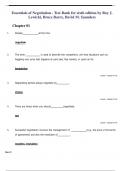
TEST BANK for Essentials of Negotiation,
7th Edition by Roy Lewicki, Bruce Barry
Chapters 1 - 12
,Table of Contents
1. The Nature of Negotiation
2. Strategy and Tactics of Distributive Bargaining
3. Strategy and Tactics of Integrative Negotiation
4. Negotiation: Strategy and Planning
5. Ethics in Negotiation
6. Perception, Cognition, and Emotion
7. Communication
8. Finding and Using Negotiation Power
9. Relationships in Negotiation
10. Multiple Parties, Groups, and Teams in Negotiation
11. International and Cross-Cultural Negotiation
12. Best Practices in Negotiations
Chapter 1
Student:
1. People all the time.
2. The term is used to describe the competitive, win-
lose situations such as hagglingover price thatHhappens atHyard sale, flea market, or used car lot.
,3. Negotiating parties always negotiate by .
4. There are times when you should negotiate.
5. Successful negotiation involves the managementHof _
(e.g., the price or the terms ofagreement) and also the resolution of.
6. Independent parties are able to meet their own
withoutHthe help and assistance ofothers.
7. The mix of convergentHand conflicting goals characterizes many relationships.
8. The of people's goals, and the
of the situation in which they aregoing to negotiate, strongly shapes negotiation processes
and outcomes.
9. Whether you should or should not agree on something in a negotiation depends entirely upon th
eattractiveness to you of the best available .
, 10. When parties are interdependent, they have to find a way to their differences.
11. Negotiation is a that transforms over time.
12. Negotiations often begin with statements of opening .
13. When one party accepts a change in his or her position, a has been made.
14. Two of the dilemmas in mutual adjustment that all negotiators face are the dilemma of
and the dilemma of .
15. Most actual negotiations are a combination of claiming and value processes.
16.
is analyzed as it affects the ability of the group to make decisions
,work productively, resolve its differences, and continue to achieve its goals effectively.
17. Most people initially believe that is always bad or dysfunctional.
18. The objective is not to eliminate conflict but to learn how to manage it to control the
elements while enjoying the productive aspects.
7th Edition by Roy Lewicki, Bruce Barry
Chapters 1 - 12
,Table of Contents
1. The Nature of Negotiation
2. Strategy and Tactics of Distributive Bargaining
3. Strategy and Tactics of Integrative Negotiation
4. Negotiation: Strategy and Planning
5. Ethics in Negotiation
6. Perception, Cognition, and Emotion
7. Communication
8. Finding and Using Negotiation Power
9. Relationships in Negotiation
10. Multiple Parties, Groups, and Teams in Negotiation
11. International and Cross-Cultural Negotiation
12. Best Practices in Negotiations
Chapter 1
Student:
1. People all the time.
2. The term is used to describe the competitive, win-
lose situations such as hagglingover price thatHhappens atHyard sale, flea market, or used car lot.
,3. Negotiating parties always negotiate by .
4. There are times when you should negotiate.
5. Successful negotiation involves the managementHof _
(e.g., the price or the terms ofagreement) and also the resolution of.
6. Independent parties are able to meet their own
withoutHthe help and assistance ofothers.
7. The mix of convergentHand conflicting goals characterizes many relationships.
8. The of people's goals, and the
of the situation in which they aregoing to negotiate, strongly shapes negotiation processes
and outcomes.
9. Whether you should or should not agree on something in a negotiation depends entirely upon th
eattractiveness to you of the best available .
, 10. When parties are interdependent, they have to find a way to their differences.
11. Negotiation is a that transforms over time.
12. Negotiations often begin with statements of opening .
13. When one party accepts a change in his or her position, a has been made.
14. Two of the dilemmas in mutual adjustment that all negotiators face are the dilemma of
and the dilemma of .
15. Most actual negotiations are a combination of claiming and value processes.
16.
is analyzed as it affects the ability of the group to make decisions
,work productively, resolve its differences, and continue to achieve its goals effectively.
17. Most people initially believe that is always bad or dysfunctional.
18. The objective is not to eliminate conflict but to learn how to manage it to control the
elements while enjoying the productive aspects.