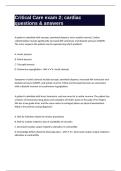
Critical Care exam 2; cardiac
questions & answers
A patient is admitted with syncope, exertional dyspnea, and a systolic murmur. Cardiac
catheterization reveals significantly increased left ventricular end-diastolic pressure (LVEDP).
The nurse suspects the patient may be experiencing which problem?
A. Aortic stenosis
B. Mitral stenosis
C. Tricuspid stenosis
D. Pulmonary regurgitation - ANS ✔✔A. Aortic stenosis
Symptoms of aortic stenosis include syncope, exertional dyspnea, increased left ventricular end-
diastolic pressure (LVEDP), and systolic murmur. Mitral and tricuspid stenoses are associated
with a diastolic murmur as is pulmonary regurgitation.
A patient is admitted with fever, hematuria, and new onset of a cardiac murmur. The patient has
a history of intravenous drug abuse and complains of tender spots on the pads of her fingers.
She has a low-grade fever, and the nurse notes an enlarged spleen on physical examination.
What is the priority nursing diagnosis?
A. Risk for infection related to invasive procedures
B. Risk for anxiety related to lack of availability of narcotics
C. Decreased cardiac output related to alteration in contractility
D. Knowledge deficit related to discharge plans - ANS ✔✔C. Decreased cardiac output related to
alteration in contractility
,Because the patient is experiencing endocarditis, the most important nursing diagnosis is
decreased cardiac output related to alteration in contractility. Infection and anxiety are only
potential problems, and although knowledge deficit is important, it is not the priority on
admission.
A patient with a family history of coronary artery disease (CAD) has the following laboratory
results: total cholesterol, 250 mg/dL; high-density lipoprotein, 35 mg/dL; low-density
lipoprotein, 160 mg/dL; and triglycerides, 240 mg/dL. Which interventions should the nurse
anticipate? (Select all that apply.)
A. Document the normal findings.
B. Instruct the patient to increase exercise to 30 minutes a day, 5 days a week.
C. Educate on increasing saturated fat and decreasing fiber in the diet.
D. Monitor and control blood pressure.
E. Enroll in smoking cessation classes. - ANS ✔✔B. Instruct the patient to increase exercise to 30
minutes a day, 5 days a week.
D. Monitor and control blood pressure.
E. Enroll in smoking cessation classes.
The patient with elevated lipids and a history of coronary artery disease (CAD) should be
instructed to increase exercise, monitor blood pressure, and stop smoking. Documenting the
findings as normal would be inappropriate because the laboratory test results are not normal.
The patient should be educated to decrease saturated fats and increase fiber.
A patient in the acute phase of systolic heart failure is admitted to the intensive care unit. Which
interventions would the nurse anticipate? (Select all that apply.)
A. Diuretics to lower systemic vascular resistance (SVR)
B. Morphine for peripheral dilation and to decrease anxiety
C. Nitroglycerin to decrease preload and afterload
, D. Dopamine to decrease contractility of the heart
E. Nesiritide to decrease pulmonary artery occlusion pressure and dyspnea - ANS ✔✔B.
Morphine for peripheral dilation and to decrease anxiety
C. Nitroglycerin to decrease preload and afterload
E. Nesiritide to decrease pulmonary artery occlusion pressure and dyspnea
Morphine, nitroglycerine, and nesiritide are all used to treat patients in systolic heart failure.
Diuretics will decrease preload, not systemic vascular reistance (SVR). Dopamine will increase
myocardial contractility.
In the early stages of pulmonary edema, which arterial blood gas pH would the nurse expect to
find?
A. pH of 7.38
B. pH of 7.34
C. pH of 7.50
D. pH of 7.26 - ANS ✔✔C. pH of 7.50
In the early stage of pulmonary edema, respiratory alkalosis (pH > 7.45) may be present because
of hyperventilation, which eliminates carbon dioxide. As the pulmonary edema progresses and
gas exchange becomes impaired, acidosis (pH > 7.45) develops.
A patient is admitted for worsening heart failure (HF). While administering medications per
practitioner order, the nurse assesses the patient's response. What is the goal of therapy for this
patient?
A. Managing fluid overload and improving cardiac output
B. Increasing preload while decreasing afterload
C. Enhancing the renin-angiotensin-aldosterone system (RAAS)
questions & answers
A patient is admitted with syncope, exertional dyspnea, and a systolic murmur. Cardiac
catheterization reveals significantly increased left ventricular end-diastolic pressure (LVEDP).
The nurse suspects the patient may be experiencing which problem?
A. Aortic stenosis
B. Mitral stenosis
C. Tricuspid stenosis
D. Pulmonary regurgitation - ANS ✔✔A. Aortic stenosis
Symptoms of aortic stenosis include syncope, exertional dyspnea, increased left ventricular end-
diastolic pressure (LVEDP), and systolic murmur. Mitral and tricuspid stenoses are associated
with a diastolic murmur as is pulmonary regurgitation.
A patient is admitted with fever, hematuria, and new onset of a cardiac murmur. The patient has
a history of intravenous drug abuse and complains of tender spots on the pads of her fingers.
She has a low-grade fever, and the nurse notes an enlarged spleen on physical examination.
What is the priority nursing diagnosis?
A. Risk for infection related to invasive procedures
B. Risk for anxiety related to lack of availability of narcotics
C. Decreased cardiac output related to alteration in contractility
D. Knowledge deficit related to discharge plans - ANS ✔✔C. Decreased cardiac output related to
alteration in contractility
,Because the patient is experiencing endocarditis, the most important nursing diagnosis is
decreased cardiac output related to alteration in contractility. Infection and anxiety are only
potential problems, and although knowledge deficit is important, it is not the priority on
admission.
A patient with a family history of coronary artery disease (CAD) has the following laboratory
results: total cholesterol, 250 mg/dL; high-density lipoprotein, 35 mg/dL; low-density
lipoprotein, 160 mg/dL; and triglycerides, 240 mg/dL. Which interventions should the nurse
anticipate? (Select all that apply.)
A. Document the normal findings.
B. Instruct the patient to increase exercise to 30 minutes a day, 5 days a week.
C. Educate on increasing saturated fat and decreasing fiber in the diet.
D. Monitor and control blood pressure.
E. Enroll in smoking cessation classes. - ANS ✔✔B. Instruct the patient to increase exercise to 30
minutes a day, 5 days a week.
D. Monitor and control blood pressure.
E. Enroll in smoking cessation classes.
The patient with elevated lipids and a history of coronary artery disease (CAD) should be
instructed to increase exercise, monitor blood pressure, and stop smoking. Documenting the
findings as normal would be inappropriate because the laboratory test results are not normal.
The patient should be educated to decrease saturated fats and increase fiber.
A patient in the acute phase of systolic heart failure is admitted to the intensive care unit. Which
interventions would the nurse anticipate? (Select all that apply.)
A. Diuretics to lower systemic vascular resistance (SVR)
B. Morphine for peripheral dilation and to decrease anxiety
C. Nitroglycerin to decrease preload and afterload
, D. Dopamine to decrease contractility of the heart
E. Nesiritide to decrease pulmonary artery occlusion pressure and dyspnea - ANS ✔✔B.
Morphine for peripheral dilation and to decrease anxiety
C. Nitroglycerin to decrease preload and afterload
E. Nesiritide to decrease pulmonary artery occlusion pressure and dyspnea
Morphine, nitroglycerine, and nesiritide are all used to treat patients in systolic heart failure.
Diuretics will decrease preload, not systemic vascular reistance (SVR). Dopamine will increase
myocardial contractility.
In the early stages of pulmonary edema, which arterial blood gas pH would the nurse expect to
find?
A. pH of 7.38
B. pH of 7.34
C. pH of 7.50
D. pH of 7.26 - ANS ✔✔C. pH of 7.50
In the early stage of pulmonary edema, respiratory alkalosis (pH > 7.45) may be present because
of hyperventilation, which eliminates carbon dioxide. As the pulmonary edema progresses and
gas exchange becomes impaired, acidosis (pH > 7.45) develops.
A patient is admitted for worsening heart failure (HF). While administering medications per
practitioner order, the nurse assesses the patient's response. What is the goal of therapy for this
patient?
A. Managing fluid overload and improving cardiac output
B. Increasing preload while decreasing afterload
C. Enhancing the renin-angiotensin-aldosterone system (RAAS)