

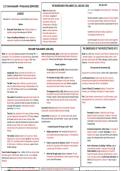
THE BAREBONES PARLIAMENT (JUL 1653-DEC 1653) Why did it fail?
2.2: Commonwealth + Protectorate (1649-1658)
What: Also known as the Conflicts – Radicals VS Moderates Gen. Lambert brought in vote to dissolve Parl + hand power
CONTEXT Nominated Assembly/Parliament to Crom.
of the Saints. Comprised of Religion: (R): Opposed organised religion +
Execution of C = political vacuum, most of country wanted monarchy selected 'lower-gentry' men who a national church, supporting the abolition of Members radicalism: sought to prepare for Christ's kingdom
represented counties, like tithes. (M): Supported tithes as an effective by removing organised religion, believing in the Book of
Options Parliamentarians. Only 26 of way of funding the Church Daniel that 4 ancient monarchies would precede the rule of
these MPs had been in Parl. a fifth.
Bring back Charles Stuart: now 18 living in Holland, but before, so lacked experience. The Law: (R): Sought a biblical law whereby
reputation damaged via involvement in Civil War the courts would be reformed + common law Cromwell: took little part in leading, organising or
Passed 26 ordinances in 5
to be replaced with a simple written code. encouraging the Barebones Parl.
months, such as compulsory
Form an Army/Rump Parliament: ready to embark on
registrations of births/deaths + (M): Sought to maintain existing law without
experiment in republicanism, but the country disliked this Lost Army support: discussed an excise tax and suggested
more poor relief provisions. any fundamental changes
officers give up 1yr pay to allow economising to take place
THE RUMP PARLIAMENT (1650-1653) THE EMERGENCE OF THE PROTECTORATE GOVT.
//.
What: Not a united body following restoration of 80 moderate MPs - a Battle of Worcester (Sept. 1651): 16,000 Scottish meet 28,000 NMA to What: Dec. 1653: Crom. invested as Lord Protector in Westminster hall
continuation of The Long Parliament so demanded loyalty. Only existed achieve a Royalist revival. NMA easily defeated Scottish, killing 3k and - rejected 'Kingship'. Crom. stopped wearing military uniform + wore
because of the Army, so dependent upon it's support. 1649+ Army capturing 10k. Charles Stuart left England + fled to European continent plain black clothes instead. BUT: MPs challenges Crom/IoG authority +
claimed to be a servant of Parl, but reality was the reverse legitimacy - it remained a product of the Army
Passed Legislation
Problems The Instrument of Government (IoG)
The Engagement Act (Jan 1650): Required all adult males to
Unpopularity: Rump only existed due to the Army - if it declare loyalty to the Commonwealth A proposed new constitution by Gen. Lambert, with 3 separate bodies
created it, it could get rid of it. It had committed regicide +
imposed high taxation. It hadn't held elections since 1640 The Toleration Act (Sept. 1650): Legislation to end Lord Protector (Crom.): Head of state, life tenure, annul any
compulsory church attendance so long other alternative measures that went against the Instrument/threatened liberty of
The NMA: Rump relied on NMA for its survival, but tried to worshipping arrangements were made. Marked a significant conscience, dissolve parl. after 5m, veto legislation
reduce it's political influence through 'A Representation of the step away from the belief in liberty of conscience
Army'. YET: The Rump needed the army as it faced threats Council of State (13-21 members): Appoint LP, recruited own
from Scottish + Irish The Navigation Act (Oct. 1651): Made it so imports would only members, act as watchdog, inform/guide LP in policy measures
be accepted if they were carried into England on English ships.
The Levellers: Demanded the 'Agreement of the People' to be Primarily an attack on Dutch shipping which dominated trading Parl.: Single chamber, summoned every 3 yrs, 460 members, county
implemented, requiring widespread political reform. Following ships. Protectionist policy sparked a growth in ship-building seats proportional to tax, control over tax, Catholics excluded from
Burford Mutiny, actions were taken to supress the levellers, inc. industry voting.
executing NMA ringleaders, reintroducing censorship +
imprisoning John Lilburne Successful: Maintained stability of the Commonwealth. Restored Cromwell as a Ruler
national pride. Increased English dominance in Europe
The Irish: Crom. treatment of Irish a part of political mythology Personality: Emotional - subjected to bouts of anger.
used by Royalists/Irish to discredit him. YET: Crom. treatment Unsuccessful: Navigation act = war. War kept taxation high. Avg. 50 Believed in Liberty of conscience, Providence + the God of
of Irish was harsh but within the rules of warfare. Crom. MPs served the Rump. 1652 Army Petition - corrupt + parl. only wanted the old testament (a living God who intervenes). Politically
exultant tones in speeches interpreted as cruelty, but could be sustained powers conservative. Resisted public adulation + aimed to promote
seen as (1) a sign of God, (2) as a way of dealing with a healing/settling
Cromwell dissolved The Rump in 1653 – Why?
stressful mission. His greatest crime in Ireland was being too
Governance perspectives: Julius Caesar - an example of
effective Religious grievances: Parl. introduced the Blasphemy Act dangerous ambition - a dictator. Cincinnatus - a man of
The Scottish: Scottish declared C.S. King of Scot + Britain 1650, targeting dissenting religious groups + preventing liberty republican virtue (a gen. who saved Rome, given dictatorial
following Crom. return from Ireland. Signed the Treaty of Breda of conscience powers, then relinquished them upon Rome's return to
(1650): C.S. committed himself to Presbyterianism, agreement safety)
Failure to carry out new elections: debated 'The Missing Bill'
of 1641 reforms + Catholicism to be banned. Leads to Crom's
the day Crom. closed down Parl. Believed to contain elections Aims of Governance: (1) Healing + Settling: sought to
Scottish campaign
CROMWELL’S DECREES RULE OFtoTHE
vacantMAJOR
seats ORGENERALS (RoMG)
elections to a new Parl. (AUG 1655- 2nd PROTECTORATE PARLIAMENT
reconcile former enemies (SEPT
+ restructure 1656-FEB
the country. (2)
Crom’s Scottish Campaign: Crom. + NMA of 10,000 win decisive Battle JAN 1657) Political Stability: sought
1658)a settlement in line with the
Ordinance for sequestered estates (Feb. 1654): Reform of the legal system: failure to implement The Hale Heads of Proposals, with power divided between 1 person +
of Dunbar against 12,000 Scottish, led by Alexander Leslie. Captured
Royalists whose land was seized during the wars could pay Commissions
What: Cromwell turned torecommendations
the Army + dividedtoEngland
tackle corruption in the legal
into 11 military What: Crom.arecalled
parl. with regular
Parl. elections.
to fund (3) The Godly
the Anglo-Spanish war.reformation:
100 MPs he
6000 prisoners and declared 'let God arise and his enemies shall be
fines to re-acquire them. Crom. hoped this would engender system
districts, each (many
ran by MPs
a Major lawyers)Primary role was to reduce
General. believed
declared ineligible God had
+ banned given
from himtheir
taking a mission
seats.+SOME
it was progress
his duty to
shattered'
new loyalty to the regime disorder, specifically from Pro-Royalists - recruited militia under enforce
made, inc. taxes it to support war + The reformation in manners
passed
Decimation Tax paid by former Royalists. Also intervened on issues continues with laws passed to regulate alehouses + 'incident fashions'
Ordinance to Pardon the People of Scotland (May.
relating to everyday life, encouraging JPs to enforce laws against
2.2: Commonwealth + Protectorate (1649-1658)
What: Also known as the Conflicts – Radicals VS Moderates Gen. Lambert brought in vote to dissolve Parl + hand power
CONTEXT Nominated Assembly/Parliament to Crom.
of the Saints. Comprised of Religion: (R): Opposed organised religion +
Execution of C = political vacuum, most of country wanted monarchy selected 'lower-gentry' men who a national church, supporting the abolition of Members radicalism: sought to prepare for Christ's kingdom
represented counties, like tithes. (M): Supported tithes as an effective by removing organised religion, believing in the Book of
Options Parliamentarians. Only 26 of way of funding the Church Daniel that 4 ancient monarchies would precede the rule of
these MPs had been in Parl. a fifth.
Bring back Charles Stuart: now 18 living in Holland, but before, so lacked experience. The Law: (R): Sought a biblical law whereby
reputation damaged via involvement in Civil War the courts would be reformed + common law Cromwell: took little part in leading, organising or
Passed 26 ordinances in 5
to be replaced with a simple written code. encouraging the Barebones Parl.
months, such as compulsory
Form an Army/Rump Parliament: ready to embark on
registrations of births/deaths + (M): Sought to maintain existing law without
experiment in republicanism, but the country disliked this Lost Army support: discussed an excise tax and suggested
more poor relief provisions. any fundamental changes
officers give up 1yr pay to allow economising to take place
THE RUMP PARLIAMENT (1650-1653) THE EMERGENCE OF THE PROTECTORATE GOVT.
//.
What: Not a united body following restoration of 80 moderate MPs - a Battle of Worcester (Sept. 1651): 16,000 Scottish meet 28,000 NMA to What: Dec. 1653: Crom. invested as Lord Protector in Westminster hall
continuation of The Long Parliament so demanded loyalty. Only existed achieve a Royalist revival. NMA easily defeated Scottish, killing 3k and - rejected 'Kingship'. Crom. stopped wearing military uniform + wore
because of the Army, so dependent upon it's support. 1649+ Army capturing 10k. Charles Stuart left England + fled to European continent plain black clothes instead. BUT: MPs challenges Crom/IoG authority +
claimed to be a servant of Parl, but reality was the reverse legitimacy - it remained a product of the Army
Passed Legislation
Problems The Instrument of Government (IoG)
The Engagement Act (Jan 1650): Required all adult males to
Unpopularity: Rump only existed due to the Army - if it declare loyalty to the Commonwealth A proposed new constitution by Gen. Lambert, with 3 separate bodies
created it, it could get rid of it. It had committed regicide +
imposed high taxation. It hadn't held elections since 1640 The Toleration Act (Sept. 1650): Legislation to end Lord Protector (Crom.): Head of state, life tenure, annul any
compulsory church attendance so long other alternative measures that went against the Instrument/threatened liberty of
The NMA: Rump relied on NMA for its survival, but tried to worshipping arrangements were made. Marked a significant conscience, dissolve parl. after 5m, veto legislation
reduce it's political influence through 'A Representation of the step away from the belief in liberty of conscience
Army'. YET: The Rump needed the army as it faced threats Council of State (13-21 members): Appoint LP, recruited own
from Scottish + Irish The Navigation Act (Oct. 1651): Made it so imports would only members, act as watchdog, inform/guide LP in policy measures
be accepted if they were carried into England on English ships.
The Levellers: Demanded the 'Agreement of the People' to be Primarily an attack on Dutch shipping which dominated trading Parl.: Single chamber, summoned every 3 yrs, 460 members, county
implemented, requiring widespread political reform. Following ships. Protectionist policy sparked a growth in ship-building seats proportional to tax, control over tax, Catholics excluded from
Burford Mutiny, actions were taken to supress the levellers, inc. industry voting.
executing NMA ringleaders, reintroducing censorship +
imprisoning John Lilburne Successful: Maintained stability of the Commonwealth. Restored Cromwell as a Ruler
national pride. Increased English dominance in Europe
The Irish: Crom. treatment of Irish a part of political mythology Personality: Emotional - subjected to bouts of anger.
used by Royalists/Irish to discredit him. YET: Crom. treatment Unsuccessful: Navigation act = war. War kept taxation high. Avg. 50 Believed in Liberty of conscience, Providence + the God of
of Irish was harsh but within the rules of warfare. Crom. MPs served the Rump. 1652 Army Petition - corrupt + parl. only wanted the old testament (a living God who intervenes). Politically
exultant tones in speeches interpreted as cruelty, but could be sustained powers conservative. Resisted public adulation + aimed to promote
seen as (1) a sign of God, (2) as a way of dealing with a healing/settling
Cromwell dissolved The Rump in 1653 – Why?
stressful mission. His greatest crime in Ireland was being too
Governance perspectives: Julius Caesar - an example of
effective Religious grievances: Parl. introduced the Blasphemy Act dangerous ambition - a dictator. Cincinnatus - a man of
The Scottish: Scottish declared C.S. King of Scot + Britain 1650, targeting dissenting religious groups + preventing liberty republican virtue (a gen. who saved Rome, given dictatorial
following Crom. return from Ireland. Signed the Treaty of Breda of conscience powers, then relinquished them upon Rome's return to
(1650): C.S. committed himself to Presbyterianism, agreement safety)
Failure to carry out new elections: debated 'The Missing Bill'
of 1641 reforms + Catholicism to be banned. Leads to Crom's
the day Crom. closed down Parl. Believed to contain elections Aims of Governance: (1) Healing + Settling: sought to
Scottish campaign
CROMWELL’S DECREES RULE OFtoTHE
vacantMAJOR
seats ORGENERALS (RoMG)
elections to a new Parl. (AUG 1655- 2nd PROTECTORATE PARLIAMENT
reconcile former enemies (SEPT
+ restructure 1656-FEB
the country. (2)
Crom’s Scottish Campaign: Crom. + NMA of 10,000 win decisive Battle JAN 1657) Political Stability: sought
1658)a settlement in line with the
Ordinance for sequestered estates (Feb. 1654): Reform of the legal system: failure to implement The Hale Heads of Proposals, with power divided between 1 person +
of Dunbar against 12,000 Scottish, led by Alexander Leslie. Captured
Royalists whose land was seized during the wars could pay Commissions
What: Cromwell turned torecommendations
the Army + dividedtoEngland
tackle corruption in the legal
into 11 military What: Crom.arecalled
parl. with regular
Parl. elections.
to fund (3) The Godly
the Anglo-Spanish war.reformation:
100 MPs he
6000 prisoners and declared 'let God arise and his enemies shall be
fines to re-acquire them. Crom. hoped this would engender system
districts, each (many
ran by MPs
a Major lawyers)Primary role was to reduce
General. believed
declared ineligible God had
+ banned given
from himtheir
taking a mission
seats.+SOME
it was progress
his duty to
shattered'
new loyalty to the regime disorder, specifically from Pro-Royalists - recruited militia under enforce
made, inc. taxes it to support war + The reformation in manners
passed
Decimation Tax paid by former Royalists. Also intervened on issues continues with laws passed to regulate alehouses + 'incident fashions'
Ordinance to Pardon the People of Scotland (May.
relating to everyday life, encouraging JPs to enforce laws against


