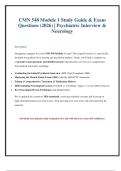
CMN 548 Module 1 Study Guide & Exam
Questions (2026) | Psychiatric Interview &
Neurology
Description
Struggling to prepare for your CMN 548 Module 1 exam? This targeted resource is specifically
designed for graduate-level nursing and psychiatry students. Inside, you'll find a complete set
of practice exam questions and detailed answers that directly cover the core competencies
from Sadock and Carlat, including:
Conducting the Initial Psychiatric Interview (HPI, Chief Complaint, MSE)
Mastering the Mental Status Exam (MSE) with the ABSATTC mnemonic
Taking a Comprehensive Treatment & Medication History
Differentiating Neurological Lesions (Cerebral vs. Cerebellar, Upper vs. Lower Motor Neuron)
Key Neurological Exam Techniques and Interpretation
We've updated the content to 2026 standards, removing outdated concepts and focusing on
high-yield information you need to pass. Stop stressing over your notes and start mastering the
material.
Download your ultimate study companion now and walk into your exam with confidence!
, CMN 548 Module 1 Exam Guide: Psychiatric Interview &
Neurology Questions & Answers
1. When initiating a psychiatric interview, what is the most effective approach for collecting a
patient's identifying data?
a) Use open-ended questions to encourage a narrative response.
b) Ask for specific details directly to ensure accuracy.
c) Defer these questions until after establishing rapport.
d) Rely solely on information from the referral source.
Answer: b) Ask for specific details directly to ensure accuracy.
Explanation: Identifying data, such as name, age, and contact information, consists of concrete
facts. A direct approach minimizes ambiguity and ensures the information is precise and
complete, which is crucial for patient identification, record-keeping, and follow-up care.
2. A patient states their chief complaint as, "The toasters are telling me to reorganize the
government." What is the most appropriate action for the interviewer?
a) Immediately explore the patient's political beliefs.
b) Ask for clarification on what they mean by "toasters."
c) Record the statement verbatim in the chart.
d Gently challenge the reality of the belief.
Answer: c) Record the statement verbatim in the chart.
Explanation: Recording the chief complaint in the patient's own words provides an objective
and unfiltered data point. A bizarre complaint, such as this one, is a significant clinical indicator
that may point to a psychotic process, making its precise documentation essential for diagnostic
purposes.
3. When exploring the History of Present Illness (HPI) for a patient in crisis, what is the most
appropriate initial time frame to focus on?
a) The patient's entire life history.
b) The preceding 1 to 4 weeks.
c) The last 24-48 hours only.
d) The period since their last psychiatric hospitalization.
, Answer: b) The preceding 1 to 4 weeks.
Explanation: Psychiatric crises often develop or escalate over a period of one to four weeks.
Focusing initially on this recent timeframe allows the clinician to efficiently understand the acute
factors leading to the presentation, including recent stressors, symptom onset, and changes in
functioning.
4. A key diagnostic differentiator between schizophrenia and bipolar disorder often revealed in the
history is:
a) The presence of mood symptoms.
b) The patient's premorbid level of functioning.
c) A family history of mental illness.
d) The patient's response to previous medications.
Answer: b) The patient's premorbid level of functioning.
Explanation: In schizophrenia, there is typically a gradual decline in functioning over months or
years. In contrast, a patient with bipolar disorder may have been functioning at a very high level
just weeks before a manic or depressive episode. Establishing the premorbid baseline is therefore
critically important for differential diagnosis.
5. The "Go CHaMP" mnemonic is a structured guide for obtaining which part of the psychiatric
history?
a) Mental Status Exam
b) Review of Systems
c) Treatment History
d) Developmental History
Answer: c) Treatment History
Explanation: The "Go CHaMP" mnemonic helps ensure a comprehensive review of a patient's
treatment history by covering: General questions, Current caregivers, Hospitalization
history, Medication history, and Psychotherapy history.
Questions (2026) | Psychiatric Interview &
Neurology
Description
Struggling to prepare for your CMN 548 Module 1 exam? This targeted resource is specifically
designed for graduate-level nursing and psychiatry students. Inside, you'll find a complete set
of practice exam questions and detailed answers that directly cover the core competencies
from Sadock and Carlat, including:
Conducting the Initial Psychiatric Interview (HPI, Chief Complaint, MSE)
Mastering the Mental Status Exam (MSE) with the ABSATTC mnemonic
Taking a Comprehensive Treatment & Medication History
Differentiating Neurological Lesions (Cerebral vs. Cerebellar, Upper vs. Lower Motor Neuron)
Key Neurological Exam Techniques and Interpretation
We've updated the content to 2026 standards, removing outdated concepts and focusing on
high-yield information you need to pass. Stop stressing over your notes and start mastering the
material.
Download your ultimate study companion now and walk into your exam with confidence!
, CMN 548 Module 1 Exam Guide: Psychiatric Interview &
Neurology Questions & Answers
1. When initiating a psychiatric interview, what is the most effective approach for collecting a
patient's identifying data?
a) Use open-ended questions to encourage a narrative response.
b) Ask for specific details directly to ensure accuracy.
c) Defer these questions until after establishing rapport.
d) Rely solely on information from the referral source.
Answer: b) Ask for specific details directly to ensure accuracy.
Explanation: Identifying data, such as name, age, and contact information, consists of concrete
facts. A direct approach minimizes ambiguity and ensures the information is precise and
complete, which is crucial for patient identification, record-keeping, and follow-up care.
2. A patient states their chief complaint as, "The toasters are telling me to reorganize the
government." What is the most appropriate action for the interviewer?
a) Immediately explore the patient's political beliefs.
b) Ask for clarification on what they mean by "toasters."
c) Record the statement verbatim in the chart.
d Gently challenge the reality of the belief.
Answer: c) Record the statement verbatim in the chart.
Explanation: Recording the chief complaint in the patient's own words provides an objective
and unfiltered data point. A bizarre complaint, such as this one, is a significant clinical indicator
that may point to a psychotic process, making its precise documentation essential for diagnostic
purposes.
3. When exploring the History of Present Illness (HPI) for a patient in crisis, what is the most
appropriate initial time frame to focus on?
a) The patient's entire life history.
b) The preceding 1 to 4 weeks.
c) The last 24-48 hours only.
d) The period since their last psychiatric hospitalization.
, Answer: b) The preceding 1 to 4 weeks.
Explanation: Psychiatric crises often develop or escalate over a period of one to four weeks.
Focusing initially on this recent timeframe allows the clinician to efficiently understand the acute
factors leading to the presentation, including recent stressors, symptom onset, and changes in
functioning.
4. A key diagnostic differentiator between schizophrenia and bipolar disorder often revealed in the
history is:
a) The presence of mood symptoms.
b) The patient's premorbid level of functioning.
c) A family history of mental illness.
d) The patient's response to previous medications.
Answer: b) The patient's premorbid level of functioning.
Explanation: In schizophrenia, there is typically a gradual decline in functioning over months or
years. In contrast, a patient with bipolar disorder may have been functioning at a very high level
just weeks before a manic or depressive episode. Establishing the premorbid baseline is therefore
critically important for differential diagnosis.
5. The "Go CHaMP" mnemonic is a structured guide for obtaining which part of the psychiatric
history?
a) Mental Status Exam
b) Review of Systems
c) Treatment History
d) Developmental History
Answer: c) Treatment History
Explanation: The "Go CHaMP" mnemonic helps ensure a comprehensive review of a patient's
treatment history by covering: General questions, Current caregivers, Hospitalization
history, Medication history, and Psychotherapy history.