

Written by students who passed Immediately available after payment Read online or as PDF Wrong document? Swap it for free 4.6 TrustPilot
logo-home
Document preview thumbnail
Preview 2 out of 12 pages
Exam (elaborations)

OB Peds practices Exam 3 : NUR 231 Concepts Of Nursing: The Childbearing/Child Caring Family - Answered Latest 100% Updated Fall 2025.

Document preview thumbnail
Preview 2 out of 12 pages

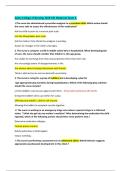
Galen College of Nursing: NUR 231 Maternal Exam 3. 1. The nurse has administered a prescribe analgesic to a preschool child. Which action should the nurse take to assess the effectiveness of this medication? Ask the child to point to a numeric pain scale. Use the Wong-Baker pain scale Ask the mother if she thinks the analgesic is working. Assess for changes in the child’s vital signs. 2. The nurse is caring for a child in middle school who is hospitalized. When developing plan of care, the nurse should consider that children in this age group. Are unable to see things from than any perspective other than their own. Are increasingly aware of disappointments in life. Are anxious about missing interactions with friends. Think in abstract terms and can deal with uncertainly. 3. The nurse is caring for a group of toddlers and is developing a plan for Age-appropriate play activities during hospitalization. Which of the following play activities should the nurse include? Let the toddlers race toy cars against each other. throw ball overhead at 18 months Giving the toddlers dress-up clothes for a play. Offering each toddler, a ball to roll around. Allowing the toddler to complete a puzzle together. 4. The nurse is working in an emergency triage area where a parent brings in a child and states. “I think she got into my mother’s medicine” After determining the medication the child ingested, which of the following actions should then nurse perform next.? Determine medication allergies. Contact poison control. Notify authorities of child neglect. Induce vomiting. 5. The nurse is performing a assessment on an adolescent client. Which behavior suggests appropriate psychosocial development in this client.? Gets along well with others in authority. Thinks about peers’ opinions of them. Validation for socially acceptable behavior from older adults. Navigates away from peers and enjoy spending time with family members. 6. The nurse is performing a nutritional assessment on an adolescent client. Which of the following client statement best indicates the client’ diet is healthy? “We use cheese in some of our meals.” “I make sure to eat 2 meals daily.” “My parents make sure my 7- year-old sibling and I eat the same amount” “I make sure to drink 16 ounces of milk per day” 7. The nurse is caring for a 10- year- old child who is schedule for cardiac surgery. Using Erikson’s theory of psychosocial development, which statement about the surgery is appropriate for the nurse to make to the child? “Only 1 of your parents may stay with you during operation.” “Children rarely have much pain following this type of procedure.” “You will leave your room, go to sleep, and not remember anything” “After the procedure, we will need your help with different task to get you better” 8. The nurse is educating new parent about immunization and immunity. It indicates the need for additional teaching if a parent states. “My child will be protected for life from man disease with passive immunity” “Through active immunity, my child will develop long-term protection against organism” “Passive immunity is what my child gets from me and is short- term protection.” “My child will develop active immunity by producing antibodies to specific organism. 9. The nurse has attended a conference on immunizations. Which of the following of the statement by the nurse that teaching has been effective? “Preterm infants should receive their primary vaccination when they reached full-term birth age”. “The recommended age to begin immunizations is 1 month” “Oral polio vaccine is preferred over inactivated poliovirus vaccine.” “Children who begin a series of vaccinations but fail to complete them need to begin the series again.” 10. The school nurse is on the playground with students and observes a child watching a small group of playing tag. The nurse recognizes this type of play as. Assistive. Associative Onlooker. Parallel. 11. The nurse has provided discharge instructions to the parents of a 3-year-old who had a cardiac catheterization. Which of the following statements by the parents indicates a correct understanding of the teaching? “We encourage our child to engage in normal activity for the next several days” “Our child will need to follow a low- Protein diet for the next week.” High protein d “Our child can take a tub bath beginning tomorrow” No bath tube for one wks “We will refrain from removing the adhesive bandage strip when we get home”. For one wks 12. The nurse is performing a respiratory assessment of an infant. It is necessary for the nurse to notify the primary health care (PHCP)? if the nurse observes that the infant Is using abdominal breathing Has a respiratory rate of 30? Has scattered. 13. The nurse working in the pediatric cardiac unit is reviewing the telemetry monitors for assigned clients. The nurse should initially plan to assess the client who is a. 5-year-old child and is playing with other children in the playroom and has a pulse of 110. 2-year-old toddler and is sleeping and has a pulse of 125. 3-month-old infant and has a fever and a pulse of 148. 14-year-old adolescent and is resting in bed watching television and has a pulse of 110. 14. The nurse is caring for an infant who is having cyanosis, a pulse of 210, and respiratory rate of 78. Which of the following actions should the nurse plan to take first? Administer 11 of oxygen by blow Suction nares and mouth. Place the infant in the knee-chest position. Elevate the infant bed to 30 degrees. 15. The nurse is assessing an infant with patient ductus arteriosus. Which of the following finding should the nurse anticipate, the infant will have? Increased blood pressure (BP) and decreased oxygen saturation. Bounding pulses and a widened pulse pressure. Bounding femoral pulses and weak radial pulses. Increased blood pressure (BP) in the arms and decreased BP in the legs. 16. The nurse is administering pancreatic enzymes to a client who has cystic fibrosis (CF). Which of the following should the nurse include in the client education concerning the administrating of these enzymes? Pancreatic enzymes can be swallowed whole or sprinkled on a small amount of food before eating. Decrease dose of pancreatic enzymes if having frequent, Bulky stools. Do not take pancreatic enzymes if receiving antibiotics. Take pancreatic enzymes between meals as possible. 17. The nurse is caring for a child who had a Tonsillectomy and Adenoidectomy 4 hours ago. Which of the following actions observed by the nurse requires immediate intervention? The child is eating a green popsicle. The child is drinking warm tea with honey. The child is eating ice cream with a spoon. The child is drinking diluted apple juice. 18. The nurse is developing a plan of care for a child who has respiratory syncytial virus (RSV). Which of the following interventions should the nurse include in the infant’s plan of care? Wear a mask when in contact with the child’s siblings. Use contact isolation precautions. Administer antibiotics. Place child in a negative pressure room. 19. The nurse is preparing to administer digoxin to an infant. Upon assessment, the nurse notes that the apical is 88. Based on this finding, which of the following nursing actions is appropriate? Have another nurse verify the apical pulse. Hold the medication. Administer the digoxin. Give half the dose of the digoxin. 20. The nurse is accessing a toddler who is suspected of having epiglottitis. It is necessary for the nurse to immediately notify the primary health care provider (PHCP) if the child. Becomes agitated, is leaning forward with the mouth open, and drooling. Has vesicular breath sounds in the peripheral lung fields. Is leaning backward and supporting self with hands and arms. Developing a barking cough, has a temperature of 101. degree F, and a respiratory rate of 25. 21. The nurse is providing home care instructions to the parent of a child who has cystic fibrosis (CF). Which of the following statements by the parent indicates the need of further teaching? “I will need to give the replacement pancreatic enzymes with every meal and snack.” “I will ensure that our child’s meals contain some type of protein and high-calorie food.” “My child will need to have postural drainage performed once every week.” 3- 4 times every day before meals & before bedtime. “I am sad that my child may not be able to have children when they reach adulthood.” 26. The nurse is teaching the parents of a child who is newly diagnosed with Kawasaki disease. Which of the following statements, if made by a parent, indicates a correct understanding of the disease? “I should avoid giving my child aspirin to help prevent the development of this disease” “My child will need iv blood transfusions for at least 4 weeks” “My child will have a high temperature during the acute phase of the illness” “I should notify my primary health care provider (PHCP) immediately if my child develops peeling of the skin on the hands and feet.” 27. The nurse is monitoring an infant who has respiratory syncytial virus (RSV) bronchiolitis. Which of the following clinical manifestations should the nurse expect to assess? Friction rub. Peeling of the skin on the fingertips. Copious secretions. Barking cough 28. The new nurse and a preceptor are discussing assessment findings for a child with a congenital heart anomaly resulting in chronic cyanosis. Which of the following observations? If stated by the nurse, requires follow-up education by the nurse preceptor? High body mass index (BMI)? Squatting during play activities Exercise intolerance. Clubbing of the nail beds. 29. The nurse is educating a family of a child who is about to return to school after being hospitalized for rheumatic fever with carditis. Which statement, if made by the family, indicates the need for follow-up instruction. “I need to tell the teacher that my child may be extra clumsy, but it will pass.” “My child needs to finish all the prescribed medication” “My child should begin to regain appetite and should have adequate nutrition” “I need to encourage my child to get back to the normal sports practice schedule” 30. The nurse is developing a plan of care for a child with croup. Which of the following should the nurse include in the care plan? Place in the airborne isolation./ Droplet Increase intake of dairy liquids. Assess for barking cough S/S Apply menthol rub to the chest. 31. The nurse is assessing a pediatrics client who is has hepatomegaly, Ascites, and edema. The nurse should plan interventions to treat which possible condition? Right-sided heart failure (HF) Bilateral pneumonia Rheumatic fever. Kawasaki disease. 32. A nurse is caring for adolescent who is newly diagnosed with asthma. Which of the following from the box below should the nurse include in the discharge plan of care? 1. Encourage the child to avoid triggers. 2. Encourage the child to use a peak expiratory flow meter. 3. Encourage the child to play endurance sport. 4. Encourage the child to keep an epinephrine auto-injector pen with them at all times. 5. Encourage the child to rinse their mouth after use of a metered dose inhaler. 6. Encourage the child to use a long-term medication in an emergency. a) 2,3,5. b) 1,3,4,5 c) 2,4,5,6. d) 1,2,5. 33. The nurse is educating a student nurse on Tetralogy of Fallot. Which of the following responses by the student nurse indicates an understanding of the education? “The structural defects would include 1) aortic stenosis. Ventricular septal defect, overriding aorta, right ventricular hypertrophy.” 2) aortic stenosis, atrial septal defect, overriding aorta, left ventricular hypertrophy.” 3) pulmonic stenosis, ventricular septal defect, overriding aorta, right ventricular hypertrophy.” 4) pulmonic stenosis, ventricular septal defect, aortic hypertrophy, left ventricular hypertrophy.” 34. The nurse is caring for a child in the pediatric unit. The nurse has a licensed practical/vocational nurse (LP/VN) and an unlicensed assistant professional (UAP) as part of the care team. Which are the following assignments being appropriate to delegate to a member of the care team? 1) UAP to transport client for a computed tomography (CAT) scan. 2) LPN to administer intravenous immunoglobulin (IVIG) via a central venous access device (CVAD). 3) UAP to insert an indwelling urinary catheter. 4) LPN to educate about current disease process. 35. The triage nurse in the emergency department (ED) must prioritize the children waiting to be seen. Which child is in the greatest need of emergency medical treatment? 1) 3-year-old with a fever of a 100-degrees Fahrenheit, a barky cough, and mild intercostal retractions. 2) 6-year-old with a fever of 104-degrees Fahrenheit, a mufled voice, no spontaneous cough, and drooling. 3) 13-year-old with a fever 104-degrees Fahrenheit, chills, and cough with thick yellow secretions. 4) 4-year-old with a fever of 101-degrees Fahrenheit, a hoarse cough, inspiratory stridor, and restlessness. 36. The nurse is assessing a client who has intussusception. Which of the following is an expected finding? 1) Weight gain. lethargy, vomiting, weight loss. 2) Ribbon-like stools current- jelly -like stool, mixed with the blood & mucus 3) Profuse projectile vomiting. 4) Palpable sausage-shaped mass. URQ 37. The nurse has the attended continuing education conference on enuresis. Which of the following statements by the nurse indicates a correct understanding of the conference.? “Children who are diagnosed with enuresis have inappropriate voiding of urine at least twice a week for at least 3 months.” Below 5 years “The primary treatment for nocturnal enuresis is restricting fluid 30minutes before the evening meal.” “Children who have Phenylketonuria (PKU) typically demonstrate enuresis by age 3 years” “The medication most frequently prescribed to treat the enuresis is haloperidol.” 38. The nurse preceptors is teaching a newly hired knows about the Tracheoesophageal fistula. which of the following should the newly hired nurse identify as a common manifestation.? Excessive coughing and diarrhea. Excessive fatigue and edema. Downloaded by Christal Morales () Excessive lethargy and Constipation. Excessive salivation and chocking. 39. The nurse is caring for a child with probable intussusception. which of the following is the Most appropriate nursing action when the child has normal, brown stool.? Notify the Primary Health care provider PSCHP. It cures itself Auscultate for bowel sounds. Take vital signs, including blood pressure (BP) Measure the child's abdominal girth. 40. The nurse has provided the postoperative education to the parents of a newborn who had a cleft lip repair which of the following statement by the parents indicate a need for further teaching? “I can provide it pacifier to my child as a comfort measure.” “Petroleum Jelly can be applied to the incision “ “My child should be placed in an upright position for feedings” “Pain medication will be prescribed and should be given as ordered” 41. The nurse is assessing a child who is suspected to having a celiac disease. Which of the following findings should the nurse expect the parents to report? Excessive hunger. Anorexia Black and tarry stool. Weight loss. Chronic Constipation. Not chronic 42. The nurse is caring for a child with the celiac disease. The mother of the child has been learning correct food choices for her child in preparation for discharge. Which of the following food choices by the mother indicates a need for further teaching? - Avoid high fiber food avoid barley,matt , matt flovering, oat, rye, wheat, Oatmeal and banana. Corn tortilla tacos and the tapioca pudding. Chicken breast and Spinach. Wild rice and apple slices. 43. The nurse is caring for a 12-year-old female child who has been diagnosed with an Escherichia coli positive urinary tract infection (UTI). The nurse is teaching the child ways to reduce the chance of a future UTI which of the following statement by the child's require follow-up teaching.? “I should wipe from front to back” I should wash my tight leggings daily” “I should avoid hot bubble bath “ “I should drink plenty of water throughout the day.” 44. The nurse is teaching the parent of an infant who has just been diagnosed with Hirschsprung’s disease. Which of the following is statement by the parents indicates teaching about the treatment has been effective? “My infant will have a colostomy placed permanently” “My infant will have Constipation for a few days “ “My infant will have monitor for potential infection following the surgery”? “My infant will follow a high fiber diet “ Slowly to increase. 45. The nurse is assessing a child who is suspected having Heavy acute glomerulonephritis. which of the following is expected finding.?? Hypokalemia Hypertension Enuresis Periorbital edema. 46. The nurse is caring for a child who has admitted to the pediatric unit with nephrotic syndrome. Which of the following laboratory results should the nurse expect to see? Elevated cholesterol. Thrombocytopenia Low specific gravity. Gross hematuria. 47. The nurse is caring for a 3-years old child admitted with the acute diarrhea and dehydration. The child is alert and awake. Which of the following interventions should the nurse implement for this client.? 0.9% sodium chloride oral rehydration solution (ORS) BRAT (banana, rice, applesauce, toast diet.) Not for child Gelatin and popsicles. 48. The nurse is discussing Erikson's stages of development with the parents of a 14-year-old child. which stage of Erikson does the nurse recognize the child is attempting to master? Autonomy Vs shame and doubt. 1-3 Industry Vs inferiority 6-12 Identity Vs role confusion 12-20 Initiative Vs guilt. 3-6 49. The nurse has provided the medication instructions to the parents of an infant who has gastroesophageal reflux disease (GERD) and has been prescribed lansoprazole. Which statement made by the parent indicates the need for additional teaching.? “We will administer the medication when our baby has an empty stomach.” Yes “This medication will help decreases the acid in our baby's stomach.” Yes “We will mix rice cereal with the formula to help thicken feelings.” Yes “Our baby will need to take this medication for a lifetime.” 50. The nurse is discussing the Erikson’s stages of development with the parents of a 4- years old child. Which stage of Erikson does the nurse recognize the child is attempting to master? Initiative versus guilt. Autonomy versus shame and doubt. Industry versus inferiority. Identity versus role confusion. • Acute Glomerulonephritis o Strep throat causes this o Most common of the post infectious renal diseases in childhood o 10 – 21 days between strep infection and clinical manifestations o Can recover totally from this o Will have circulatory congestion, HYPERTENSION, and edema o Signs/Symptoms: Y Oliguria Y Edema Y HYPERTENSION and circulatory congestion Y Hematuria – bleeding in upper respiratory tract O smoky urine Y Proteinuria – increased amount of protein = increased severity of renal disease Y Decreased H&H Y Periorbital edema Y Loss of appetite Y Decreased urinary output Y Cola or tea-colored urine o Management: Y Children with normal BP and urine output can be treated at home Y Moderate sodium restriction and fluid restriction Y DAILY WEIGHTS - Body weight fluid balance – same time every day, same clothing Y Acute hypertension – BP every 4-6 hours • Antihypertensive meds Y I & O’s – DAILY WEIGHT Y Antibiotics only with persistent strep * * Y Will have a lot of fatigue so it will take a while to recover

Content preview

Galen College of Nursing: NUR 231 Maternal Exam 3.
1. The nurse has administered a prescribe analgesic to a preschool child. Which action should
the nurse take to assess the effectiveness of this medication?
Ask the child to point to a numeric pain scale.
Use the Wong-Baker pain scale

Ask the mother if she thinks the analgesic is working.
Assess for changes in the child’s vital signs.
2. The nurse is caring for a child in middle school who is hospitalized. When developing plan
of care, the nurse should consider that children in this age group.
Are unable to see things from than any perspective other than their own.
Are increasingly aware of disappointments in life.
Are anxious about missing interactions with friends.
Think in abstract terms and can deal with uncertainly.
3. The nurse is caring for a group of toddlers and is developing a plan for
Age-appropriate play activities during hospitalization. Which of the following play activities
should the nurse include?
Let the toddlers race toy cars against each other. throw ball overhead at 18 months
Giving the toddlers dress-up clothes for a play.
Offering each toddler, a ball to roll around.
Allowing the toddler to complete a puzzle together.
4. The nurse is working in an emergency triage area where a parent brings in a child and
states. “I think she got into my mother’s medicine” After determining the medication the child
ingested, which of the following actions should then nurse perform next.?
Determine medication allergies.
Contact poison control.
Notify authorities of child neglect.
Induce vomiting.
5. The nurse is performing a assessment on an adolescent client. Which behavior suggests
appropriate psychosocial development in this client.?

, Gets along well with others in authority.
Thinks about peers’ opinions of them.
Validation for socially acceptable behavior from older adults.
Navigates away from peers and enjoy spending time with family members.
6. The nurse is performing a nutritional assessment on an adolescent client. Which of the
following client statement best indicates the client’ diet is healthy?
“We use cheese in some of our meals.”
“I make sure to eat 2 meals daily.”
“My parents make sure my 7- year-old sibling and I eat the same amount”
“I make sure to drink 16 ounces of milk per day”
7. The nurse is caring for a 10- year- old child who is schedule for cardiac surgery. Using
Erikson’s theory of psychosocial development, which statement about the surgery is
appropriate for the nurse to make to the child?
“Only 1 of your parents may stay with you during operation.”
“Children rarely have much pain following this type of procedure.”
“You will leave your room, go to sleep, and not remember anything”
“After the procedure, we will need your help with different task to get you better”
8. The nurse is educating new parent about immunization and immunity. It indicates the need
for additional teaching if a parent states.
“My child will be protected for life from man disease with passive immunity”
“Through active immunity, my child will develop long-term protection against organism”
“Passive immunity is what my child gets from me and is short- term protection.”
“My child will develop active immunity by producing antibodies to specific organism.
9. The nurse has attended a conference on immunizations. Which of the following of the
statement by the nurse that teaching has been effective?
“Preterm infants should receive their primary vaccination when they reached full-term birth
age”.
“The recommended age to begin immunizations is 1 month”
“Oral polio vaccine is preferred over inactivated poliovirus vaccine.”


Document information

Uploaded on
November 24, 2025
Number of pages
12
Written in
2024/2025
Type
Exam (elaborations)
Contains
Questions & answers
$17.99

Wrong document? Swap it for free Within 14 days of purchase and before downloading, you can choose a different document. You can simply spend the amount again.
Written by students who passed
Immediately available after payment
Read online or as PDF

Seller avatar
Reputation scores are based on the amount of documents a seller has sold for a fee and the reviews they have received for those documents. There are three levels: Bronze, Silver and Gold. The better the reputation, the more your can rely on the quality of the sellers work.
MindCraft
3.8
(47)
Sold
370
Followers
7
Items
2789
Last sold
1 day ago


Why students choose Stuvia

Created by fellow students, verified by reviews

Quality you can trust: written by students who passed their tests and reviewed by others who've used these notes.

Didn't get what you expected? Choose another document

No worries! You can instantly pick a different document that better fits what you're looking for.

Pay as you like, start learning right away

No subscription, no commitments. Pay the way you're used to via credit card and download your PDF document instantly.

Student with book image

“Bought, downloaded, and aced it. It really can be that simple.”

Alisha Student

Working on your references?

Create accurate citations in APA, MLA and Harvard with our free citation generator.

Working on your references?

Frequently asked questions
