Unit 4 The Global Economy
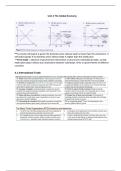
***A country will export a good if its domestic price without trade is lower than the world price. It
will import goods if its domestic price without trade is higher than the world price.
***Free trade = absence of government intervention of any kind in international trade, so that
trade takes place without any restrictions between individuals, firms or governments of different
countries
4.1 International Trade
,4.2 Types of Trade Protection
Trade Protection = government intervention in international trade through the
imposition of trade barriers/restrictions to prevent the free entry of imports into a
country and to protect the domestic economy from foreign competition
TARIFFS → indirect taxes on imported goods.
1. To protect a domestic industry from foreign
competition
2. To raise revenue for government
❖ Increase COP → decrease Sworld (shift
up) → P increase, Qddom decrease, Qsdom
increase, Quint imports decrease
PROS CONS
● Domestic producers: ● domestic consumers: pay a higher price (from Pw to Pw + t),
receive higher price and can only buy a smaller quantity (decreased from Q4 to Q3)
(increased from Pw to Pw ● Worsen domestic income distribution: tariff is regressive,
+ t) and sell a larger burdens lower income people more. As income increases, the
quantity (increased from proportion of income paid as tax falls
Q1 to Q2) ● Increased inefficiency in production: increase in production
● Domestic employment in by inefficiency domestic producers —> waste of scarce
the protected industry resources, inefficiency
increases ● Foreign producers: export a smaller quantity (Q3–Q2), lose
● Government gains tariff export revenues.
revenues: e ● Global misallocation of resources: decrease in consumption,
the shift of production away from more efficient foreign
producers and towards more inefficient domestic producers.
● DWL = d + f
○ D = misallocation of resources caused by increased
production by inefficient domestic producers (g —> g+c)
○ F = loss of consumer surplus due to decreased
consumption (a+b+c+d+e+f —> a+b)
,QUOTAS → legal limit to the quantity of a good that can be imported over a
particular time period
PROS CONS
● domestic producers: receive ● Domestic consumers: pay a higher price (from Pw to
higher price (increased from Pw Pq), and can only buy a smaller quantity (decreased from
to Pq) and sell a larger quantity Q2 to Q4)
(increased from Q1 to Q2) ● Worsen domestic income distribution: higher prices of
● Domestic employment in the goods, which burdens lower income people more
protected industry increases (regressive)
● Increased inefficiency in production: increase in
production by inefficiency domestic producers
● Foreign producers: export a smaller quantity (from Q2-
Q1 to Q4–Q3), lose export revenues.
● Global misallocation of resources: decrease in
consumption, the shift of production away from more
efficient foreign producers and towards more inefficient
domestic producers.
● DWL = d + f
○ D = misallocation of resources caused by
increased production by inefficient domestic
producers (g —> g+c)
○ F = loss of consumer surplus due to decreased
consumption (a+b+c+d+e+f —> a+b)
Neutral Impact: government doesn’t gain revenue / lose money
, PRODUCTION SUBSIDIES — payments per unit of output granted by the government on
domestic producers that compete with imports.
PROS CONS
● domestic producers: receive ● Government loses: pay subsidy (greater budget deficit /
higher price (increased from Pw smaller surplus) (green area)
to Pw+sub) and sell a larger ● Gov opportunity costs: could spent on more merit goods
quantity (increased from Q1 to ● Taxpayers pay indirectly for subsidy
Q3) ● Increased inefficiency in production: domestic producers
● Domestic employment in the can protected by the higher prices they receive
protected industry increases ● Foreign producers: export a smaller quantity, lose export
revenues.
● Global misallocation of resources: the shift of production from
efficient foreign producers towards more inefficient domestic
producers.
● DWL
○ Inefficient production
Neutral Impact: domestic consumers unaffected (pay same price and can purchase same quantity)
***A country will export a good if its domestic price without trade is lower than the world price. It
will import goods if its domestic price without trade is higher than the world price.
***Free trade = absence of government intervention of any kind in international trade, so that
trade takes place without any restrictions between individuals, firms or governments of different
countries
4.1 International Trade
,4.2 Types of Trade Protection
Trade Protection = government intervention in international trade through the
imposition of trade barriers/restrictions to prevent the free entry of imports into a
country and to protect the domestic economy from foreign competition
TARIFFS → indirect taxes on imported goods.
1. To protect a domestic industry from foreign
competition
2. To raise revenue for government
❖ Increase COP → decrease Sworld (shift
up) → P increase, Qddom decrease, Qsdom
increase, Quint imports decrease
PROS CONS
● Domestic producers: ● domestic consumers: pay a higher price (from Pw to Pw + t),
receive higher price and can only buy a smaller quantity (decreased from Q4 to Q3)
(increased from Pw to Pw ● Worsen domestic income distribution: tariff is regressive,
+ t) and sell a larger burdens lower income people more. As income increases, the
quantity (increased from proportion of income paid as tax falls
Q1 to Q2) ● Increased inefficiency in production: increase in production
● Domestic employment in by inefficiency domestic producers —> waste of scarce
the protected industry resources, inefficiency
increases ● Foreign producers: export a smaller quantity (Q3–Q2), lose
● Government gains tariff export revenues.
revenues: e ● Global misallocation of resources: decrease in consumption,
the shift of production away from more efficient foreign
producers and towards more inefficient domestic producers.
● DWL = d + f
○ D = misallocation of resources caused by increased
production by inefficient domestic producers (g —> g+c)
○ F = loss of consumer surplus due to decreased
consumption (a+b+c+d+e+f —> a+b)
,QUOTAS → legal limit to the quantity of a good that can be imported over a
particular time period
PROS CONS
● domestic producers: receive ● Domestic consumers: pay a higher price (from Pw to
higher price (increased from Pw Pq), and can only buy a smaller quantity (decreased from
to Pq) and sell a larger quantity Q2 to Q4)
(increased from Q1 to Q2) ● Worsen domestic income distribution: higher prices of
● Domestic employment in the goods, which burdens lower income people more
protected industry increases (regressive)
● Increased inefficiency in production: increase in
production by inefficiency domestic producers
● Foreign producers: export a smaller quantity (from Q2-
Q1 to Q4–Q3), lose export revenues.
● Global misallocation of resources: decrease in
consumption, the shift of production away from more
efficient foreign producers and towards more inefficient
domestic producers.
● DWL = d + f
○ D = misallocation of resources caused by
increased production by inefficient domestic
producers (g —> g+c)
○ F = loss of consumer surplus due to decreased
consumption (a+b+c+d+e+f —> a+b)
Neutral Impact: government doesn’t gain revenue / lose money
, PRODUCTION SUBSIDIES — payments per unit of output granted by the government on
domestic producers that compete with imports.
PROS CONS
● domestic producers: receive ● Government loses: pay subsidy (greater budget deficit /
higher price (increased from Pw smaller surplus) (green area)
to Pw+sub) and sell a larger ● Gov opportunity costs: could spent on more merit goods
quantity (increased from Q1 to ● Taxpayers pay indirectly for subsidy
Q3) ● Increased inefficiency in production: domestic producers
● Domestic employment in the can protected by the higher prices they receive
protected industry increases ● Foreign producers: export a smaller quantity, lose export
revenues.
● Global misallocation of resources: the shift of production from
efficient foreign producers towards more inefficient domestic
producers.
● DWL
○ Inefficient production
Neutral Impact: domestic consumers unaffected (pay same price and can purchase same quantity)