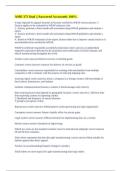
AMD 372 final || Answered Accurately 100%.
4 steps required for apparel factories to become certified by WRAP correct answers 1 :
Factory applies to be evaluated by WRAP and pays a fee.
2 : Factory performs a three-month self-assessment using WRAP guidelines and submits a
report.
3 : Factory performs a three-month self-assessment using WRAP guidelines and submits a
report
4 : Based on WRAP evaluation of the report, factory either has to improve certain issues or is
recommended to be certified by WRAP.
WRAP (worldwide responsible accredited production) correct answers an independent
nonprofit corporation dedicated to the promotion and certification of lawful, humane, and
ethical manufacturing throughout the world
Vendor correct answers Delivers services or finished goods
Customer correct answers contracts for delivery of services or goods
Consolidator correct answers responsible for working with merchandise from multiple
companies to fill a container with the purpose of reducing shipping rates
Sourcing Agent correct answers assists a company in a foreign country with knowledge of
local culture, bureaucracy, and industry
facilitate communications between a retailer or brand manager and a factory
three sourcing factors than depend on geographic location: correct answers 1; Delivery time
from exporting country to importing country
2; likelihood and frequency of natural disasters
3; people's perception of time
Bureaucracy correct answers Administrative system governing any large organization
Corruption correct answers Abuse of public office for private gains
Legal system correct answers Official structure for implementing laws in a country
Morals correct answers Standards of right/wrong
Which two sizes are the standard container sizes for international shipping? correct answers
20 and 40 foot containers
Select three statements that describe agile manufacturing. correct answers Most suitable for
fashion apparel than basic apparel.
Focuses on accommodating frequent changes in product.
Small orders are more typical for agile manufacturing than large orders.
, Lean manufacturing. correct answers More suitable for basic apparel than fashion apparel
Employed to achieve efficiency and decrease product cost
well suited for large orders (rather than small batches)
Select three statements that are true about WRAP: correct answers WRAP now stands for
Worldwide Responsible Accredited Production
Focuses on promoting and certifying ethical labor conditions around the world.
It takes several years for a factory to become WRAP certified manufacturing facility.
T/F According to WTO, country of origin is defined now as the country where a substantial
transformation of apparel product occurs during assembly process. correct answers True
Country of origin labeling is: correct answers required in order to determine tariff rates to
charge import duty on products at the Customs
Central American countries correct answers Primarily CMT factories that often use US-made
fabrics
India correct answers Most factories offer full-package service and capable of intricate
garment embellishments
Sri Lanka correct answers Many full-package factories specialize in intimate apparel
China correct answers A wide range of factories at different price points, with a broad
selection of materials available in the country
Bangaladesh correct answers Primarily CMT factories that specialize in cotton knit and
woven garments
LDP Garment correct answers Landed-duty-paid Garment final cost when it is in your DC
(everything you paid to make and get them there)Includes cost of goods, transporting, duties,
and custom clearance.
LDP= correct answers FOB + shipping + duty + customs clearance + insurance + in-land
transportation to DC
CIF garment correct answers Includes all production and packaging costs as well as insurance
and shipping expenses to the destination.
FOB= correct answers Fabric cost + production cost (CMT) + agent cost
FOB (Free on Board) correct answers - Includes all production and packaging costs as well as
expenses associated with getting the goods on a vessel in exporting country.
- Material cost (fabrics and trims) + labor cost (CMT)
- Garment cost when the order leaves the country (what you pay the factory per garment)
4 steps required for apparel factories to become certified by WRAP correct answers 1 :
Factory applies to be evaluated by WRAP and pays a fee.
2 : Factory performs a three-month self-assessment using WRAP guidelines and submits a
report.
3 : Factory performs a three-month self-assessment using WRAP guidelines and submits a
report
4 : Based on WRAP evaluation of the report, factory either has to improve certain issues or is
recommended to be certified by WRAP.
WRAP (worldwide responsible accredited production) correct answers an independent
nonprofit corporation dedicated to the promotion and certification of lawful, humane, and
ethical manufacturing throughout the world
Vendor correct answers Delivers services or finished goods
Customer correct answers contracts for delivery of services or goods
Consolidator correct answers responsible for working with merchandise from multiple
companies to fill a container with the purpose of reducing shipping rates
Sourcing Agent correct answers assists a company in a foreign country with knowledge of
local culture, bureaucracy, and industry
facilitate communications between a retailer or brand manager and a factory
three sourcing factors than depend on geographic location: correct answers 1; Delivery time
from exporting country to importing country
2; likelihood and frequency of natural disasters
3; people's perception of time
Bureaucracy correct answers Administrative system governing any large organization
Corruption correct answers Abuse of public office for private gains
Legal system correct answers Official structure for implementing laws in a country
Morals correct answers Standards of right/wrong
Which two sizes are the standard container sizes for international shipping? correct answers
20 and 40 foot containers
Select three statements that describe agile manufacturing. correct answers Most suitable for
fashion apparel than basic apparel.
Focuses on accommodating frequent changes in product.
Small orders are more typical for agile manufacturing than large orders.
, Lean manufacturing. correct answers More suitable for basic apparel than fashion apparel
Employed to achieve efficiency and decrease product cost
well suited for large orders (rather than small batches)
Select three statements that are true about WRAP: correct answers WRAP now stands for
Worldwide Responsible Accredited Production
Focuses on promoting and certifying ethical labor conditions around the world.
It takes several years for a factory to become WRAP certified manufacturing facility.
T/F According to WTO, country of origin is defined now as the country where a substantial
transformation of apparel product occurs during assembly process. correct answers True
Country of origin labeling is: correct answers required in order to determine tariff rates to
charge import duty on products at the Customs
Central American countries correct answers Primarily CMT factories that often use US-made
fabrics
India correct answers Most factories offer full-package service and capable of intricate
garment embellishments
Sri Lanka correct answers Many full-package factories specialize in intimate apparel
China correct answers A wide range of factories at different price points, with a broad
selection of materials available in the country
Bangaladesh correct answers Primarily CMT factories that specialize in cotton knit and
woven garments
LDP Garment correct answers Landed-duty-paid Garment final cost when it is in your DC
(everything you paid to make and get them there)Includes cost of goods, transporting, duties,
and custom clearance.
LDP= correct answers FOB + shipping + duty + customs clearance + insurance + in-land
transportation to DC
CIF garment correct answers Includes all production and packaging costs as well as insurance
and shipping expenses to the destination.
FOB= correct answers Fabric cost + production cost (CMT) + agent cost
FOB (Free on Board) correct answers - Includes all production and packaging costs as well as
expenses associated with getting the goods on a vessel in exporting country.
- Material cost (fabrics and trims) + labor cost (CMT)
- Garment cost when the order leaves the country (what you pay the factory per garment)