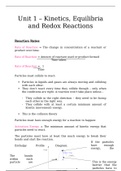
Unit 1 – Kinetics, Equilibria
and Redox Reactions
Reaction Rates
Rate of Reaction = The change in concentration of a reactant or
product over time.
Rate of Reaction = Amount of reactant used or product formed
Time taken
Rate of Reaction = 1
Time
Particles must collide to react:
Particles in liquids and gases are always moving and colliding
with each other.
They don’t react every time they collide though – only when
the conditions are right. A reaction won’t take place unless –
- They collide in the right direction – they need to be facing
each other in the right way.
- They collide with at least a certain minimum amount of
kinetic (movement) energy.
This is the collision theory
Particles must have enough energy for a reaction to happen:
Activation Energy = The minimum amount of kinetic energy that
particles need to react.
The particles must have at least this much energy to break their
bonds and start the reaction.
If the particles
Enthalpy Profile Diagram: have enough
energy, the
bonds will
The bonds
within each
particle are This is the energy
being stretched. barrier that the
particles have to
, Reactions with low activation energies often happy pretty easily
however, reactions with high activation energies don’t – you need
to give the particles extra energy by heating them.
Molecules in a gas don’t all have the same amount of energy:
With molecules in a gas, some don’t have much kinetic energy
and move slowly. Others have lots of kinetic energy however
and whizz along. But most molecules are somewhere in
between.
If you plot a graph of the number of molecules in gas with
different kinetic energies it produces a Maxwell-Boltzmann
Distribution.
Maxwell-Boltzmann Distribution
Very small % of particles have E > Eact – Energy rather than
activation energy so most collisions don’t result in a reaction.
Increasing the Temperature makes reactions faster
1. If you increase the temperature of a reaction, the particles on
average have more kinetic energy and will move faster.
2. So a greater proportion of molecules will have at least the
activation energy and be able to react. This changes the shape
of the Maxwell – Boltzmann Distribution
3. Curve – pushing it over to the right.
and Redox Reactions
Reaction Rates
Rate of Reaction = The change in concentration of a reactant or
product over time.
Rate of Reaction = Amount of reactant used or product formed
Time taken
Rate of Reaction = 1
Time
Particles must collide to react:
Particles in liquids and gases are always moving and colliding
with each other.
They don’t react every time they collide though – only when
the conditions are right. A reaction won’t take place unless –
- They collide in the right direction – they need to be facing
each other in the right way.
- They collide with at least a certain minimum amount of
kinetic (movement) energy.
This is the collision theory
Particles must have enough energy for a reaction to happen:
Activation Energy = The minimum amount of kinetic energy that
particles need to react.
The particles must have at least this much energy to break their
bonds and start the reaction.
If the particles
Enthalpy Profile Diagram: have enough
energy, the
bonds will
The bonds
within each
particle are This is the energy
being stretched. barrier that the
particles have to
, Reactions with low activation energies often happy pretty easily
however, reactions with high activation energies don’t – you need
to give the particles extra energy by heating them.
Molecules in a gas don’t all have the same amount of energy:
With molecules in a gas, some don’t have much kinetic energy
and move slowly. Others have lots of kinetic energy however
and whizz along. But most molecules are somewhere in
between.
If you plot a graph of the number of molecules in gas with
different kinetic energies it produces a Maxwell-Boltzmann
Distribution.
Maxwell-Boltzmann Distribution
Very small % of particles have E > Eact – Energy rather than
activation energy so most collisions don’t result in a reaction.
Increasing the Temperature makes reactions faster
1. If you increase the temperature of a reaction, the particles on
average have more kinetic energy and will move faster.
2. So a greater proportion of molecules will have at least the
activation energy and be able to react. This changes the shape
of the Maxwell – Boltzmann Distribution
3. Curve – pushing it over to the right.