

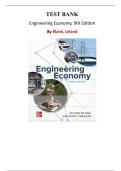
TEST BANK
Engineering Economy, 9th Edition
By Blank, Leland
N
U
R
SE
D
O
C
S
,TABLE OF CONTENT
1) Foundations of Engineering Economy
2) Factors: How Time and Interest Affect Money
3) Combining Factors and Spreadsheet Functions
4) Nominal and Effective Interest Rates
Learning Stage 2 - Basic Analysis Tools
5) Analysis Using Present Worth and Future Worth Values
6) Annual Worth Analysis
N
7) Rate of Return Analysis: One Project
8) Rate of Return Analysis: Multiple Alternatives
U
9) Benefit/Cost Analysis and Public Sector Economics
Learning Stage 2 - Epilogue: Selecting the Basic Analysis Tool
R
Learning Stage 3 - Making Decisions
10) Project Financing and Noneconomic Attributes
SE
11) Replacement and Retention Decisions
12) Independent Projects with Budget Limitation
13) Breakeven and Payback Analysis
Learning Stage 4 - Rounding Out the Study
D
14) Effects of Inflation
15) Cost Estimation and Indirect Cost Allocation
O
16) Depreciation and Depletion Methods
17) After-Tax Economic Analysis
18) Sensitivity Analysis and Staged Decisions
C
19) Decision Making under Risk
S
,Student name:__________
TRUE/FALSE - Write 'T' if the statement is true and 'F' if the statement is false.
Interest rates are always expressed as a percentage over an annual time period.
true
false
When interest is compounded annually, the amount of money accumulated in one year is the
same under either a simple or compound interest scenario.
N
true
U
false
R
The symbol for present worth is P and it always represents a cash outflow (cost).
true
SE
false
A company's minimum attractive rate of return is generally equal to the rate of return obtainable
on a bank savings account.
D
true
false
O
Cash inflows are also known as disbursements.
C
true
false
S
Version 1 1
, Answer Key
Test name: CH01
FALSE
The time period does not have to be annual.
TRUE
FALSE
N
The Symbol P can also represent a net income.
U
FALSE
A company's MARR is usually higher than the safe rate.
R
FALSE
SE
Dispursements are cash outflows.
D
O
C
S
Version 1 2
Engineering Economy, 9th Edition
By Blank, Leland
N
U
R
SE
D
O
C
S
,TABLE OF CONTENT
1) Foundations of Engineering Economy
2) Factors: How Time and Interest Affect Money
3) Combining Factors and Spreadsheet Functions
4) Nominal and Effective Interest Rates
Learning Stage 2 - Basic Analysis Tools
5) Analysis Using Present Worth and Future Worth Values
6) Annual Worth Analysis
N
7) Rate of Return Analysis: One Project
8) Rate of Return Analysis: Multiple Alternatives
U
9) Benefit/Cost Analysis and Public Sector Economics
Learning Stage 2 - Epilogue: Selecting the Basic Analysis Tool
R
Learning Stage 3 - Making Decisions
10) Project Financing and Noneconomic Attributes
SE
11) Replacement and Retention Decisions
12) Independent Projects with Budget Limitation
13) Breakeven and Payback Analysis
Learning Stage 4 - Rounding Out the Study
D
14) Effects of Inflation
15) Cost Estimation and Indirect Cost Allocation
O
16) Depreciation and Depletion Methods
17) After-Tax Economic Analysis
18) Sensitivity Analysis and Staged Decisions
C
19) Decision Making under Risk
S
,Student name:__________
TRUE/FALSE - Write 'T' if the statement is true and 'F' if the statement is false.
Interest rates are always expressed as a percentage over an annual time period.
true
false
When interest is compounded annually, the amount of money accumulated in one year is the
same under either a simple or compound interest scenario.
N
true
U
false
R
The symbol for present worth is P and it always represents a cash outflow (cost).
true
SE
false
A company's minimum attractive rate of return is generally equal to the rate of return obtainable
on a bank savings account.
D
true
false
O
Cash inflows are also known as disbursements.
C
true
false
S
Version 1 1
, Answer Key
Test name: CH01
FALSE
The time period does not have to be annual.
TRUE
FALSE
N
The Symbol P can also represent a net income.
U
FALSE
A company's MARR is usually higher than the safe rate.
R
FALSE
SE
Dispursements are cash outflows.
D
O
C
S
Version 1 2


