-
Definition
-
Symbol
Bond and bond
length
energy
Heat of reaction (At--The chemical potential the system
net
change of energy of
Exothermic reactions Reactions which chemical
transform potential into thermal
--
energy energy
Endothermic reactions >
-
Reactions which transform thermal energy into chemical potential energy
Activation energy (Ea)
--
The minimum
energy required to start a chemical reaction
or
The
required to form the activated complex
energy
Activated complex --
A
high energy ,
unstable , temporary transition state between the reactants and
the
products s.
Endothermic reactions break down bonds Exothermic reactions build bonds
AH >0
1HL0
-
A
stronger bond requires more
energy
to build/break down bonds
-
Exothermic reactions release and thus increases the temperature of the
energy
reaction mixtures
Endothermic reactions absorb thus decrease the temperature of the
-
and
energy
reaction mixtures .
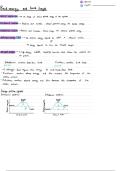
Energy profile graphs :
Exothermic reactions : Endothermic reactions :
Activated
E Activata E
complex
-
o
t -
u -
1
Ea
..........
Produce ---Eq
-
E
-
AH
Products Reactants ---
↳
V - - -
- - -
Course of reaction Course of reaction
,kates
of reactions :
Rates reaction The
of - >
change in concentration per unit time of either a reactant or
product.
Asproducts) - Adreactants
Rate of reaction = At
=
At
-
On concentration the
a time
graph the
gradient represents rate of reaction .
Collision
theory :
Collision different before reaction
theory
- >
The particles of reactants first have to collide with each other a can take place.
-
Only effective collisions can lead to chemical reactions
> A collision is effective when:
1 Particles have break bonds and activation
enough kinetic energy to existing energy
.
overcome
2
. Particles have the correct orientation
Factors that influence the rate of reaction
Nature of reactants :
Ionic react faster than covalent
substances usually substances
-
Organic due covalent molecules
-
molecules take to bonds and
large
longer many
Metals
high
-
in the reactivity series react faster
up
Concentration : 10 mol dm-3
.
-
5 mol . dm-3
Only mol dm-3
-
in
aqueous /age
solutions and gasses/y) 0
,5 .
-
Number particles container
-
The reaction limited
of
per volume in the increases is
by
another substance
More collisions
-
If substance was
limiting reagent
-
occur
per second
then volume of CO2 produced would be
Increases Time
-
the chance of effective collisions per second to occur . greater with a
greater concentration
-
Rate of reaction increases
Definition
-
Symbol
Bond and bond
length
energy
Heat of reaction (At--The chemical potential the system
net
change of energy of
Exothermic reactions Reactions which chemical
transform potential into thermal
--
energy energy
Endothermic reactions >
-
Reactions which transform thermal energy into chemical potential energy
Activation energy (Ea)
--
The minimum
energy required to start a chemical reaction
or
The
required to form the activated complex
energy
Activated complex --
A
high energy ,
unstable , temporary transition state between the reactants and
the
products s.
Endothermic reactions break down bonds Exothermic reactions build bonds
AH >0
1HL0
-
A
stronger bond requires more
energy
to build/break down bonds
-
Exothermic reactions release and thus increases the temperature of the
energy
reaction mixtures
Endothermic reactions absorb thus decrease the temperature of the
-
and
energy
reaction mixtures .
Energy profile graphs :
Exothermic reactions : Endothermic reactions :
Activated
E Activata E
complex
-
o
t -
u -
1
Ea
..........
Produce ---Eq
-
E
-
AH
Products Reactants ---
↳
V - - -
- - -
Course of reaction Course of reaction
,kates
of reactions :
Rates reaction The
of - >
change in concentration per unit time of either a reactant or
product.
Asproducts) - Adreactants
Rate of reaction = At
=
At
-
On concentration the
a time
graph the
gradient represents rate of reaction .
Collision
theory :
Collision different before reaction
theory
- >
The particles of reactants first have to collide with each other a can take place.
-
Only effective collisions can lead to chemical reactions
> A collision is effective when:
1 Particles have break bonds and activation
enough kinetic energy to existing energy
.
overcome
2
. Particles have the correct orientation
Factors that influence the rate of reaction
Nature of reactants :
Ionic react faster than covalent
substances usually substances
-
Organic due covalent molecules
-
molecules take to bonds and
large
longer many
Metals
high
-
in the reactivity series react faster
up
Concentration : 10 mol dm-3
.
-
5 mol . dm-3
Only mol dm-3
-
in
aqueous /age
solutions and gasses/y) 0
,5 .
-
Number particles container
-
The reaction limited
of
per volume in the increases is
by
another substance
More collisions
-
If substance was
limiting reagent
-
occur
per second
then volume of CO2 produced would be
Increases Time
-
the chance of effective collisions per second to occur . greater with a
greater concentration
-
Rate of reaction increases