
Containment Strategies of Infectious Diseases in Global Context
L1: Introduction to Course and Assignment Theory
Epidemic- on rise
Endemic- always at certain level – not rise of real concern
Pandemic- worldwide
Isolation vs quarantine- isolation is locking someone up when there is
confirmed case. Quarantine- suspected case.
Spanish flu- influenza 1918-1919 – Spanish first to report as other
countries busy with war
Stigma- one of biggest challenges for infectious disease- cancer vs STI vs
mental health
Evidence informed decision making – linking the problem to the solution.
Evidence and context (what works for where for whom).
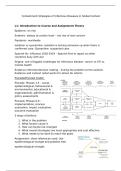
Precede/Proceed model:
Precede- Phases 1-5 – social,
epidemiological, behavioural &
environmental, educational &
organizational, administration &
policy assessments
Proceed- Phases 6-9 –
implementation, process
evaluation, impact evaluation,
outcome evaluation
5 steps of Jenkins:
1. What is the problem
2. What factors cause it
3. How can factors be changed
4. What overall strategies are most appropriate and cost effective
5. What needs to be done to reach the goals
Assignment- show references used. Use
epidemiological triangle and problem tree
epidemiological triangle:
,Disease occurrence: Is the result of an interaction between host, agent
(vector) and environment
– Agents/Factors which absence or presence
cause the disease
– Susceptible host
– Favorable environment
Social/economic:
• Low economic level strongest predictor of poor health and high mortality
• Low educational level next strongest predictor
Problem tree- understanding of where to intervene
How can factors be changed? 5 basic strategies: remove the agent, raise
host resistance, modify environment, separate agent and host, interrupt
transmission
Primary, secondary, tertiary prevention: primary-before disease,
secondary- early detection and treatment, tertiary- prevent further
disability
Multi criteria decision making – criteria for best interventions
Selecting the best intervention:
Medical technical effectiveness: extent to which it controls the disease
Organization feasibility: implementation of intervention (level of facilities,
skills of health workers) - does it fit in with existing services.
Social, cultural and ‘political’ feasibility: acceptability of intervention to
community and (political) leader
Financial feasibility: costs for personnel and materials, et; economic
appraisal and sustainability
What needs to be done to reach the goals? With what (sub)populations
shall work be done, and in what sequence, to solve the problem?
Anticipate barriers to implementation and negative side effects
L2: Control of Infectious diseases
MDA: mass drug administration- lets treat everyone, no diagnosing
More than 60% zoonotic
One health: human, animal and environmental
Infection: when a microorganism is present in a host in placed where it is
not normally found (replicating)
, Infectious disease: when this causes symptoms
Bacteria, viruses, protozoa, multicellular, external (fleas), non living
(prions)
Direct vs indirect transmission:
Direct: skin skin, blood, across placenta, sneeze cough, breast milk
Indirect: food, water, vector bourne
Exposure: skin, sexual, water etc
Subclinical- don’t see them as they don’t get sick but carry the disease
Index case- the first case identified in the population
Primary case – case that brings infection into a population
Secondary – infected by a primary case
Tertiary – infected by a secondary case
Sometimes miss a person because they were not symptomatic
Reproductive rate- how many people one person can
infect
determined by: the agent, susceptible hosts and
relevant contacts
1st graph- Graph with one wave- one source of
infection not human to human – point source outbreak
2nd graph- continuing source outbreak (eg contaminate
water)
3rd graph- propagated spread eg covid
L1: Introduction to Course and Assignment Theory
Epidemic- on rise
Endemic- always at certain level – not rise of real concern
Pandemic- worldwide
Isolation vs quarantine- isolation is locking someone up when there is
confirmed case. Quarantine- suspected case.
Spanish flu- influenza 1918-1919 – Spanish first to report as other
countries busy with war
Stigma- one of biggest challenges for infectious disease- cancer vs STI vs
mental health
Evidence informed decision making – linking the problem to the solution.
Evidence and context (what works for where for whom).
Precede/Proceed model:
Precede- Phases 1-5 – social,
epidemiological, behavioural &
environmental, educational &
organizational, administration &
policy assessments
Proceed- Phases 6-9 –
implementation, process
evaluation, impact evaluation,
outcome evaluation
5 steps of Jenkins:
1. What is the problem
2. What factors cause it
3. How can factors be changed
4. What overall strategies are most appropriate and cost effective
5. What needs to be done to reach the goals
Assignment- show references used. Use
epidemiological triangle and problem tree
epidemiological triangle:
,Disease occurrence: Is the result of an interaction between host, agent
(vector) and environment
– Agents/Factors which absence or presence
cause the disease
– Susceptible host
– Favorable environment
Social/economic:
• Low economic level strongest predictor of poor health and high mortality
• Low educational level next strongest predictor
Problem tree- understanding of where to intervene
How can factors be changed? 5 basic strategies: remove the agent, raise
host resistance, modify environment, separate agent and host, interrupt
transmission
Primary, secondary, tertiary prevention: primary-before disease,
secondary- early detection and treatment, tertiary- prevent further
disability
Multi criteria decision making – criteria for best interventions
Selecting the best intervention:
Medical technical effectiveness: extent to which it controls the disease
Organization feasibility: implementation of intervention (level of facilities,
skills of health workers) - does it fit in with existing services.
Social, cultural and ‘political’ feasibility: acceptability of intervention to
community and (political) leader
Financial feasibility: costs for personnel and materials, et; economic
appraisal and sustainability
What needs to be done to reach the goals? With what (sub)populations
shall work be done, and in what sequence, to solve the problem?
Anticipate barriers to implementation and negative side effects
L2: Control of Infectious diseases
MDA: mass drug administration- lets treat everyone, no diagnosing
More than 60% zoonotic
One health: human, animal and environmental
Infection: when a microorganism is present in a host in placed where it is
not normally found (replicating)
, Infectious disease: when this causes symptoms
Bacteria, viruses, protozoa, multicellular, external (fleas), non living
(prions)
Direct vs indirect transmission:
Direct: skin skin, blood, across placenta, sneeze cough, breast milk
Indirect: food, water, vector bourne
Exposure: skin, sexual, water etc
Subclinical- don’t see them as they don’t get sick but carry the disease
Index case- the first case identified in the population
Primary case – case that brings infection into a population
Secondary – infected by a primary case
Tertiary – infected by a secondary case
Sometimes miss a person because they were not symptomatic
Reproductive rate- how many people one person can
infect
determined by: the agent, susceptible hosts and
relevant contacts
1st graph- Graph with one wave- one source of
infection not human to human – point source outbreak
2nd graph- continuing source outbreak (eg contaminate
water)
3rd graph- propagated spread eg covid


