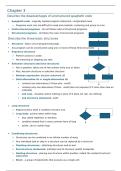
Chapter 3: Consumer buying behaviour
3.1 Consumer Behaviour: Between Rationality, Irrationality and Hedonism
cognitive processes:
automatic thinking <-> deliberate (unhurried and careful) thinking
complementary:
→ system 1: handles routine and familiar tasks
→ system 2: solves more complex problems
conflict:
→ System 1 quick judgment can lead to mistakes
that system 2 needs to correct
→ System 1 makes us vulnerable to biases
1. Confirmation bias: The tendency for individuals to seek out, interpret, and remember
information in a way that confirms their pre-existing beliefs, while disregarding or
minimizing evidence that contradicts those beliefs.
- Selective search for information
- Interpretation of information
- Recall of information
- Ignore warning sings
example: You invest in a tech company:
→ Focus on financial reports that are positive about the company
→ The significance of negative news is downplayed
→ You remember past instances where investments in tech have
paid off but overlooks instances where youlost money
2. Availability heuristic: Assess the frequency of a class or the probability of an event by
the ease with which instances or occurrences can be brought to mind
We are biased by information that is:
- Easier to recall
- Memorable, vivid, or recent
- More salient (our attention is drawn to it)
- Available
example: 9/11:
3000 people died in one day. → Out of fear of new attacks, people
started travelling by car
Car crashes: 3000 deaths per month
3. Likeability heuristic: We are more likely influenced by people we like
Likeability:
- People who are similar to us
- People we recognize
- People who pay us compliments
, - Attractive people (halo-effect)
example: cookbook by influencers
4. Endowment effect: Tendency for people to overvalue something they own
example: returnment policy → you feel like you already own it
5. Present bias : Stronger preference for immediate rewards
Longer-term goals <->immediate pleasure
example: buy 1 get 1 free
6. Sunk cost fallacy: the amount of time, money or effort you already invested in
something => will make it harder to let go of things
7. Blindspot bias or bias bias: To think you are less biased than everyone else
- Failing to recognize your own cognitive biases is a bias in itself
- People notice cognitive and motivational biases much more in others than in
themselves
3.2 Proposition Acquisition
The consumer proposition acquisition process: he pathway by which customers discover,
evaluate, and accept a brand’s promise of value => purchase + loyalty
step 1: motive development
→ When we decide we wish to obtain an offering
→ Recognize the need to solve a “problem”
be aware of
- needs: Uber → cars + food
- need inhibitors (factors that disrupt the needs): They can “stop” a
purchase: → Perceived risks
→ Lack of trust
Solution?
→ Insurance
→ Feedback processes: Let buyers rate and review sellers
Market research is key
example: Ebay
- needs can be stimulated
Step 2: Information Gathering
- awareness: You first need to notice that you need information.
- overt (active): you search on purpose (f.e. searching reviews)
<->
3.1 Consumer Behaviour: Between Rationality, Irrationality and Hedonism
cognitive processes:
automatic thinking <-> deliberate (unhurried and careful) thinking
complementary:
→ system 1: handles routine and familiar tasks
→ system 2: solves more complex problems
conflict:
→ System 1 quick judgment can lead to mistakes
that system 2 needs to correct
→ System 1 makes us vulnerable to biases
1. Confirmation bias: The tendency for individuals to seek out, interpret, and remember
information in a way that confirms their pre-existing beliefs, while disregarding or
minimizing evidence that contradicts those beliefs.
- Selective search for information
- Interpretation of information
- Recall of information
- Ignore warning sings
example: You invest in a tech company:
→ Focus on financial reports that are positive about the company
→ The significance of negative news is downplayed
→ You remember past instances where investments in tech have
paid off but overlooks instances where youlost money
2. Availability heuristic: Assess the frequency of a class or the probability of an event by
the ease with which instances or occurrences can be brought to mind
We are biased by information that is:
- Easier to recall
- Memorable, vivid, or recent
- More salient (our attention is drawn to it)
- Available
example: 9/11:
3000 people died in one day. → Out of fear of new attacks, people
started travelling by car
Car crashes: 3000 deaths per month
3. Likeability heuristic: We are more likely influenced by people we like
Likeability:
- People who are similar to us
- People we recognize
- People who pay us compliments
, - Attractive people (halo-effect)
example: cookbook by influencers
4. Endowment effect: Tendency for people to overvalue something they own
example: returnment policy → you feel like you already own it
5. Present bias : Stronger preference for immediate rewards
Longer-term goals <->immediate pleasure
example: buy 1 get 1 free
6. Sunk cost fallacy: the amount of time, money or effort you already invested in
something => will make it harder to let go of things
7. Blindspot bias or bias bias: To think you are less biased than everyone else
- Failing to recognize your own cognitive biases is a bias in itself
- People notice cognitive and motivational biases much more in others than in
themselves
3.2 Proposition Acquisition
The consumer proposition acquisition process: he pathway by which customers discover,
evaluate, and accept a brand’s promise of value => purchase + loyalty
step 1: motive development
→ When we decide we wish to obtain an offering
→ Recognize the need to solve a “problem”
be aware of
- needs: Uber → cars + food
- need inhibitors (factors that disrupt the needs): They can “stop” a
purchase: → Perceived risks
→ Lack of trust
Solution?
→ Insurance
→ Feedback processes: Let buyers rate and review sellers
Market research is key
example: Ebay
- needs can be stimulated
Step 2: Information Gathering
- awareness: You first need to notice that you need information.
- overt (active): you search on purpose (f.e. searching reviews)
<->