THE WHITE TIGER
Prelim & Finals Prep
A BREAKDOWN OF THEMES & CHARACTERS
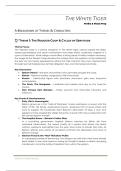
THEME 1: THE ROOSTER COOP & CYCLES OF SERVITUDE
Theme Focus:
The “Rooster Coop” is a central metaphor in The White Tiger, used to expose the deep-
rooted psychological and social mechanisms that keep India’s underclass trapped in a
cycle of submission. While Adiga’s novel offers a biting satire of India’s modern economy,
the image of the Rooster Coop elevates the critique from the systemic to the existential:
the poor are not merely oppressed by others but help maintain their own imprisonment
through learned helplessness, familial obligation, fear, and internalised servitude.
Key Characters:
• Balram Halwai – Narrator and antihero who ultimately escapes the Coop.
• Kishan – Balram’s brother, resigned to a life of servitude.
• Kusum – Matriarchal figure who prioritises short-term gain over long-term
emancipation.
• The Stork, The Mongoose – Landlords and masters who rely on the Coop for
control.
• Ram Persad, Ram Bahadur – Fellow servants who internalise hierarchy and
enforce it.
Key Events & Developments:
1. Early Life in Laxmangahr:
Balram grows up in the "India of Darkness," where submission is woven into the
fabric of life. His family—particularly Kusum—pressures him to leave school and
work to support the household. Even Balram’s admiration of Vijay, a man who
appears to have escaped the village hierarchy, is laced with irony as Vijay later joins
the corrupt system himself.
2. The Hospital Scene – Balram’s Father Dies:
In a crumbling government hospital, Balram watches his father die from
untreated tuberculosis. The casual cruelty of a system that allows this death
without resistance exemplifies how the poor have come to accept their fate. As
Balram reflects, even stories of corruption entertain the oppressed, who have no
belief in change.
3. Election Fraud & the "Mad" Rickshaw Puller:
In a grotesque parody of democracy, the villagers are told their votes have already
been tallied. A man who insists on voting for himself is beaten to death, stamping
into Balram’s mind the futility of rebellion from within the system.
XANTHIPI THEOPHANOUS 1
, 4. The Symbolic Zoo & the White Tiger:
On a visit to the zoo, Balram sees the white tiger pacing in its cage and recognises
himself. The tiger, a rare and beautiful predator, is imprisoned and has hypnotised
himself into acceptance by pacing up and down, without question—an
embodiment of latent power constrained by invisible bars. The zoo is a
metaphorical mirror of the Coop.
5. Balram’s Blackmail of Ram Persad:
When Balram discovers that Ram Persad is a Muslim posing as a Hindu to
maintain his job, he blackmails him. This event marks Balram’s first successful act
of rebellion—mirroring the tactics of his oppressors to escape the lower tier of
servitude.
6. Balram’s Internal Struggle:
Even after the murder of Ashok, Balram admits he still reflexively acts like a
servant, bowing and being apologetic at times. The Coop’s influence runs deep,
making freedom not a moment but a continual psychological battle.
7. Sacrifice of the Family:
The final and most disturbing aspect of Balram’s escape is his acknowledgment
that his family will likely be killed in retaliation. The Coop functions precisely
because the oppressed love those still trapped inside it.
Key Quotes:
• “The Rooster Coop was doing its work.”
• “The Coop is guarded from the inside.”
• “You were looking for the key for years / But the door was always open!”
• “The point of your living is that if you die, who’s going to pay me three and a half
thousand rupees a month?”
• “Imagine yourself in the cage.”
• “I can’t live the rest of my life in a cage, Granny. I’m so sorry.”
• “Let animals live like animals; let humans live like humans.”
F URTHER N OTES :
XANTHIPI THEOPHANOUS 2
, ESSAY DEVELOPMENT GUIDE:
Paragraph 1: Entrapment by System and Family
• Topic Sentence: The Rooster Coop is not just a metaphor for political oppression,
but also a psychological prison created by familial and societal expectations.
• Explanation: The Coop ensures obedience by threatening not just the individual
but their entire family.
• Example: Balram reflects on how masters control servants by ‘owning’ their
families, who are financially dependent on the Landlords.
• Quote: “They can’t break out of the Coop because they know what will happen to
their families.”
Paragraph 2: Internalised Submission and Peer Enslavement
• Topic Sentence: The Coop is self-sustaining because the oppressed internalise
their inferiority and perpetuate it.
• Explanation: Servants enforce hierarchy among themselves, as seen with Ram
Persad and Ram Bahadur.
• Example: Petty power struggles among servants show how servitude is enforced
laterally, not just top-down.
• Quote: “Servants, incidentally, are obsessed with being called ‘sir’ by other
servants.”
Paragraph 3: Breaking Free Demands Sacrifice and Ruthlessness
• Topic Sentence: Escape from the Coop demands the rejection of morality, loyalty,
and familial bonds.
• Explanation: Balram recognises that true freedom requires him to become a
“freak” in the system.
• Example: He kills Ashok and accepts the probable murder of his entire family as
the price of freedom.
• Quote: “To break out of the Coop takes no normal human being, but a freak, a
pervert of nature…”
XANTHIPI THEOPHANOUS 3
Prelim & Finals Prep
A BREAKDOWN OF THEMES & CHARACTERS
THEME 1: THE ROOSTER COOP & CYCLES OF SERVITUDE
Theme Focus:
The “Rooster Coop” is a central metaphor in The White Tiger, used to expose the deep-
rooted psychological and social mechanisms that keep India’s underclass trapped in a
cycle of submission. While Adiga’s novel offers a biting satire of India’s modern economy,
the image of the Rooster Coop elevates the critique from the systemic to the existential:
the poor are not merely oppressed by others but help maintain their own imprisonment
through learned helplessness, familial obligation, fear, and internalised servitude.
Key Characters:
• Balram Halwai – Narrator and antihero who ultimately escapes the Coop.
• Kishan – Balram’s brother, resigned to a life of servitude.
• Kusum – Matriarchal figure who prioritises short-term gain over long-term
emancipation.
• The Stork, The Mongoose – Landlords and masters who rely on the Coop for
control.
• Ram Persad, Ram Bahadur – Fellow servants who internalise hierarchy and
enforce it.
Key Events & Developments:
1. Early Life in Laxmangahr:
Balram grows up in the "India of Darkness," where submission is woven into the
fabric of life. His family—particularly Kusum—pressures him to leave school and
work to support the household. Even Balram’s admiration of Vijay, a man who
appears to have escaped the village hierarchy, is laced with irony as Vijay later joins
the corrupt system himself.
2. The Hospital Scene – Balram’s Father Dies:
In a crumbling government hospital, Balram watches his father die from
untreated tuberculosis. The casual cruelty of a system that allows this death
without resistance exemplifies how the poor have come to accept their fate. As
Balram reflects, even stories of corruption entertain the oppressed, who have no
belief in change.
3. Election Fraud & the "Mad" Rickshaw Puller:
In a grotesque parody of democracy, the villagers are told their votes have already
been tallied. A man who insists on voting for himself is beaten to death, stamping
into Balram’s mind the futility of rebellion from within the system.
XANTHIPI THEOPHANOUS 1
, 4. The Symbolic Zoo & the White Tiger:
On a visit to the zoo, Balram sees the white tiger pacing in its cage and recognises
himself. The tiger, a rare and beautiful predator, is imprisoned and has hypnotised
himself into acceptance by pacing up and down, without question—an
embodiment of latent power constrained by invisible bars. The zoo is a
metaphorical mirror of the Coop.
5. Balram’s Blackmail of Ram Persad:
When Balram discovers that Ram Persad is a Muslim posing as a Hindu to
maintain his job, he blackmails him. This event marks Balram’s first successful act
of rebellion—mirroring the tactics of his oppressors to escape the lower tier of
servitude.
6. Balram’s Internal Struggle:
Even after the murder of Ashok, Balram admits he still reflexively acts like a
servant, bowing and being apologetic at times. The Coop’s influence runs deep,
making freedom not a moment but a continual psychological battle.
7. Sacrifice of the Family:
The final and most disturbing aspect of Balram’s escape is his acknowledgment
that his family will likely be killed in retaliation. The Coop functions precisely
because the oppressed love those still trapped inside it.
Key Quotes:
• “The Rooster Coop was doing its work.”
• “The Coop is guarded from the inside.”
• “You were looking for the key for years / But the door was always open!”
• “The point of your living is that if you die, who’s going to pay me three and a half
thousand rupees a month?”
• “Imagine yourself in the cage.”
• “I can’t live the rest of my life in a cage, Granny. I’m so sorry.”
• “Let animals live like animals; let humans live like humans.”
F URTHER N OTES :
XANTHIPI THEOPHANOUS 2
, ESSAY DEVELOPMENT GUIDE:
Paragraph 1: Entrapment by System and Family
• Topic Sentence: The Rooster Coop is not just a metaphor for political oppression,
but also a psychological prison created by familial and societal expectations.
• Explanation: The Coop ensures obedience by threatening not just the individual
but their entire family.
• Example: Balram reflects on how masters control servants by ‘owning’ their
families, who are financially dependent on the Landlords.
• Quote: “They can’t break out of the Coop because they know what will happen to
their families.”
Paragraph 2: Internalised Submission and Peer Enslavement
• Topic Sentence: The Coop is self-sustaining because the oppressed internalise
their inferiority and perpetuate it.
• Explanation: Servants enforce hierarchy among themselves, as seen with Ram
Persad and Ram Bahadur.
• Example: Petty power struggles among servants show how servitude is enforced
laterally, not just top-down.
• Quote: “Servants, incidentally, are obsessed with being called ‘sir’ by other
servants.”
Paragraph 3: Breaking Free Demands Sacrifice and Ruthlessness
• Topic Sentence: Escape from the Coop demands the rejection of morality, loyalty,
and familial bonds.
• Explanation: Balram recognises that true freedom requires him to become a
“freak” in the system.
• Example: He kills Ashok and accepts the probable murder of his entire family as
the price of freedom.
• Quote: “To break out of the Coop takes no normal human being, but a freak, a
pervert of nature…”
XANTHIPI THEOPHANOUS 3