
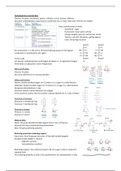
Carbohydrates (saccharides)
Glucose, fructose, saccharose, pectin, cellulose, starch, lactose, raffinose
Structure carbohydrates; ring structure sometimes two or more rings with minimal one oxygen
Roles carbohydrates in food:
- Sweetener: sugar
- Humectant: lower water activity
- Energy supplier: glucose, saccharose, starch
- Texture: cell wall, thickeners, gelling agents
- Color: browning reactions
D/L-enantiomer: L is the mirror of D (the hydroxyl group on the highest
numbered C is positioned to the right)
Uronic acids
pH: low pH, carboxyl group is uncharged, pH above +/- 4 negatively charged D L
Know what a O-glycoside is and a N-glycoside
Monosaccharides
Glucose, fructose
Structural differences in monosaccharides:
Aldose and ketose:
Ketone: double bonded oxygen on C2 (when it is a sugar it is called ketose)
Aldehyde: double bonded oxygen on C1 (when it is a sugar it is called aldose)
Recognize aldose/ketose in ring:
Anomeric carbon: carbon between two oxygen
If this anomeric carbon also has another C group attached to it, it was a ketose.
Pyranose or furanose
Pyranose: 6 membered ring
Furanose: 5 membered ring
Pentose or hexose
Pentose: 5 C atoms
Hexose: 6 C atoms
Alpha or beta
Alpha: OH group (double bonded oxygen that is now a OH group
because the ring is closed) pointing downwards
Beta: OH group pointing upwards
Reducing properties (reducing sugars)
Open form: free Oh-groups becomes =O (double bonded oxygen)
Double bonded oxygen is reactive
- Maillard reactions
- Caramelization reactions
Reducing property: the carbonyl croup (C=O) of a sugar is able to reduce for
example Cu2+
This reducing property is used in the quantification of carbohydrates in food
,Look for free OH group (only at the end of a long structure)
Some sugars/carbohydrates are not reducing
Mutarotation: equilibrium between different anomeric forms
Monomers in solution convert from the a-anomer into the b-anomer, and
vice versa
Glycosidic bonds
Bond connecting monosaccharides in the carbohydrate
Alfa or beta glycosidic bond? Systematic name:
Hydrolysis
Water molecule is added
- Enzymatically: invertase
- Chemically: acid and high temperature
More reducing ends are formed: Every hydrolysis releases one extra reducing end
DE: Dextrose Equivalent
Dextrose = glucose
Starch = polymer of glucose
DE = 100 * (number of reducing end / total number of glucose units)
DE = 100 * (concentration of reducing sugars / concentration of total sugar)
DE pure glucose solution is 100, for starch it is almost zero
Oligosaccharides
2-20 units connected to each other
Alfa-galacto-oligosaccharides:
- Saccharose: disaccharide
- Raffinose: trisaccharide
- Stachyose: tetrasaccharide
- Verbescose: pentasaccharide
,Oligosaccharides in food:
- NDO’s (non digestible oligosaccharides):
➔ Not degraded in digestive tract
➔ Can function af prebiotic
➔ Can cause flatulence
➔ For example raffinose, GOS, FOS
- Ingredient in food:
➔ Cyclodextrins are used to stabilize hydrophobic compounds aqueous phase
- Sweeteners:
➔ Disaccharides
➔ Malto-oligosaccharides can be used as sweetener
Polysaccharides
Classification based on structural properties
Homoglycan: 1 type of units (linear/branched)
Heterogycans: 2 or more types of units (linear/branched)
Amylose Cellulose
Present in Potatoes Paper
The glycosidic bond is Alfa 1,4 Beta 1,4
For humans Energy supplier Indigestible
The chain is Flexible Rigid
When heated in water Becomes soluble Stays insoluble
Properties
Solubility: a certain amount of sugar can be completely dissolved in a certain volume of water at a certain
temperature
Oversaturation: more sugar in the food product than can be dissolved in water, the oversaturated sugar can
crystalize
Lowering water activity: sugar in solution lowers the water activity
Water activity = ratio free water and bounded water in the solution
Sugar in solution binds water, lowering the aw
Aw affects:
- The rate of chemical reactions taking place in
food systems
- The growth of micro-organisms
- Auto oxidation of fats during drying of food
increases
Sweetness of sugars
Normal sugar (=saccharose) is set to 1.0
Sweetness is depending on the temperature, pH and presence of other components
, By raising the viscosity, the rate of food-fiber passage in mouth and stomach is slowed down → the feeling of
saturation is increased
Non-digestible oligosaccharides (NDO’s) → the growth of certain intestinal bacteria is promoted
Positive effect of accelerated intestine passage by food-fibers → potential carcinogenic substances stay in the
large intestine for a shorter period
Oligosaccharides can easily be added to foods without large consequences → oligosaccharides are non-toxic,
resistant to acid, bile, and heat, tasteless and natural
Food-fibers have a strong ability to bind water → weight of feaces increases and intestine passage accelerates
(acts against obstipation)
Negative effect of accelerated intestine passage by food-fibers → uptake of minerals by large intestine is
decreased
Properties of polysaccharides
Thicken or gel
Viscosity: resistance to flow
- Conformation of monosaccharide unit → alfa (flexible, less space, lower viscosity) or beta
- Branching: lot branching: molecule compact, less space, lower viscosity
- Degree of polymerization (DP): number of monomeric units, smaller molecule, less space, lower
viscosity
- Presence of charged groups: molecules with charges repel each other, take more space, higher
viscosity
Gelation: 3-d network which can retain water/liquid, polysaccharides make 3-d networks with each other and
catch water in this
Ways to format gels: 1. Random coils 2. Crystalline junction zones 3. Branching points 4. Double helixes
Formation steps gels:
1. Macromolecules turn and fold
2. Polysaccharides associate
3. Loops/junction-zones/double helixes are formed
4. When there are enough knots a 3-d network will arise
5. Water is retained in this network: a gel
Non-enzymatic browning
Brown color formation: caramelization/maillard reactions
Under influence of heat
Maillard reactions: reducing sugar + amino group → brown pigments + aroma’s (meat, coffee, soy sauce, fried
onions)
Glucose, fructose, saccharose, pectin, cellulose, starch, lactose, raffinose
Structure carbohydrates; ring structure sometimes two or more rings with minimal one oxygen
Roles carbohydrates in food:
- Sweetener: sugar
- Humectant: lower water activity
- Energy supplier: glucose, saccharose, starch
- Texture: cell wall, thickeners, gelling agents
- Color: browning reactions
D/L-enantiomer: L is the mirror of D (the hydroxyl group on the highest
numbered C is positioned to the right)
Uronic acids
pH: low pH, carboxyl group is uncharged, pH above +/- 4 negatively charged D L
Know what a O-glycoside is and a N-glycoside
Monosaccharides
Glucose, fructose
Structural differences in monosaccharides:
Aldose and ketose:
Ketone: double bonded oxygen on C2 (when it is a sugar it is called ketose)
Aldehyde: double bonded oxygen on C1 (when it is a sugar it is called aldose)
Recognize aldose/ketose in ring:
Anomeric carbon: carbon between two oxygen
If this anomeric carbon also has another C group attached to it, it was a ketose.
Pyranose or furanose
Pyranose: 6 membered ring
Furanose: 5 membered ring
Pentose or hexose
Pentose: 5 C atoms
Hexose: 6 C atoms
Alpha or beta
Alpha: OH group (double bonded oxygen that is now a OH group
because the ring is closed) pointing downwards
Beta: OH group pointing upwards
Reducing properties (reducing sugars)
Open form: free Oh-groups becomes =O (double bonded oxygen)
Double bonded oxygen is reactive
- Maillard reactions
- Caramelization reactions
Reducing property: the carbonyl croup (C=O) of a sugar is able to reduce for
example Cu2+
This reducing property is used in the quantification of carbohydrates in food
,Look for free OH group (only at the end of a long structure)
Some sugars/carbohydrates are not reducing
Mutarotation: equilibrium between different anomeric forms
Monomers in solution convert from the a-anomer into the b-anomer, and
vice versa
Glycosidic bonds
Bond connecting monosaccharides in the carbohydrate
Alfa or beta glycosidic bond? Systematic name:
Hydrolysis
Water molecule is added
- Enzymatically: invertase
- Chemically: acid and high temperature
More reducing ends are formed: Every hydrolysis releases one extra reducing end
DE: Dextrose Equivalent
Dextrose = glucose
Starch = polymer of glucose
DE = 100 * (number of reducing end / total number of glucose units)
DE = 100 * (concentration of reducing sugars / concentration of total sugar)
DE pure glucose solution is 100, for starch it is almost zero
Oligosaccharides
2-20 units connected to each other
Alfa-galacto-oligosaccharides:
- Saccharose: disaccharide
- Raffinose: trisaccharide
- Stachyose: tetrasaccharide
- Verbescose: pentasaccharide
,Oligosaccharides in food:
- NDO’s (non digestible oligosaccharides):
➔ Not degraded in digestive tract
➔ Can function af prebiotic
➔ Can cause flatulence
➔ For example raffinose, GOS, FOS
- Ingredient in food:
➔ Cyclodextrins are used to stabilize hydrophobic compounds aqueous phase
- Sweeteners:
➔ Disaccharides
➔ Malto-oligosaccharides can be used as sweetener
Polysaccharides
Classification based on structural properties
Homoglycan: 1 type of units (linear/branched)
Heterogycans: 2 or more types of units (linear/branched)
Amylose Cellulose
Present in Potatoes Paper
The glycosidic bond is Alfa 1,4 Beta 1,4
For humans Energy supplier Indigestible
The chain is Flexible Rigid
When heated in water Becomes soluble Stays insoluble
Properties
Solubility: a certain amount of sugar can be completely dissolved in a certain volume of water at a certain
temperature
Oversaturation: more sugar in the food product than can be dissolved in water, the oversaturated sugar can
crystalize
Lowering water activity: sugar in solution lowers the water activity
Water activity = ratio free water and bounded water in the solution
Sugar in solution binds water, lowering the aw
Aw affects:
- The rate of chemical reactions taking place in
food systems
- The growth of micro-organisms
- Auto oxidation of fats during drying of food
increases
Sweetness of sugars
Normal sugar (=saccharose) is set to 1.0
Sweetness is depending on the temperature, pH and presence of other components
, By raising the viscosity, the rate of food-fiber passage in mouth and stomach is slowed down → the feeling of
saturation is increased
Non-digestible oligosaccharides (NDO’s) → the growth of certain intestinal bacteria is promoted
Positive effect of accelerated intestine passage by food-fibers → potential carcinogenic substances stay in the
large intestine for a shorter period
Oligosaccharides can easily be added to foods without large consequences → oligosaccharides are non-toxic,
resistant to acid, bile, and heat, tasteless and natural
Food-fibers have a strong ability to bind water → weight of feaces increases and intestine passage accelerates
(acts against obstipation)
Negative effect of accelerated intestine passage by food-fibers → uptake of minerals by large intestine is
decreased
Properties of polysaccharides
Thicken or gel
Viscosity: resistance to flow
- Conformation of monosaccharide unit → alfa (flexible, less space, lower viscosity) or beta
- Branching: lot branching: molecule compact, less space, lower viscosity
- Degree of polymerization (DP): number of monomeric units, smaller molecule, less space, lower
viscosity
- Presence of charged groups: molecules with charges repel each other, take more space, higher
viscosity
Gelation: 3-d network which can retain water/liquid, polysaccharides make 3-d networks with each other and
catch water in this
Ways to format gels: 1. Random coils 2. Crystalline junction zones 3. Branching points 4. Double helixes
Formation steps gels:
1. Macromolecules turn and fold
2. Polysaccharides associate
3. Loops/junction-zones/double helixes are formed
4. When there are enough knots a 3-d network will arise
5. Water is retained in this network: a gel
Non-enzymatic browning
Brown color formation: caramelization/maillard reactions
Under influence of heat
Maillard reactions: reducing sugar + amino group → brown pigments + aroma’s (meat, coffee, soy sauce, fried
onions)


