

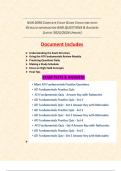
NUR 2090 COMPLETE STUDY GUIDE STRUCTURE WITH
DETAILED INFORMATION AND QUESTIONS & ANSWERS
(LATEST 2025/2026 UPDATE)
Document Includes
➢ Understanding the Exam Structure
➢ Using the ATI Fundamentals Review Module
➢ Practicing Questions Daily
➢ Making a Study Schedule
➢ Focus on High-Yield Concepts
➢ Final Tips
EXAM TESTS & ANSWERS
➢
,To study effectively for the ATI Content Mastery Series: Fundamentals for Nursing, you need a focused,
structured approach using the ATI Fundamentals Review Module, practice questions, and consistent
review. Here’s a comprehensive study strategy:
➢ Understand the Exam Structure
The ATI Fundamentals exam covers key areas from basic nursing care. Common topics include:
● Safety & Infection Control
● Mobility & Immobility
● Medication Administration
● Vital Signs
● Nutrition & Elimination
● Skin Integrity & Wound Care
● Health Promotion
● Documentation
● Delegation & Prioritization
● Therapeutic Communication
● Legal & Ethical Practice
➢ Use the ATI Fundamentals Review Module
Break the module into sections. Focus on understanding concepts, not memorization. For each chapter:
● Read the chapter summary first.
● Use “Active Recall” (close the book and summarize aloud what you read).
● Use “Spaced Repetition” to revisit topics over time.
, ➢ Study Tools
Use these tools for reinforcement:
● ATI Practice Assessments (A & B): Take one practice test early to identify weak areas. Use the
focused review afterward.
● NurseLogic & Learning System: These interactive tools help reinforce test-taking skills and
knowledge.
● Active Learning Templates (ALTs): Complete ALTs for key concepts like mobility, infection control,
and wound healing.
➢ Practice Questions Daily
● Aim for 20-30 questions a day with rationales.
● Use sources like:
○ ATI Practice Exams
○ Saunders NCLEX Review
○ NurseLabs or RegisteredNurseRN.com
➢ Focus on High-Yield Concepts
Spend extra time on areas most tested:
● Safety First (QSEN)
● Maslow’s Hierarchy of Needs
● Standard Precautions & PPE
● Delegation (RN vs. LPN vs. UAP)
● Vital signs ranges & interventions
● Patient positioning for various conditions
● Documentation do’s and don’ts
DETAILED INFORMATION AND QUESTIONS & ANSWERS
(LATEST 2025/2026 UPDATE)
Document Includes
➢ Understanding the Exam Structure
➢ Using the ATI Fundamentals Review Module
➢ Practicing Questions Daily
➢ Making a Study Schedule
➢ Focus on High-Yield Concepts
➢ Final Tips
EXAM TESTS & ANSWERS
➢
,To study effectively for the ATI Content Mastery Series: Fundamentals for Nursing, you need a focused,
structured approach using the ATI Fundamentals Review Module, practice questions, and consistent
review. Here’s a comprehensive study strategy:
➢ Understand the Exam Structure
The ATI Fundamentals exam covers key areas from basic nursing care. Common topics include:
● Safety & Infection Control
● Mobility & Immobility
● Medication Administration
● Vital Signs
● Nutrition & Elimination
● Skin Integrity & Wound Care
● Health Promotion
● Documentation
● Delegation & Prioritization
● Therapeutic Communication
● Legal & Ethical Practice
➢ Use the ATI Fundamentals Review Module
Break the module into sections. Focus on understanding concepts, not memorization. For each chapter:
● Read the chapter summary first.
● Use “Active Recall” (close the book and summarize aloud what you read).
● Use “Spaced Repetition” to revisit topics over time.
, ➢ Study Tools
Use these tools for reinforcement:
● ATI Practice Assessments (A & B): Take one practice test early to identify weak areas. Use the
focused review afterward.
● NurseLogic & Learning System: These interactive tools help reinforce test-taking skills and
knowledge.
● Active Learning Templates (ALTs): Complete ALTs for key concepts like mobility, infection control,
and wound healing.
➢ Practice Questions Daily
● Aim for 20-30 questions a day with rationales.
● Use sources like:
○ ATI Practice Exams
○ Saunders NCLEX Review
○ NurseLabs or RegisteredNurseRN.com
➢ Focus on High-Yield Concepts
Spend extra time on areas most tested:
● Safety First (QSEN)
● Maslow’s Hierarchy of Needs
● Standard Precautions & PPE
● Delegation (RN vs. LPN vs. UAP)
● Vital signs ranges & interventions
● Patient positioning for various conditions
● Documentation do’s and don’ts


