Chapter 9
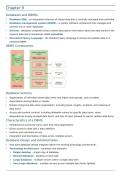
Databases and DBMSs
Database (DB) - an integrated collection of stored data that is centrally managed and controlled
Database management system (DBMS) - a system software component that manages and
controls one or more databases
Schema - database component that contains descriptive information about the data stored in the
physical data store (sometimes called metadata)
Structured Query Language - the standard query language to access and update data in a
relational DBMS
DBMS Components
Database Schema
Organization of individual stored data items into higher level groups, such as tables
Associations among tables or classes
Details of physical data store organization, including types, lengths, locations, and indexing of
data items
Access and content controls, including allowable values for specific data items, value
dependencies among multiple data items, and lists of users allowed to read or update data items
Characteristics of a DBMS
Simultaneous access by many users and many applications
Direct access to data with a data interface
Uniform and consistent access
Integration and distribution of data across multiple servers
Database Design and Administration
How does database design integrate within the existing technology architecture?
Technology Architecture – hardware and networks
Single desktop – single copy of database
Shared database – residing on local LAN
Large database – multiple servers within a single data farm
Very large database – multiple servers across multiple data farms (global)
, How does database design integrate within the project plan?
Water-fall development – design and implement database first
Iterative development – database is foundational, early iterations need to focus on data and
key portions of the database
Iterative development – important to consider database impacts of all subsystems
Who is involved in database design?
Data Administrator (DA) – person in charge of structure and integrity of the data
Data standards – naming, definition, data typing
Data use – ownership, accessibility, confidentiality
Data quality – validation rules, completeness, currency
Who is involved in database design?
Database Administrator (DBA) – person in charge of safety and the operation of the database
Manage multiple DBMS environment
Protect the database and data – authentication
Maintain high-performance level
Backup data and define recovery procedures
DA and DBA Responsibilities
Relational Databases
Relational database management system (RDBMS) - a DBMS that organizes data in tables
(relations)
Table - a two-dimensional data structure of columns and rows
Row - one horizontal group of data attribute values
Attribute - one vertical group of data attribute values
Attribute value - the value held in a single table cell
Key – an attribute or set of attributes, the values of which occur only once in all the rows of the
table
Candidate Key – an attribute or set of attributes that could server as the primary key
Primary key – the key chosen by a database designer to represent relationships among rows in
different tables
Foreign key – an attribute that duplicates the primary key of a different (or foreign) table
Databases and DBMSs
Database (DB) - an integrated collection of stored data that is centrally managed and controlled
Database management system (DBMS) - a system software component that manages and
controls one or more databases
Schema - database component that contains descriptive information about the data stored in the
physical data store (sometimes called metadata)
Structured Query Language - the standard query language to access and update data in a
relational DBMS
DBMS Components
Database Schema
Organization of individual stored data items into higher level groups, such as tables
Associations among tables or classes
Details of physical data store organization, including types, lengths, locations, and indexing of
data items
Access and content controls, including allowable values for specific data items, value
dependencies among multiple data items, and lists of users allowed to read or update data items
Characteristics of a DBMS
Simultaneous access by many users and many applications
Direct access to data with a data interface
Uniform and consistent access
Integration and distribution of data across multiple servers
Database Design and Administration
How does database design integrate within the existing technology architecture?
Technology Architecture – hardware and networks
Single desktop – single copy of database
Shared database – residing on local LAN
Large database – multiple servers within a single data farm
Very large database – multiple servers across multiple data farms (global)
, How does database design integrate within the project plan?
Water-fall development – design and implement database first
Iterative development – database is foundational, early iterations need to focus on data and
key portions of the database
Iterative development – important to consider database impacts of all subsystems
Who is involved in database design?
Data Administrator (DA) – person in charge of structure and integrity of the data
Data standards – naming, definition, data typing
Data use – ownership, accessibility, confidentiality
Data quality – validation rules, completeness, currency
Who is involved in database design?
Database Administrator (DBA) – person in charge of safety and the operation of the database
Manage multiple DBMS environment
Protect the database and data – authentication
Maintain high-performance level
Backup data and define recovery procedures
DA and DBA Responsibilities
Relational Databases
Relational database management system (RDBMS) - a DBMS that organizes data in tables
(relations)
Table - a two-dimensional data structure of columns and rows
Row - one horizontal group of data attribute values
Attribute - one vertical group of data attribute values
Attribute value - the value held in a single table cell
Key – an attribute or set of attributes, the values of which occur only once in all the rows of the
table
Candidate Key – an attribute or set of attributes that could server as the primary key
Primary key – the key chosen by a database designer to represent relationships among rows in
different tables
Foreign key – an attribute that duplicates the primary key of a different (or foreign) table