Electricity
Circuit Diagram Symbols:
Current:
• Electrical current is a flow of electrical charge. Electrical charge will only flow round a complete
circuit if there is a potential difference.
• The unit of current is Amp, A. Q
• Charge (coulombs, C)= current (amps, A) x time (seconds, s)
• Q = It t
I
Voltage:
• Potential difference (voltage) is the driving force that pushes the charge round.
• The unit of voltage is Volt, V.
• Resistance is anything that slows the flow down. Unit Ohm, Ω.
• When measuring voltage across a component, the voltmeter is always connected in parallel with (or
across) the component.
• The current flowing through a component depends on the potential difference across it and the
resistance of the component.
• The greater the resistance across a component, the smaller the current that flows.
Resistance:
!"#$%#&'( *&++$,$%-$
• Resistance = -.,,$%#
I
• V= IR
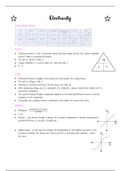
• Resistor – the current through a resistor at a constant temperature is directly proportional to
potential difference so you get a straight line.
V
• Filament lamp – as the current increases, the temperature of the filament increases, so the
resistance increases. This means less current can flow so the graph gets shallower – hence
I
the curve.
V
Circuit Diagram Symbols:
Current:
• Electrical current is a flow of electrical charge. Electrical charge will only flow round a complete
circuit if there is a potential difference.
• The unit of current is Amp, A. Q
• Charge (coulombs, C)= current (amps, A) x time (seconds, s)
• Q = It t
I
Voltage:
• Potential difference (voltage) is the driving force that pushes the charge round.
• The unit of voltage is Volt, V.
• Resistance is anything that slows the flow down. Unit Ohm, Ω.
• When measuring voltage across a component, the voltmeter is always connected in parallel with (or
across) the component.
• The current flowing through a component depends on the potential difference across it and the
resistance of the component.
• The greater the resistance across a component, the smaller the current that flows.
Resistance:
!"#$%#&'( *&++$,$%-$
• Resistance = -.,,$%#
I
• V= IR
• Resistor – the current through a resistor at a constant temperature is directly proportional to
potential difference so you get a straight line.
V
• Filament lamp – as the current increases, the temperature of the filament increases, so the
resistance increases. This means less current can flow so the graph gets shallower – hence
I
the curve.
V