

Samenvatting Cognitive Psychology II
PARKINSON’S DISEASE (PD)
Chronic Progressive Degenerative Brain Disorder
Cause: degeneration of dopamine producing cells in the substantia nigra of the basal ganglia
Effect:
- Motor symptoms; slowless of movement, tremors, posture instability…
- Non-motor features: cognitive deficits
and neurobehavioral abnormalities
In the first 10 years after onset it doesn’t decrease mortality, but after that it doubles compared tot
he general population
Epidemology: twice as often in males
Etiology: most cases idiopatic (no known cause)
- Age (greatest risk factors
- Environmental: eg MPTP gives parkinson’s like symptoms and can develop in parkinson’s disease
- Genetic 10-20%
Surprisingly caffeine intake and smoking may discrease the risk.
As we age: Oxidative stress destroys mitochondria → apoptosis (cell death) of dopaminergic cells.
Pathophysiological
- The brain doesn’t shrink like in dementia : NO general macroscopic atrophy of the brain, but there
is degeneration in certain types of neurons within particular brain regions.
=> Early stage PD: loss of dopaminergic neurons restricted to (VL) ventrolateral/ pars compacta of
the substantia nigra
=> End stage PD: more widespread loss
=> Results in a reduction of the neurotransmitter dopamine in the basal ganglia
Characteristic features:
- Loss of dopaminergic neurons in the pars compacta of the substantia nigra
- Widespread protein accumulation (lewy bodies) in neurons (in the substantia nigra)
1
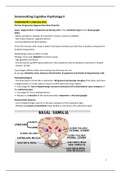
,Functions:
- Motor control
> Voluntary motor movement
> Eye movement
- Cognitive processes
> Procedural learning
> Habit learning
- Cognition/emotion
➔ Control of goal-directed and habitual actions
Connectivity
Input Nuclei of the BG (they receive info):
- Nucleus Caudatus
- Putamen
- Subthalamic Nucleus
Output Nuclei of the BG (send info to the motor cortex):
- Globus Pallidus (pars interna)
- Substantia Nigra (pars reticulata)
Cortico-Basal-Ganglia-Thalamo-
Cortical Loop: CBGTC Loop
Evolutionary interpretation:
There are 2 systems needed for behavioral control
1. Routine responses to KNOWN environmental stimuli > Basal ganglia
2. Reflective, problem-solving behavior in NEW situations > Frontal cortex
=> These 2 systems are integrated in the FRONTOSTRATIAL NETWORK
2
,There are 3 circuits but these are not independent. Because there are problems in the network, each
circuit has issues.
Direct pathway
https://youtu.be/c-mhDChCD4Y (2mins about direct pathway in the
frontostriatal network)
3
, Indirect pathway:
https://youtu.be/RzcXkvxXKEQ
Link between these pathways and PD :
Neurons from the substantia nigra, which produces dopamine, travel tot he striatum
via the nigrostriatal pathway. Through this pathway the activity of the direct and
indirect pathways is modulated by this dopamine release. As dopamine depletion in PD
causes an imbalance between these direct/indirect pathways, the thalamus is
excessively inhibited. This leads to difficulties in initiating movement.
DIRECT PATHWAY (netto = excitation of cortex) cortex – striatum – globus pallidus
pars interna – thalamus - cortex
INDIRECT PATHWAY (netto = inhibition of cortex) cortex – striatum – globus pallidus
pars externa – nucleus subthalamicus – globus pallidus pars interna – thalamus –
cortex
PD: Dopamine depletion causes imbalance between
direct (excitatory) and indirect (inhibitory) pathways
➔ thalamus is inhibited
➔ movement disorders
4
PARKINSON’S DISEASE (PD)
Chronic Progressive Degenerative Brain Disorder
Cause: degeneration of dopamine producing cells in the substantia nigra of the basal ganglia
Effect:
- Motor symptoms; slowless of movement, tremors, posture instability…
- Non-motor features: cognitive deficits
and neurobehavioral abnormalities
In the first 10 years after onset it doesn’t decrease mortality, but after that it doubles compared tot
he general population
Epidemology: twice as often in males
Etiology: most cases idiopatic (no known cause)
- Age (greatest risk factors
- Environmental: eg MPTP gives parkinson’s like symptoms and can develop in parkinson’s disease
- Genetic 10-20%
Surprisingly caffeine intake and smoking may discrease the risk.
As we age: Oxidative stress destroys mitochondria → apoptosis (cell death) of dopaminergic cells.
Pathophysiological
- The brain doesn’t shrink like in dementia : NO general macroscopic atrophy of the brain, but there
is degeneration in certain types of neurons within particular brain regions.
=> Early stage PD: loss of dopaminergic neurons restricted to (VL) ventrolateral/ pars compacta of
the substantia nigra
=> End stage PD: more widespread loss
=> Results in a reduction of the neurotransmitter dopamine in the basal ganglia
Characteristic features:
- Loss of dopaminergic neurons in the pars compacta of the substantia nigra
- Widespread protein accumulation (lewy bodies) in neurons (in the substantia nigra)
1
,Functions:
- Motor control
> Voluntary motor movement
> Eye movement
- Cognitive processes
> Procedural learning
> Habit learning
- Cognition/emotion
➔ Control of goal-directed and habitual actions
Connectivity
Input Nuclei of the BG (they receive info):
- Nucleus Caudatus
- Putamen
- Subthalamic Nucleus
Output Nuclei of the BG (send info to the motor cortex):
- Globus Pallidus (pars interna)
- Substantia Nigra (pars reticulata)
Cortico-Basal-Ganglia-Thalamo-
Cortical Loop: CBGTC Loop
Evolutionary interpretation:
There are 2 systems needed for behavioral control
1. Routine responses to KNOWN environmental stimuli > Basal ganglia
2. Reflective, problem-solving behavior in NEW situations > Frontal cortex
=> These 2 systems are integrated in the FRONTOSTRATIAL NETWORK
2
,There are 3 circuits but these are not independent. Because there are problems in the network, each
circuit has issues.
Direct pathway
https://youtu.be/c-mhDChCD4Y (2mins about direct pathway in the
frontostriatal network)
3
, Indirect pathway:
https://youtu.be/RzcXkvxXKEQ
Link between these pathways and PD :
Neurons from the substantia nigra, which produces dopamine, travel tot he striatum
via the nigrostriatal pathway. Through this pathway the activity of the direct and
indirect pathways is modulated by this dopamine release. As dopamine depletion in PD
causes an imbalance between these direct/indirect pathways, the thalamus is
excessively inhibited. This leads to difficulties in initiating movement.
DIRECT PATHWAY (netto = excitation of cortex) cortex – striatum – globus pallidus
pars interna – thalamus - cortex
INDIRECT PATHWAY (netto = inhibition of cortex) cortex – striatum – globus pallidus
pars externa – nucleus subthalamicus – globus pallidus pars interna – thalamus –
cortex
PD: Dopamine depletion causes imbalance between
direct (excitatory) and indirect (inhibitory) pathways
➔ thalamus is inhibited
➔ movement disorders
4


