NUR 1025 EXAM 1 – Questions Answered With
Expert Insight
Save
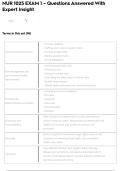
Terms in this set (96)
• Nursing students
• Staffing and nurse-to-patient ratios
Nursing workforce issues • Nursing assignments
• Patient abandonment
• Nurse delegation
• Identifying possible risks
• Analyzing risks
Risk management and
• Acting to reduce risks
performance/quality
• Evaluating the steps take to reduce risks
improvement
• Quality improvement
• Patient safety and improved care are the goals
-Autonomy and Accountability:
-Educator
Professional -Caregiver
Responsibilities and Roles -Advocate
-Communicator
-Manager
have initiation of independent nursing interventions
Autonomy and without medical orders. Responsible professionally and
Accountability: legally for the type and quality of nursing care
provided.
protects patient's human and legal rights and provide
advocate assistance in asserting these rights. Secure patient
health care rights.
help patients maintain and regain health, manage
disease and symptoms, and attain a maximal level of
Caregiver
function and independence. Restore patients emotional,
spiritual a social well-being.
, explain concepts and facts about health, describe
reason for routine care activities, demonstrate
educator
procedures, reinforce learning or patient behavior, and
evaluate progress in learning.
essential to routinely communicate with patients, to
communicator advocate, give emotional support, and make decisions
with patients and family.
establish environment for collaborate patient-center
care with positive patient outcome. Coordinate activities
manager of members of nursing staff. Creates a nursing
environment that reflects the mission and values of the
health care organization.
the most independently functioning nurse. An APRN has
a master's degree or Doctor of Nursing Practice (DNP)
Advanced Practice degree in nursing; advanced education in
Registered Nurses pathophysiology, pharmacology, and physical
assessment; and certification and expertise in a
specialized area of practice
APRN who is an expert clinician in a specialized area of
practice. The specialty may be identified by a
population (e.g., geriatrics), setting (e.g., critical care),
disease specialty (e.g., diabetes), type of care (e.g.,
rehabilitation), or type of problem (e.g., pain). Clinical
nurse specialists provide diagnosis, treatment, and
Clinical Nurse Specialist
ongoing management of patients in all health care
settings. They also provide expertise and support to
nurses caring for patients at the bedside, help drive
practice changes throughout an organization, and
ensure the use of best practices and evidence-based
care to achieve the best possible patient
, APRN who provides comprehensive health care to a
group of patients in an inpatient, outpatient, ambulatory
care, or community-based setting. This care includes
assessment, diagnosis, planning, and treatment;
monitoring ongoing health status; evaluation of
therapies; and health education. Some NPs provide
care to acutely ill patients in hospital settings, including
Nurse Practitioner critical care units. Other NPs provide comprehensive
care, directly managing the nursing and medical care of
patients who are healthy or who have chronic
conditions. It is important to review state regulations for
advanced practice. Some states require the NP to have
a collaborative provider agreement with an agency or
physician/physician group to treat a specific group of
patients; other states do not.
APRN who is also educated in midwifery and is certified
by the American College of Nurse-Midwives (ACNM).
The scope of practice of nurse-midwifery has been
defined by the ACNM (2011) as encompassing a full
range of primary health care services for women from
adolescence beyond menopause. These services
include primary care; gynecologic and family planning
services; preconception care; care during pregnancy,
Certified Nurse-Midwife: childbirth, and the postpartum period; care of the
normal newborn during the first 28 days of life; and
treatment of male partners for sexually transmied
infections (ACNM, 2011). The nurse-midwife conducts
physical examinations; prescribes medications,
including controlled substances and contraceptive
methods; admits, manages, and discharges patients;
orders and interprets laboratory and diagnostic tests;
and orders the use of medical devices.
Expert Insight
Save
Terms in this set (96)
• Nursing students
• Staffing and nurse-to-patient ratios
Nursing workforce issues • Nursing assignments
• Patient abandonment
• Nurse delegation
• Identifying possible risks
• Analyzing risks
Risk management and
• Acting to reduce risks
performance/quality
• Evaluating the steps take to reduce risks
improvement
• Quality improvement
• Patient safety and improved care are the goals
-Autonomy and Accountability:
-Educator
Professional -Caregiver
Responsibilities and Roles -Advocate
-Communicator
-Manager
have initiation of independent nursing interventions
Autonomy and without medical orders. Responsible professionally and
Accountability: legally for the type and quality of nursing care
provided.
protects patient's human and legal rights and provide
advocate assistance in asserting these rights. Secure patient
health care rights.
help patients maintain and regain health, manage
disease and symptoms, and attain a maximal level of
Caregiver
function and independence. Restore patients emotional,
spiritual a social well-being.
, explain concepts and facts about health, describe
reason for routine care activities, demonstrate
educator
procedures, reinforce learning or patient behavior, and
evaluate progress in learning.
essential to routinely communicate with patients, to
communicator advocate, give emotional support, and make decisions
with patients and family.
establish environment for collaborate patient-center
care with positive patient outcome. Coordinate activities
manager of members of nursing staff. Creates a nursing
environment that reflects the mission and values of the
health care organization.
the most independently functioning nurse. An APRN has
a master's degree or Doctor of Nursing Practice (DNP)
Advanced Practice degree in nursing; advanced education in
Registered Nurses pathophysiology, pharmacology, and physical
assessment; and certification and expertise in a
specialized area of practice
APRN who is an expert clinician in a specialized area of
practice. The specialty may be identified by a
population (e.g., geriatrics), setting (e.g., critical care),
disease specialty (e.g., diabetes), type of care (e.g.,
rehabilitation), or type of problem (e.g., pain). Clinical
nurse specialists provide diagnosis, treatment, and
Clinical Nurse Specialist
ongoing management of patients in all health care
settings. They also provide expertise and support to
nurses caring for patients at the bedside, help drive
practice changes throughout an organization, and
ensure the use of best practices and evidence-based
care to achieve the best possible patient
, APRN who provides comprehensive health care to a
group of patients in an inpatient, outpatient, ambulatory
care, or community-based setting. This care includes
assessment, diagnosis, planning, and treatment;
monitoring ongoing health status; evaluation of
therapies; and health education. Some NPs provide
care to acutely ill patients in hospital settings, including
Nurse Practitioner critical care units. Other NPs provide comprehensive
care, directly managing the nursing and medical care of
patients who are healthy or who have chronic
conditions. It is important to review state regulations for
advanced practice. Some states require the NP to have
a collaborative provider agreement with an agency or
physician/physician group to treat a specific group of
patients; other states do not.
APRN who is also educated in midwifery and is certified
by the American College of Nurse-Midwives (ACNM).
The scope of practice of nurse-midwifery has been
defined by the ACNM (2011) as encompassing a full
range of primary health care services for women from
adolescence beyond menopause. These services
include primary care; gynecologic and family planning
services; preconception care; care during pregnancy,
Certified Nurse-Midwife: childbirth, and the postpartum period; care of the
normal newborn during the first 28 days of life; and
treatment of male partners for sexually transmied
infections (ACNM, 2011). The nurse-midwife conducts
physical examinations; prescribes medications,
including controlled substances and contraceptive
methods; admits, manages, and discharges patients;
orders and interprets laboratory and diagnostic tests;
and orders the use of medical devices.