NGR6605 EXAM 2 - GU: Questions With Fully
Explained Solutions
Save
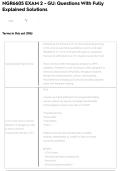
Terms in this set (106)
Defined as the presence of 1 or more bacteria growing
in the urine at specified quantitative counts of at least
100,000/ml (>/= 10^5 CFU) and NO signs or symptoms
that can be attributed to a UTI. Usually caused by E.coli
Asymptomatic Bacteriuria Most common after menopause, pregnancy, BPH,
catheters. Treatment is not necessary unless pregnant or
immunocompromised (HIV/AIDA, transplan recipient,
taking immunsuppressants, cancer, neutropenia).
Recommend increasing po fluids and avoiding bladder
stasis with frequent voiding.
True
Always use Cat B antibiotics for pregnant/lactating
women unless risk severly outweight the benefits.
Think pregnant women may like to "CAMP"
*Cephalosporins
*Amoxicillin
A UTI is the most common *Macrolides
infection of all ages as well *PNC's
as most common
nosocomial infection, T/F? Patients who are hemodynamically unstable,
severely dehydrated, or unable to take po meds
should be admitted
■ Refer:
- UTIs in men
- Hemodynamically unstable pts.
- Recurrent
- Structural abnormalities?
,Refer unusual presentations True
and those with recurrent
problems or who do not
respond to standard
treatment, T/F?
Usually an uncomplicated lower urinary tract infection
involving the urethra and bladder Most commonly
caused by the gram negative bacteria E. Coli (80-90%
of cases)
Risk factors:
*Female
*DM
*Pregnancy
Cystitis:
*Aging
*Constipation
*Family history
*Catheters
*Oral contraceptives?
*Neurogenic bladder
*Spermicides & barrier methods
*Frequent sexual activity (esp. anal sex)
Tumors Stones *Strictures (Reflux of urine)
Bacteriuria in older adults - Mental status changes
(over 65 yrs) may present - May present may be afebrile
with: * Older adults often do NOT have fevers with UTIs
, UA Dipstick (always do clean catch)
o (+) leukocytes
o (+) Nitrites (gram negative bacteria)
o Possible (+) blood
o Possible WBC or WBC esterase
o Bacteria
o Cloudy or Turbid foul smelling
Obtain a Urine sample for C & S- If atypical symptoms,
Diagnosis of Cystitis: recurrent UTI (esp. within 2-4 weeks after antibiotic tx),
older patients, diabetics, or is you suspect more severe
UTI or pyelonephritis. Not all UTI have nitrates on UA.
Consider imaging If:
*Atypical symptoms,
*Recurrent UTI (>3/year or 2 in 6 months)
*Older patients
*Diabetics
*Severe UTI
*Pyelonephritis
- TMP-SMX (Bactrim DS) 1 tablet po BID X 3 days
(IDSA recommends 3 days for complicated and 14
days for uncomplicated)
- Nitrofurantoin (Macrobid) 100 mg po BID X 5-7 days
- Ciprofloxacin (Cipro) 250-500 mg po Q 12hrs X 3 days
Treatment of
- Cephalexin (Keflex) 250-500 mg po Q 6hrs X 3-7 days
Uncomplicated Cystitis:
**Do not give Macrobid in the 3rd trimester**
Consider treatment with:
■ Low dose daily antibiotics, post-coital antibiotics
(single dose after sex), or "self-start" antibiotics
(meaning they have refills of antibiotics on hand to use
when the symptoms start)
, - Levofloxacin (Levaquin) 500-750mg po daily 7-10 days
- TMP-SMX (Bactrim DS) 1 tablet po BID x14 days
- Ciprofloxacin (Cipro) 250-500 mg po Q 12hrs x14 days
Treatment Of Cystitis:
• Complicated (ie. severe - Cephalexin (Keflex) 250-500 mg po Q 6hrs x14 days
infection, recurrent
infection, infections in - Nitrofurantoin (Macrobid) 100 mg po BID x14 days
males, or in (Poor choice for pyelonephritis/complictaed UTI)
immunocompromised pts) **Do not give Macrobid in the 3rd trimester**
Pain relief:
- Pyridium (phenazopyridine) 100-200 mg po TID,
for max 2-3 days. Do not give with G6PD anemia. liver
or renal disease.
Teach:
o Post-coidal voiding
o Avoid barrier methods and spermacides
o Increase po fluid intake
o Drink cranberry juice daily - changes pH of
urine making harder for bacteria to stick "controversial"
Prevention of Cystitis:
o Consider intra-vaginal estrogen replacement
for post menopausal women
o Good hygiene, wipe front-back
o No douches
o Showers instead of baths
o Finish entire course of antibiotics
Explained Solutions
Save
Terms in this set (106)
Defined as the presence of 1 or more bacteria growing
in the urine at specified quantitative counts of at least
100,000/ml (>/= 10^5 CFU) and NO signs or symptoms
that can be attributed to a UTI. Usually caused by E.coli
Asymptomatic Bacteriuria Most common after menopause, pregnancy, BPH,
catheters. Treatment is not necessary unless pregnant or
immunocompromised (HIV/AIDA, transplan recipient,
taking immunsuppressants, cancer, neutropenia).
Recommend increasing po fluids and avoiding bladder
stasis with frequent voiding.
True
Always use Cat B antibiotics for pregnant/lactating
women unless risk severly outweight the benefits.
Think pregnant women may like to "CAMP"
*Cephalosporins
*Amoxicillin
A UTI is the most common *Macrolides
infection of all ages as well *PNC's
as most common
nosocomial infection, T/F? Patients who are hemodynamically unstable,
severely dehydrated, or unable to take po meds
should be admitted
■ Refer:
- UTIs in men
- Hemodynamically unstable pts.
- Recurrent
- Structural abnormalities?
,Refer unusual presentations True
and those with recurrent
problems or who do not
respond to standard
treatment, T/F?
Usually an uncomplicated lower urinary tract infection
involving the urethra and bladder Most commonly
caused by the gram negative bacteria E. Coli (80-90%
of cases)
Risk factors:
*Female
*DM
*Pregnancy
Cystitis:
*Aging
*Constipation
*Family history
*Catheters
*Oral contraceptives?
*Neurogenic bladder
*Spermicides & barrier methods
*Frequent sexual activity (esp. anal sex)
Tumors Stones *Strictures (Reflux of urine)
Bacteriuria in older adults - Mental status changes
(over 65 yrs) may present - May present may be afebrile
with: * Older adults often do NOT have fevers with UTIs
, UA Dipstick (always do clean catch)
o (+) leukocytes
o (+) Nitrites (gram negative bacteria)
o Possible (+) blood
o Possible WBC or WBC esterase
o Bacteria
o Cloudy or Turbid foul smelling
Obtain a Urine sample for C & S- If atypical symptoms,
Diagnosis of Cystitis: recurrent UTI (esp. within 2-4 weeks after antibiotic tx),
older patients, diabetics, or is you suspect more severe
UTI or pyelonephritis. Not all UTI have nitrates on UA.
Consider imaging If:
*Atypical symptoms,
*Recurrent UTI (>3/year or 2 in 6 months)
*Older patients
*Diabetics
*Severe UTI
*Pyelonephritis
- TMP-SMX (Bactrim DS) 1 tablet po BID X 3 days
(IDSA recommends 3 days for complicated and 14
days for uncomplicated)
- Nitrofurantoin (Macrobid) 100 mg po BID X 5-7 days
- Ciprofloxacin (Cipro) 250-500 mg po Q 12hrs X 3 days
Treatment of
- Cephalexin (Keflex) 250-500 mg po Q 6hrs X 3-7 days
Uncomplicated Cystitis:
**Do not give Macrobid in the 3rd trimester**
Consider treatment with:
■ Low dose daily antibiotics, post-coital antibiotics
(single dose after sex), or "self-start" antibiotics
(meaning they have refills of antibiotics on hand to use
when the symptoms start)
, - Levofloxacin (Levaquin) 500-750mg po daily 7-10 days
- TMP-SMX (Bactrim DS) 1 tablet po BID x14 days
- Ciprofloxacin (Cipro) 250-500 mg po Q 12hrs x14 days
Treatment Of Cystitis:
• Complicated (ie. severe - Cephalexin (Keflex) 250-500 mg po Q 6hrs x14 days
infection, recurrent
infection, infections in - Nitrofurantoin (Macrobid) 100 mg po BID x14 days
males, or in (Poor choice for pyelonephritis/complictaed UTI)
immunocompromised pts) **Do not give Macrobid in the 3rd trimester**
Pain relief:
- Pyridium (phenazopyridine) 100-200 mg po TID,
for max 2-3 days. Do not give with G6PD anemia. liver
or renal disease.
Teach:
o Post-coidal voiding
o Avoid barrier methods and spermacides
o Increase po fluid intake
o Drink cranberry juice daily - changes pH of
urine making harder for bacteria to stick "controversial"
Prevention of Cystitis:
o Consider intra-vaginal estrogen replacement
for post menopausal women
o Good hygiene, wipe front-back
o No douches
o Showers instead of baths
o Finish entire course of antibiotics