NR 566 Week 4 Study Guide
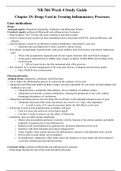
NR 566 Week 4 Study Guide Chapter 25: Drugs Used in Treating Inflammatory Processes Gout medications Drugs: Anti-gout agents: allopurinol (Zyloprim), colchicine, and febuxostat (Uloric) Uricosuric agents: probenecid (Benemid) and sulfinpyrazone (Anturane) o Peak incidence 70 to 79 years old, more common in men than women o Gout in women occurs exclusively post-menopausal and is associated with HTN, renal insufficiency, and diuretics o Gout Syndrome: Caused by an alteration in purine metabolism: end product is uric acid o Hyperuricemia and deposition of urate crystals in various tissues o Four phases: asymptomatic hyperuricemia, acute gouty arthritis, inter-critical gout, and chronic tophaceous gout o Those with asymptomatic hyperuricemia do not require treatment (diet and lifestyle changes) o Acute gout is characterized by sudden onset of pain, erythema, limited ROM, and swelling of the involved joint 50% of cases involve the first metatarsal joint of the great toe o Key elements in Tx include management of the acute pain and use of antigout and uricosuric agents o Pain: NSAIDS and corticosteroids Pharmacodynamics Antigout Drugs (allopurinol, colchicine, and febuxostat) o Act to reduce the inflammatory process or to prevent the synthesis of uric acid o Allopurinol and febuxostat inhibit xanthine oxidase: enzyme responsible for conversion of hypoxanthine and xanthine to uric acid o Allopurinol has a metabolite (alloxanthine): also an inhibitor of xanthine oxidase o Allopurinol acts directly on purine metabolism, reducing the production of uric acid, without disrupting biosynthesis of vital purines o Allopurinol and febuxostat are the only drugs that act directly on the pathophysiological cause of gout o Allopurinol decreases both serum and urinary uric acid in 2 to 3 days: dose dependent A week or more of Tx may be necessary before the full effects can be seen o Febuxostat is used to treat hyperuricemia in patients with gout o Goal is to have uric acid level of less than 6 mg/dL o Can take 2 weeks or more to see the effects of febuxostat o Colchicine: does not affect purine metabolism o Binds to the microtubular proteins to interfere with the function of the mitotic spindles and inhibit migration of granulocytes to the inflamed area o Reduces lactic acid production by granulocytes: decreases deposition of uric acid o Interferes with kinin formation and reduces phagocytosis o Taken together: these actions decrease the inflammatory response to the deposited urate crystals o Relives pain in acute attack: not an analgesic o Its prophylactic, suppressive effect helps reduce the incidence of acute attack and relives patient’s occasional residual pain and mild discomfort Uricosuric drugs: probenecid (Benemid) and sulfinpyrazone (Anturane o These drugs increase the rate of uric acid secretion in the urine o Both drugs inhibit renal tubular reabsorption of urate and thus increase the renal excretion of uric acid and decrease serum uric acid levels. o Effective uricosuria reduces the miscible urate pool, retards urate deposition, and promotes reabsorption of urate deposits o Sulfinpyrazone competitively inhibits platelet prostaglandin synthesis: prevents platelet aggregation (antithrombotic effects) o Both drugs lack anti-inflammatory activity o Most useful in patients with reduced urinary excretion of uric acid o Not intended for Tx of acute attacks Pharmacotherapeutics o Allopurinol (Zyloprim) colchicine, probenecid (Benemid, and sulfinpyrazone (Anturane): poor urate clearance in the presence of renal impairment o Use with caution: renal function tests performed regularly to determine dosage o Data is insufficient regarding febuxostat in renal impairment o Allopurinol and colchicine: hepatotoxicity o Not recommended for patients with severe hepatic dysfunction o If anorexia, weight loss, or pruritus, evaluate LFTs o For milder hepatic disorders: close monitoring of LFTs is required o Colchicine, probenecid, and sulfinpyrazone: used cautiously in PUD or spastic colon o GI ADRs from these drugs are likely to make these disorders worse o Sulfa allergy: do not use probenecid and sulfinpyrazone: sulfa-based drugs o Febuxostat, a xanthine oxidase inhibitor, is contraindicated in patients being treated with drugs requiring xanthine oxidase for metabolism: o Azathioprine, mercaptopurine, or theophylline o Risk for toxicity o When febuxostat is started there is a risk of a gout flare up: concurrently treat with NSAID or colchicine for up to 6 months o Allopurinol Preg Cat C: no adequate data o Colchicine Category C PO and D when IV/IM o Can cause fetal harm when administered to pregnant women o Probenecid is Preg cat B o Sulfinpyrazone: cat D: not much data for pregnant women o Avoided in Pregnancy o Febuxostat Cat C: no adequate studies in pregnant women o These drugs are not indicated for use in children except in hyperuricemia associated with Tx of malignancy (specialist care) o Probenecid: retarding PCN or cephalosporin excretion in selected infections ADRs o GI ADRs: colchicine, probenecid, and sulfinpyrazone o NVD, and ABD pain o Particularly troublesome for patients with Hx of PUD or active PUD o Hypersensitive reactions with sulfa allergy: probenecid and sulfinpyrazone o Severe, anaphylactic reactions are rare and typically occur within several hours after first dose, following prior use of the drug o Allopurinol: maculopapular skin rash, sometimes scaly or exfoliative o Incidence increased with renal disorders o Skin reactions may be severe and sometimes fatal: d/c at first sign of rash o The most severe reactions include: fever, chills, arthralgia, cholestatic jaundice, eosinophilia, mild leukocytosis, or leukopenia o Patients on standard therapy with colchicine who have elevated plasma levels r/t renal function have developed myopathy and neuropathy that resulted in weakness o Often unrecognized and misdiagnosed as polymyositis or uremic neuropathy o Proximal weakness and elevated creatinine kinase are generally present o Resolves in 3 to 4 weeks was drug withdrawal o Colchicine: induces reversible malabsorption of B12 o Febuxostat: risk of liver function abnormalities (40 mg/day) and nausea an arthralgia at 40 mg/day Drug Interactions o Colchicine: very few drug interactions o Probenecid, allopurinol, and sulfinpyrazone: many drug interactions o Always check the drug regimen before starting these drugs Clinical Use and Dosing Gout Goal of therapy is urate level less than 6 mg/dL: doses are titrated upward until that goal is reached o Colchicine PO: time honored drug for Tx of acute gouty attacks o Efficacy is limited by ADRs o Dose adjustments for impaired renal or hepatic function o Use with caution in older adults o Initial dose of 1.2 mg at the first sign of flare, followed by 0.6 mg 1 hour later (maximum 1.8 mg over 1 hr) Articular pain and swelling usually abate within 12 hours and gone in 24 to 48 hours o Preventive therapy for those with fewer than one acute attack per year is 0.6mg/d of colchicine for 3-4 days a week
Escuela, estudio y materia
Información del documento
- Subido en
- 26 de enero de 2021
- Número de páginas
- 16
- Escrito en
- 2020/2021
- Tipo
- Examen
- Contiene
- Preguntas y respuestas
Temas
- colchicine
-
nr 566 week 4 study guide chapter 25 drugs used in treating inflammatory processes gout medications drugs anti gout agents allopurinol zyloprim
-
and febuxostat uloric uricosuric

Documento también disponible en un lote