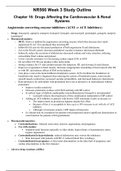
NR566 Week 3 Study Guide
NR566 Week 3 Study Outline Chapter 16: Drugs Affecting the Cardiovascular & Renal Systems Angiotensin converting enzyme inhibitors (ACEI or ACE Inhibitors) o Drugs: benazepril, captopril, enalapril, fosinopril, lisinopril, and moexipril, perindopril, quinapril, ramipril, trandolapril o Pharmacodynamics: o MOA: Slows or inhibits the angiotensin converting enzyme which then decrease how much angiotensin II (AT II) is produced thus lowering BP o Inhibit RAAS activity=decreased production of both angiotensin II and aldosterone o Act on the RAAS system: decreases peripheral vascular resistance (decreased afterload) o Indirectly reduce the secretion of aldosterone=decreased sodium and water retention, reducing extracellular fluid volume and preload o Lower vascular resistance w/o decreasing cardiac output (CO) or GFR o Do not affect CO=Do not produce reflex tachycardia o Strong evidence for CV and cerebrovascular risk reduction, HF, and slowing of renal disease o Improves oxygenation to heart muscle, decreases inappropriate remodeling of heart muscle after MI or with HF, and reduces affects of DM on the kidneys o Also plays a role in the kinin-kallikrein-bradykinin system: ACEs facilitate the breakdown of bradykinin into inactive fragments thus reducing the actions of bradykinin (pain, extravascular smooth muscle contraction, increased vascular permeability, and increased leukocyte chemotaxis) o Reno-protective for individuals with proteinuria but is not as protective in renal patients without proteinuria Improve insulin sensitivity Decrease proteinuria in those with CKD and help with BP control In earliest signs of diabetic nephropathy (microalbuminuria) lisinopril is recommended Lisinopril reduces the progression of this complication independent of BP control Adding an ACE inhibitor to patients with known CKD commonly results in increate crt The improvement in proteinuria happens despite this effect Because of this, it is acceptable to have up to a 30% increase in crt with d/c of ACE inhibitor Although crt increases acutely, GFR improved long term d/c should only be considered for patients with progression and/or significant deterioration in renal function for patients with hyperkalemia o Pharmacotherapeutics: o Contraindications: bilateral renal artery stenosis, angioedema, and pregnancy o Use with caution: Impaired renal function especially in older adults, hypovolemic or hyponatremic states, hepatic impairment o Contraindicated in hyperkalemia: reduced aldosterone may worsen the imbalance Risk increased with patients with HF r/t reduced blood flow to kidneys o Contraindicated in pregnancy r/t fetal renal abnormalities in the latter half of pregnancy and cardiac abnormalities in the first trimester o Adverse drug reactions (ADRs): o ADRs are usually transient, mild, and more common in longer acting agents o ADRs increase with higher doses o dry hacking cough, usually only last a week but is often cited as the reason for discontinuance (bradykinin and substance P after the drug interrupts the RAAS: d/c drug and see if the patient improves) More common in African Americans and Asian population Class phenomenon: changing to a new generation ACE has been associated with less cough o hypotension (dizziness, HA, fatigue, orthostatic hypotension) o Tachyphylaxis frequently occurs with continued use o loss of taste o Angioedema (serious) (can be life threating, occurs with the first dose or within the first month of therapy) More common in African Americans and Asian population o Blood dyscrasias o teratogenicity o hyperkalemia o acute renal failure (serious) o cholestatic jaundice o pancreatitis o rash (switch drugs within the class) o neutropenia that increases with high does (more common in renal impairment and collagen disease) o Photosensitivity reactions (enalapril, quinapril, and ramipril) o Drug interactions o Additive hypotension with other antihypertensives, nitrates, phenothiazines, and ETOH ingestion o Due to interference with aldosterone secretion: Concurrent use of K supplements, K-sparing diuretics, or cyclosporine may result in hyperkalemia o Antihypertensive response is reduced by NSAIDs r/t effect o Lithium: increased lithium levels and symptoms of toxicity o Digoxin: increase peak and trough concentrations o Clinical Use and Dosing HTN o Primary HTN (no identifiable cause, Tx depends on interfering with normal physiological mechanisms that regular BP o Young Caucasian patients, DM, HF, or MI: drug of choice ACEs and ARBs o Patients with angina: prevents formation of AT II and decreased pulmonary VR by decreasing retention of sodium and water reducing extracellular fluid and preload o Diabetic patients: prevents or slows nephropathy o Not as effective for African Americans however when combined with a diuretic, race no longer an issue o Doses vary for each drug o First dose may cause a steep drop in BP, especially in those taking diuretics Diuretics should be stopped for 2 to 3 days to allow rehydration before staring an ACE, ARB, or DRI o All three drug classes increase in effectiveness when given with a diuretic Reintroduce diuretics after monotherapy dose has been stabilized Thiazide diuretics are an excellent combination (foster K loss) Start low and go slow, increase the dose at 1 to 2 week intervals until BP is controlled Hypertensive Protein-uric Diabetes o Prevent diabetic nephropathy or slow its progression, ACE or ARB (DRI use off-label) Angina and Ischemic Heart Disease • An imbalance between myocardial oxygen supply (MOS) and myocardial oxygen demand (MOD) • ACE’s affect both the MOS and MOD o Prevent formation of AT II decreased PVR thereby MOD o Decreases the thickening of coronary artery wall results in increase MOS o Decreases the thickening of ventricular wall results in decreased MOD o Reduce ECF volume and preload • Recommended for all symptomatic patients with chronic stable angina o to prevent MI or death and to reduce symptoms • Also recommended to CAD patients who also have DM or LV dysfunction • ACCF/AHA recommend that ACEs be considered in CAD patients even without LV dysfunction • ACEs and ARBs are appropriate Tx options for stable CAD • DRIs are not mixed with ACEs or ARBS because r/f hyperkalemia Post-MI • Survivors of acute MI have a r/f subsequent morbidity and mortality • Combo of an ACE, a non ISA beta blocker, antiplatelet therapy, and lipid lowering therapy after MI is appropriate • ACE: reduced AT II after myocardial injury, prevention of ventricular remodeling in noninfarcted myocytes, alteration of ventricular mass, and positive hemodynamic effects on BP and fluid and electrolyte balance • ARBS: extremely effective here r/t effect on AT II and AT I receptors • Bradykinin has cardioprotective effects and a combination of an ACE and an ARB provides complete inhibition of AT II and increased levels of bradykinin • ACE (with or w/o ARB) should be started early after MI in stable high risk patients (anterior MI, previous MI, Killip class II) o Continue indefinitely for all patients with LV dysfunction (EF 40%) or symptoms of HF and use as needed to manage BP or symptoms in all other patients • Dosages usual for treating HTN are used unless HF is present • DRI: do not have post MI indication because they do not contribute to positive outcomes more than standard care Heart Failure (HF) • CAD is the underlying cause in 2/3 of patients with LV dysfunction o begins with injury to the myocardium and progresses • Principle mechanism r/t remodeling o ACEs and ARBs are useful in treating HF r/t CAD, for their role in reducing remodeling • Another underlying cause for HF is chronic HTN o ACEs and ARBs are effective in treating this cause • DRI: do not carry indication for HF • ACEs: cornerstone therapy for HF and are recommended for patients with Hx of atherosclerotic vascular disease, DM, or HTN o Improve symptoms, decrease morbidity, and increase life expectancy o Only drugs that address all the pathological mechanisms that produce HF, appropriate for all subsets of patients unless absolute contraindication • Useful in prevention: patients who have ventricular dysfunction but no overt symptoms o (prevent development of HF) • ACEs are superior to all other drugs and drug combinations used to treat HF o Start immediately w/o waiting for symptoms to become overt • For symptomatic HF, the dose is about half that used for HTN o Start low and go slow • In CHF and low EF: the vasodilating effect of ACEs provides adequate perfusion even with SBP 90 • For patients who cannot tolerate an ACE, hydralazine in combination with a long acting nitrate has been shown to be equally effective in reducing morbidity and mortality from HF o Especially noted in African Americans • Rational Drug Selection • Short-Acting versus Long-Acting o ADRs (angioedema and renal dysfunction) occur within the first few doses o Begin therapy with captopril (short acting) which allows for rapid assessment of patient response to the drug o Captopril requires frequent dosing r/t short half-life (adherence long term is less likely) o Other ACEs have once daily dosing therefore when patient tolerance is determined, convert to another agent to improve adherence o ARBs and DRIs also allow once daily dosing • Cost o Brand name ACEs and ARBs are expensive (order generic) o Combination drug formulations can reduce costs o DRIs are expensive brand names • Difficulty in swallowing o Ramipril (Altace) is a good choice o Capsule may be opened and sprinkled on applesauce, added to apple juice, or dissolved in 4 oz of water with no change in the effectiveness o Captopril may be crushed: sulfurous odor and requires frequent dosing o Monitoring: o Baseline BP and pulse before initiating therapy and with each change in dosage o Attain weight and other indicators of fluid balance and monitor o During therapy with ACEs, ARBs, and DRIs: monitor renal function Crt before starting therapy, after the first week of therapy, monthly during the first 3 months, and when increasing the dose ACE dose should be reduced if serum crt is more than 2.5 o Obtain K at baseline and with other lab suggested o For patients on ACEs or ARBs that require renal dose adjustment: assess urine protein prior to initiation, every 2 to 4 weeks for the first 3 months of therapy, and regularly for up to 1 year Increased proteinuria indicates suggests reevaluation of therapy o For patients on ARBs no change is dosage is required based on renal impairment o Initial ARB doses may be lower for patients with impaired hepatic function LFTs prior to therapy Dose may be increased as tolerated o DRIs need renal and K monitoring o For ACEs: WBC with diff prior to therapy, monthly for the first 3 to 6 months, and periodically for up to 1 year Patients ARF neutropenia: renal impairment, collagen vascular disease, high doses) d/c therapy if neutrophil count 1,000 o Patient education: o Do not double doses if one is missed, o hypotension most common ADR: reduce risk for injury o cough common with older agents o Avoid salt substitutes: high in K ACEIs & ARBs benefits in other conditions • HTN, HF, HTN with protein uric DM, angina and ischemia heart disease, and post MI • Reno protective, slow rate of progression of renal disease • LVD/post-Mi, LVD (no symptoms) Management of ACEI side effects • Angioedema: r/t increased bradykinin level must d/c o Start on captopril a short acting ACE to assess tolerance then switch to a long acting agent • ADRs are usually transient, mild and more common in longer acting agents o Taste changes usually disappear in 8 to 12 weeks • Most common: dizziness, HA, fatigue, orthostatic hypotension o Change positions slowly, not exercising in hot weather, and keeping fluid intake at more than 2 L/day • Tachyphylaxis • Dry, hacking cough: class phenomenon: changing to a newer generation ACE or change to an ARB • ACE: rash common with captopril and neutropenia that increases with high doses, renal impairment, and concomitant collagen diseases
Written for
Document information
- Uploaded on
- January 26, 2021
- Number of pages
- 50
- Written in
- 2020/2021
- Type
- Exam (elaborations)
- Contains
- Questions & answers

Also available in package deal