
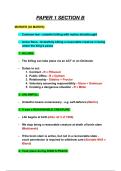
PAPER 1 SECTION B
MURDER (20 MARKS):
- Common law - unlawful killing with malice aforethought
- Actus Reus - Unlawfully killing a reasonable creature in being
under the King’s peace
1. KILLING:
- The killing can take place via an ACT or an Omission
- Duties to act:
1. Contract - R v Pittwood
2. Public Office - R v Dytham
3. Relationship - Gibbins + Proctor
4. Voluntary assuming responsibility - Stone + Dobinson
5. Creating a dangerous situation - R v Miller
2. UNLAWFUL:
- Unlawful means unnecessary - e.g. self-defence (Martin)
3. V was a REASONABLE CREATURE:
- Life begins at birth (AGs ref 3 of 1994)
- We stop being a reasonable creature at death of brain stem
(Malcherek)
- If the brain stem is active, but not in a recoverable state -
court permission is required to withdraw care (Airedale NHS v
Bland)
4. Took place during KING’S PEACE:
,- Victim may not be protected by the King’s peace if we are at
war declared by the Prime Minister (Clegg)
- The victim is protected by the King’s Peace, not the defendant
and his actions (Adebolajo)
5. Act/Omission CAUSED death:
- Factual Causation proven using the ‘but for’ test (Pagett)
- Legal Causation proven using the ‘operative and substantial’
test (Smith)
- The chain of causation can be broken be unreasonable and
unforeseeable act of:
- Third parties (Pagett)
- Medical Practitioners if the treatment is palpably
wrong (Jordan)
- The victim (Williams)
- Hidden vulnerabilities of the victim will not break the chain of
causation (Blaue)
6. MENS REA - malice aforethought:
- Express malice - D intends to kill
- Implied malice - D intends to cause GBH (Vickers)
- Intent can be proven through:
1. Direct intent - D aims to bring about the consequence
(Mohan)
2. Oblique intent - Mathews and Alleyne says the jury may
find oblique intention using the Woolin test: D realises
the consequence was virtually certain resulting from his
actions
,VOLUNTARY MANSLAUGHTER - LOSS OF SELF CONTROL (20
MARKS):
DEFINITION:
- Loss of control is defined under s54 of the Coroners and
Justice Act 2009
- Partial defence to murder giving judge discretion of
sentencing
1. D experiences a LOSS OF SELF CONTROL:
- s54(1)(a) - D must experience a loss of control
- D must lose their power to act in accordance with considered
judgement or loss of normal powers of reasoning (Jewell)
- s54(2) Loss of self control need not be sudden
- s54(4) The defence cannot be used if D acted with considered
desire for revenge
2. Caused by a QUALIFYING TRIGGER:
- s54(1)(b) Loss of control must come from a qualifying trigger
- s55(3) FEAR - Loss of self control arises from D fearing
serious violence (Ellis)
- S55(4) - ANGER (Zebedee)
1. Things said/done
2. Which are of extremely grave character
3. Giving D a justifiable sense of being seriously wronged
- s55(6) Excluding the triggers
- s55(6)(a) - excluding fear trigger if D’s fear comes from attack
that D incited
, - s55(6)(b) - excluding anger trigger if things said/done incited
by D
- s55(6)(c) - excluding anger trigger if things said/done
constituted sexual infidelity. Clinton shows it may be
considered if there are other triggers that can't be understood
without knowing of the infidelity.
3. Which EXPLAINS why D killed V:
- s54(1)(c) The loss of self control explains D's act of killing if a
person:
1. Of D’s sex + age
2. A normal degree of tolerance + self-restraint
3. In the same circumstances of D
- Would react in the same/similar way
- s54(3) - “same circumstances ignores
circumstances that bear on D’s tolerance and
self-restraint”
- Ignore D’s intoxication (Asmelash)
VOLUNTARY MANSLAUGHTER - DIMINISHED RESPONSIBILITY (20
MARKS):
DEFINITION:
- D may be able to raise the partial defence of diminished
responsibility defined in s2 of the Homicide Act (amended by
the Coroners & Justice Act 2009)
1. ABNORMALITY of MENTAL FUNCTIONING:
- A state of mind so different from that of an ordinary human
that a reasonable person would term it abnormal (Byrne)
2. Arising from a RECOGNISED MEDICAL CONDITION:
MURDER (20 MARKS):
- Common law - unlawful killing with malice aforethought
- Actus Reus - Unlawfully killing a reasonable creature in being
under the King’s peace
1. KILLING:
- The killing can take place via an ACT or an Omission
- Duties to act:
1. Contract - R v Pittwood
2. Public Office - R v Dytham
3. Relationship - Gibbins + Proctor
4. Voluntary assuming responsibility - Stone + Dobinson
5. Creating a dangerous situation - R v Miller
2. UNLAWFUL:
- Unlawful means unnecessary - e.g. self-defence (Martin)
3. V was a REASONABLE CREATURE:
- Life begins at birth (AGs ref 3 of 1994)
- We stop being a reasonable creature at death of brain stem
(Malcherek)
- If the brain stem is active, but not in a recoverable state -
court permission is required to withdraw care (Airedale NHS v
Bland)
4. Took place during KING’S PEACE:
,- Victim may not be protected by the King’s peace if we are at
war declared by the Prime Minister (Clegg)
- The victim is protected by the King’s Peace, not the defendant
and his actions (Adebolajo)
5. Act/Omission CAUSED death:
- Factual Causation proven using the ‘but for’ test (Pagett)
- Legal Causation proven using the ‘operative and substantial’
test (Smith)
- The chain of causation can be broken be unreasonable and
unforeseeable act of:
- Third parties (Pagett)
- Medical Practitioners if the treatment is palpably
wrong (Jordan)
- The victim (Williams)
- Hidden vulnerabilities of the victim will not break the chain of
causation (Blaue)
6. MENS REA - malice aforethought:
- Express malice - D intends to kill
- Implied malice - D intends to cause GBH (Vickers)
- Intent can be proven through:
1. Direct intent - D aims to bring about the consequence
(Mohan)
2. Oblique intent - Mathews and Alleyne says the jury may
find oblique intention using the Woolin test: D realises
the consequence was virtually certain resulting from his
actions
,VOLUNTARY MANSLAUGHTER - LOSS OF SELF CONTROL (20
MARKS):
DEFINITION:
- Loss of control is defined under s54 of the Coroners and
Justice Act 2009
- Partial defence to murder giving judge discretion of
sentencing
1. D experiences a LOSS OF SELF CONTROL:
- s54(1)(a) - D must experience a loss of control
- D must lose their power to act in accordance with considered
judgement or loss of normal powers of reasoning (Jewell)
- s54(2) Loss of self control need not be sudden
- s54(4) The defence cannot be used if D acted with considered
desire for revenge
2. Caused by a QUALIFYING TRIGGER:
- s54(1)(b) Loss of control must come from a qualifying trigger
- s55(3) FEAR - Loss of self control arises from D fearing
serious violence (Ellis)
- S55(4) - ANGER (Zebedee)
1. Things said/done
2. Which are of extremely grave character
3. Giving D a justifiable sense of being seriously wronged
- s55(6) Excluding the triggers
- s55(6)(a) - excluding fear trigger if D’s fear comes from attack
that D incited
, - s55(6)(b) - excluding anger trigger if things said/done incited
by D
- s55(6)(c) - excluding anger trigger if things said/done
constituted sexual infidelity. Clinton shows it may be
considered if there are other triggers that can't be understood
without knowing of the infidelity.
3. Which EXPLAINS why D killed V:
- s54(1)(c) The loss of self control explains D's act of killing if a
person:
1. Of D’s sex + age
2. A normal degree of tolerance + self-restraint
3. In the same circumstances of D
- Would react in the same/similar way
- s54(3) - “same circumstances ignores
circumstances that bear on D’s tolerance and
self-restraint”
- Ignore D’s intoxication (Asmelash)
VOLUNTARY MANSLAUGHTER - DIMINISHED RESPONSIBILITY (20
MARKS):
DEFINITION:
- D may be able to raise the partial defence of diminished
responsibility defined in s2 of the Homicide Act (amended by
the Coroners & Justice Act 2009)
1. ABNORMALITY of MENTAL FUNCTIONING:
- A state of mind so different from that of an ordinary human
that a reasonable person would term it abnormal (Byrne)
2. Arising from a RECOGNISED MEDICAL CONDITION:


